Showing posts with label fear survey schedule. Show all posts

Tuesday, May 12, 2026

A recent post on LinkedIn incorrectly claimed that no credible study has ever demonstrated people fear public speaking more than death


A couple weeks ago there was a post at LinkedIn from Robert Owen of Mission Viejo, California about Debunking the myth of public speaking fear:


The claim that people fear public speaking more than death is a myth. It traces back to a misunderstanding of a 1973 market research survey known as The Bruskin Report. In that study, 2,543 American adults were asked a simple question: ‘What are you afraid of?’ They selected answers from a list. Forty-one percent chose ‘speaking before a group.’ Nineteen percent chose ‘death.’ The survey didn’t rank these fears. After the 1977 Book of Lists published the results, the idea that people fear public speaking more than death spread like wildfire. Here’s the bottom line: No credible study has ever demonstrated that people fear public speaking more than death.”


Percentage results for all fourteen fears in the Bruskin survey were as follows (death was really seventh):


Speaking before a group  40.6%

Heights                                 32,0%

Insects and bugs                 22.1%

Financial problems             22.0%

Deep water                          21.5%

Sickness                                18.8%

Death                                    18.7%

Flying                                     18.3%

Loneliness                             13.6%

Dogs                                       11.2%

Driving/riding in a car           8.8%

Darkness                                  7.9%

Elevators                                  7.6%

Escalators                                 4.8%


This blog discussed them on October 27, 2009 in my most popular post titled The 14 Worst Human Fears in the 1977 Book of Lists: where did this data really come from?


Robert is wrong. I can easily name three surveys which found people fear public speaking more than death. (There may be more. Before you can say there is ‘no credible study,’ you would have to do a lot of research.)


First, we need to note there are two distinctly different questions. One is how many people fear public speaking, which can be answered by a percentage such as in the Bruskin survey. The other is how much do people fear public speaking, which only can be answered using a fear survey schedule to find a Fear Score on a scale such as from one to four or even ten (as shown above).


Back on October 10, 2012 I blogged about how In a 1965 study of university students, fear of public speaking ranked sixth for men and seventh for women. Fear of speaking before a group outranked death, but the death of a loved one came first. And on October 29, 2017 I blogged about What do Americans fear most? Fear Scores from the 2017 Chapman Survey of American Fears. Fear Scores were 2.425 for People I Love Dying, 1.909 for Public Speaking, and 1.852 for Dying. And on September 23, 2025 I blogged about how Public speaking was the most common and greatest fear found by a Croatian survey of ten fears published in April 2023.


Tuesday, September 23, 2025

Public speaking was the most common and greatest fear found by a Croatian survey of ten fears published in April 2023


There is an interesting article by Kamilo Antolovic, Mario Fraculji, and Sinisa Kovacic in the Proceedings of the Tenth International Scientific Conference: “Finance, Economics and Tourism – FET 2022” that was held on September 22 to 24, 2022 and published in April 2023 titled Research on stage fright and fear of public speaking.


The sample for their online survey consisted of 181 students from higher education institutions (under 30 years old) and another 355 people over the age of 30. Overall there were 536 adults, 47% female and 53% male.


They were asked how much they feared ten things, which in alphabetical order are: animals, bad weather, the dark, death, disease, flying, insects, other, public speaking, and strangers. Fears were reported on seven levels: 1 = none, 2 = barely noticeable, 3 = noticeable, 4 = medium, 5 = very noticeable, 6 = high, 7 = extremely high. Figure 3 of the article lists intensity of fears for all the percentages. We can rank them based on the sum for very noticeable, high, and extremely high.


As shown above in a bar chart, the most common Top Five percentages are: public speaking (36%), disease (27%), death (22%), insects (19) and flying (13%). (The margin of error is 4.2 percent).


But we also can rank them based on the sum for barely noticeable, noticeable, and medium, as shown in a second bar chart. Then the ranking is completely different - disease (59%), animals (58%), death (57%), public speaking (52%), and a tie at 51% for bad weather and insects.


We also can report Fear Scores on a scale from 1 to 7 where:


Fear Score = [ 1x(% None) +2x(% Barely Noticeable) +3x(% Noticeable) +4x(% Medium) +5x(% Very Noticeable) +6x(% High) +7x(% Extremely High)]/100  


As shown above in a third bar chart, the greatest Top Five Fear Scores are for public speaking (3.72), disease (3.40), death (3.13), insects (3.05) and animals (2.45). The order for the top four matches that based on the sum for very noticeable, high, and extremely high.


Figure 4 of the article lists Fear Scores (intensity of symptoms) for women and men. For women a fourth bar chart shows the top five Fear Scores again are for public speaking (4.10), disease (3.71), death (3.44), insects (3.09) and animals (2.52).


For men a fifth bar chart shows the top five Fear Scores yet again are for public speaking (3.18), disease (2.92), death (2.62), insects (2.14) and animals (2.11). Scores for women are consistently higher than those for men.  


And Figure 5 of the article lists Fear Scores (intensity of symptoms) for younger people (30 or less) and older people (>30), which I have shown above on yet another pair of bar charts. For younger people a sixth bar chart shows the top five Fear Scores are for public speaking (4.43), insects (3.57), death (3.27), disease (3.17), and strangers (2.67).


For older people a seventh bar chart shows the top five Fear Scores are for public speaking (3.57), disease (3.37), death (3.04), insects (2.53), and animals (2.32). Fear scores of younger people are higher than for older people.  


Friday, July 25, 2025

A curious article by Adam Berinsky about surveys and public speaking fear


There is a curious article by Adam Berinsky at CMSwire on July 16, 2025 titled 4 Types of Survey Bias That Can Skew Your Customer Insights.


It begins as follows:


“Poorly designed questions can skew results and taint market research. Watch out for these four types of bias.


The Gist


Survey fears can be misleading. Early polls exaggerated fear of public speaking due to flawed question structure, not genuine ranking.


Four major biases affect survey accuracy. From wording confusion to social desirability, biases can distort data if not addressed up front.


Design matters more than you think. Marketers must ask the right questions the right way – starting with how they frame response options.


Don’t Believe Everything You’ve Heard About Public Speaking


Everybody knows that people fear public speaking even more than they fear dying. Right?


Well, like many such ‘facts,’ this idea is actually the result of a flawed survey question [reference to 2012 article by Dwyer and Davidson]. In 1973, a poll taker asked more than 2,500 Americans to identify their fears from a list of options, and public speaking came out on top. Forty-one percent of respondents said they feared speaking in front of a group, compared to just 19% who said they feared dying.


(Insects and bugs, cited by 22% of respondents, also edged out dying, but no one ever talks about that.)


The problem? Respondents weren’t asked to rank these fears against each other. When a research team replicated the survey in 2010, public speaking once again topped the list. But this time, researchers asked a second group of respondents to rank their top three fears. When the fears were positioned against each other like this, death claimed the top spot.”


But that one 1973 Bruskin survey (as shown above) - not “early polls” asked how many people had each fear, with an answer in percent on a horizontal scale. Heights was second at 32.0%, insects & bugs was third at 22.1%, financial problems was fourth at 22.0%, deep water was fifth at 21.5%, sickness was sixth at 18.8%, and death was seventh at 18.7%.


It did NOT ask how much they feared each one, which would call for another type of answer: a fear score (as shown above) on a vertical scale. Their question was not flawed, but wasn’t the same as could answer what people feared more. Right after whining that “Marketers must ask the right questions the right way,” Adam got it wrong!


Way back on October 27, 2009 I blogged about The 14 Worst Human Fears in the 1977 Book of Lists: where did this data really come from? Overall it is my most popular post, and still number two for the last year. The 1973 survey had asked a national sample, while the 2010 survey instead asked 815 students at a large Midwestern university (perhaps the University of Nebraska).


By the way, the 1973 survey was really replicated in 1993 on a national sample, in a survey done by the successor to the original polling firm. I blogged about it on May 19, 2011 in a post titled America’s Number One Fear: Public Speaking – that 1993 Bruskin-Goldring Survey.


Results from another pair of surveys were reported in a March 19, 2001 article by Geoffrey Brewer at Gallup News titled Snakes Top List of Americans’ Fears. The first was done between November 20 and 22 of 1998; the second was done between February 19 and 21 of 2001 (and its results are shown above). They did not rank these 13 fears against each other.


Fear scores have been around since a 1965 article by James H. Geer titled The Development of a Scale to Measure Fear. I blogged about it October 10, 2012 in a post on 51 fears titled In a 1965 study of university students, fear of public speaking ranked sixth for men and seventh for women. And in another post on October 23, 2012 titled Either way you look at it, public speaking really is not our greatest fear I discussed both surveys with results in percent and those with fear scores.


If a survey asks about several levels of fear, like the 2024 Chapman Survey of American Fears (as was shown above), then we can also calculate fear scores. On October 24, 2024 I blogged about how In the tenth Chapman Survey of American Fears for 2024, public speaking was only ranked #59 of 85 fears at 29.0%. And in another post on November 9, 2024 titled Overblown claims about fears from investigators for the 2024 Chapman Survey of American Fears I discussed some fear scores.


The ancient 1973 Bruskin survey is still mentioned as if public speaking still was the number one fear (in percent), although that is belied by the last decade of Chapman Surveys, which found the rank to be as follows:


2014      [ # 1] not really, see this blog post

2015      [#26]

2016       [#33]

2017       [#52]

2018       [#59]

2019       [#54]

2020/21 [#54]

2022       [#46]

2023       [#53]

2024       [#59]


And, as shown above, the fear score for public speaking just is at the Slightly Afraid level, as I discussed in a blog post on June 1, 2025 titled An article on stage fright by David Pennington claimed public speaking was the #1 fear in a Chapman Survey, but ignored their nine other surveys where it was ranked from #26 to #59.


Saturday, November 9, 2024

Overblown claims about fears from investigators for the 2024 Chapman Survey of American Fears


On October 24, 2024 I blogged about how In the tenth Chapman Survey of American Fears for 2024, public speaking only was ranked #59 of 85 fears at 29.0% There is a pdf article titled Chapman Survey of American Fears 2024 – Key Findings that contains the following statement:


“ ‘More interesting, really, than what is in the top 10 list, is how the overall level of fear changes. For example, in the 2015 survey, only the top one, Corrupt Government Officials, had more than 50% reported afraid or very afraid. By the time you get to 2018, all 10 are over 50%. Americans are more afraid of everything,’ said Ed Day, Associate Professor of Sociology.”


The above statement refers to percent and thus to more Americans being afraid, NOT Americans being more afraid. But, as shown above using graphs made with Excel in 2018 there were 12 fears ranked at 50% or above. In 2019 there were 17. The number of fears rises sharply from 2016 to 2019. Then for 2020/2021 there only were 9, in 2022 there were 11, in 2023 there were only 7, and in 2024 there were 15. Similar trends (also shown above) appear when we look either at 40% or above, and 30% or above.  


Their discussion of Corruption says:


“Since the inception of the Chapman Survey of American Fears, Fear of Corrupt Government Officials (hereafter, FOC) has been the leading fear Americans reported. That is a striking fact because the surveys have spanned a decade and three presidential administrations. In the tenth wave of the survey conducted in 2024, 65.2% of Americans said that they were afraid or very afraid of corrupt government officials up more than 5% since 2023. FOC peaked at 79.6% in 2020/2021 and then declined to current levels.” 


See their graphic, to which I have added about the Trump administration.


Another article by Andre Mouchard (of the Orange County Register) published at MedicalExpress on October 28, 2024 is incorrectly titled Survey finds Americans more afraid today than at any time in history. It contains the following quotes:


“ ‘Fear is taking a larger and larger role in American life,’ said Chistopher Bader, a sociology professor at Chapman who has been involved in ‘American Fears’ since the beginning.


‘They’re afraid of more things than they used to be,’ he said.


‘And they’re more afraid of those things than they used to be.’….


But the overall number of fears (shown above) has ranged from 79 on 2016 to 97 in 2023. That number of questions asked is a choice made by investigators which varies, as does the sample size from about 1000 to 1500 (also shown above).  


Also:


“ ‘Stranger danger is growing,’ Bader said, referring to data that shows Americans – once viewed as optimistic and welcoming – are increasingly afraid of people they don’t know.”


But strangers were ranked between 73rd and 91st in the surveys, as shown above. Further, the percent very afraid or afraid of strangers only ranged from 7% in 2018 to 16.7% in 2024.


What are Americans really more afraid of? To evaluate that we need to look at Fear Scores on a scale from one to four, where 1 = Not Afraid, 2 = Slightly Afraid, 3 = Afraid, and 4 = Very Afraid. I blogged about this back on October 30, 2015 in a post titled According to the 2015 Chapman Survey of American Fears, adults are slightly less than Afraid of federal government corruption and only Slightly Afraid of Public Speaking.


As shown above, the Fear Score for Corrupt Government Officials ranged from 2.611 in 2015 to 3.175 (more than Afraid) in 2020/21. The Fear Score for Public Speaking ranged from 1.909 in 2017 to 2.172 in 2022 (more than Slightly Afraid). And the Fear Score for Strangers only ranged from 1.488 in 2018 to 1.750 in 2024.


Saturday, June 29, 2024

A Chapman University news article confuses what more people fear (sharks) with what people fear more (public speaking)


There is a brief Chapman University news article by Carly Murphy on June 27, 2024 titled Riding the Wave: fear of sharks surpasses public speaking as sharks dominate the news. She begins by stating:


“As you cover beach season stories, Chapman University’s 2023 Survey of American Fears offers a depth of data to the narrative. A trend has emerged: sharks are more feared than public speaking and other common anxieties. Key insights from the survey, which ranked 97 fears among 1,014 Americans include:


30.1% of Americans are scared or very scared of sharks, ranking 52nd overall. Fear of sharks surpasses that of public speaking (28.7%), reptiles (25.9%) and insects/spiders (25.3%).”


But the percentages she discussed represent what more people fear, and not what people fear more. What people fear more is described by Fear Scores, on a scale from one to four (as shown above) where 1 = Not Afraid, 2 = Slightly Afraid, 3 = Afraid, and 4 = Very Afraid. And sharks in not the largest. Those scores are public speaking 2.041, sharks 2.021, reptiles 1.958, and insects/spiders 1.939. On October 30, 2015 I discussed calculating them when I blogged about how According to the 2015 Chapman Survey of American Fears, adults are less than Afraid of federal government Corruption and only Slightly Afraid of Public Speaking. (For 2023 the largest Fear Score for Corrupt government officials is 2.771).  


The 30.1% for sharks is the sum for the Very Afraid (12.9%) and Afraid (17.2%) fear levels  reported since 2015 by Chapman on their Percentage Lists (2023 here). Another 29.0% were just Slightly Afraid of sharks, and adding them produces a grand sum of 59.1%. But we also could just compare based on the Very Afraid percentage. As shown above, sharks then are above reptiles and public speaking. And, based on the grand sum both public speaking and insects/arachnids are feared by more people than sharks are.   

A shark cartoon came from Openclipart.


Saturday, October 28, 2023

Another big fear survey for Halloween of 2023 from SafeHome.org


An interesting article by Rob Gabriele at SafeHome.org on October 25, 2023 is titled What Americans Fear Most: 2023 Fear Ranking. It describes results from a survey of 2,634 U.S. adults.  


His description in the overview explains:


“To understand which concerns fuel America's anxiety, we asked participants to disclose how much they fear 72 unique situations across several general categories. After adjusting results to ensure an accurate representation of the population, we calculated ‘fear scores’ to quantify the collective fear associated with each subject. Scenarios with higher scores (closer to 100) indicate more people were afraid, and situations scores closer to zero were less frightening for our respondents.”


And the second paragraph under Our Data and Complete Fear Rankings elaborates:


“Fears were ranked by two metrics: The percentage of respondents who were afraid or very afraid of each scenario, and by a fear score. The fear score is a normalized weighted sum whereby ‘Very afraid’ was weighted 3, ‘Afraid’ was weighted 2, ‘Slightly afraid’ was weighted 1, and ‘Not afraid’ was weighted at 0. The number of responses for each is multiplied by their weight and summed together, then normalized by dividing by two times the total number of responses, then multiplied by 100 and rounded to the nearest integer.”


The Fear Score describes How Much?, while the percent Afraid or Very Afraid describes How Many? But his scaling for the Fear Scores is peculiar. One way to state it is on the scale from 0 to 3 described above. Back on October 30, 2015 I blogged about calculating fear scores in a post titled According to the 2015 Chapman Survey of American Fears adults are less than Afraid of federal government Corruption and only Slightly Afraid of Public Speaking.


A second way is to divide that number by three (a Corrected Fear Score), so it is a proportion (or multiply by a hundred to make it a percent). Instead he divided by two, which for these particular results fortuitously made the highest score 99 (almost 100).


The second paragraph of the article is titled Americans’ Top 10 Fears, 2023 and he just provides a list of the scenarios without either the Fear Scores or the percent Afraid or Very Afraid. As shown above, I have provided a table with both sets of percentages - which are surprisingly close to each other. 


That similarity carries over to all 72 of the percentages for Very Afraid plus Afraid, as is shown in a pair of bar charts for the Top Forty and Bottom Thirty-Two fears. The corrected fear score is shown by the digits at the right in the caption for each scenario. Based on its corrected fear score of 41 public speaking ranks 28 of 72 fears at 41%.   


I was irritated that Mr. Gabriele did not bother to discuss the nine Chapman Surveys of American Fears, or compare his results with theirs. His questions are a smaller set similar to those in that set of surveys which began back in 2014.  


He did a similar survey of 41 fears in 2021, which is discussed in another article titled America’s Top 10 Fears: The 2021 American Fear Index. I had not discussed that one previously in this blog, since it did not include the fear of public speaking. As shown above in another table with both sets of percentages, the Top Ten there for Fear Scores and the percent Afraid or Very Afraid also are surprisingly close to each other.


The US flag fear frowny was adapted from this smiley at Openclipart.    


Friday, May 13, 2022

Do men and women get equally nervous when asked to speak in public?


At Forbes on May 11, 2022 there is an article by Diana Booher titled Why public speaking skills are critical - and how to avoid 5 big mistakes women make. The five mistakes are:


Jerking, jabbing gestures from the wrists or elbows

Speaking too softly

Standing rigidly

Speaking too fast

Ending sentences with a rising intonation


But first she discusses another topic under the heading Do men and women equally get nervous when asked to speak publicly? Her answer (based on experience as a presentation coach for more than three decades) is that both men and women are equally affected. I don’t think so. There is an article by Peter Moore at YouGov on March 27, 2014 titled Argh! Snakes! America’s Top Phobias Revealed. I blogged about it on April 2, 2014 in a post titled YouGov survey of U.S. Adults found they were most commonly very afraid of snakes, heights, public speaking, spiders, and being closed in a small space.


Mr. Moore reports results from a survey (1000 adults) of fears at four levels, including one shown above - for public speaking. First let’s look at percentages for Very afraid + A little afraid. For the Total there were 56%, for Women there were 62% and for Men there were 49%. So, significantly more women than men were afraid.


Another way to look at those results is via a Fear Score, calculated as:


Fear Score = [4x(% for Very Afraid) + 3x(% for A little Afraid)

            +2x(% for Not really Afraid) + 1x(% for Not afraid at all)]    


For the Total the Fear Score is 2.55 (just above the 2.5 middle for the scale), for Women it is 2.70, and for Men it is 2.36. So on average women were more afraid of speaking than men were. That also was the case for students, as I blogged about on April 14, 2022 in another post titled Fear of public speaking in female and male students at the University of Karachi.


Thursday, April 14, 2022

Fear of public speaking in female and male students at the University of Karachi


In the March 8, 2018 issue of the Pakistan Journal of Gender Studies there is an article on pages 57 to 70 by Kausar Perveen, Yamna Hasan and Abdur Rahman Aleemi titled Glossophobia: The Fear of Public Speaking in Female and Male Students of University of Karachi. They surveyed convenience samples of 63 females and 63 males, and asked them if they had a High, Moderately High, Moderate, Moderately Low, or Low level for that fear.


Percentage results from their Figure 1 are shown above. For females, 20.6% had a High level, 41.3% had a Moderately High level, and 38.1% had a Moderate level. For males, only 6.63% had a High level, 33.3% had a Moderately High level, and 28.6% had a Moderate level, 27.0% had a Moderately Low level, and 4.8% had a Low level. Because of the tiny sample size used, these percentages have a large Margin of Error. I have shown the plus and minus for Moderately High (12.2% for females and 11.6% for males). Typical commercial surveys use a sample size of 1000 to make their margin of error about 3%.  


It is possible to also analyze their results via a Fear Score on a scale from 1 to 5, a weighted average calculated from those percentages according to this formula:     


Fear Score = [5x(% for High) = 4x(% for Moderately High)

+ 3x(% for Moderate) + 2x(% for Moderately Low) + 1X(% for Low)]/100


Fear scores are 3.825 for females and 3.093 for males, so females are 0.732 higher. Back on October 30, 2015 I discussed fear score calculation in a blog post titled According to the 2015 Chapman Survey of American Fears, adults are less than Afraid of federal government Corruption and only Slightly Afraid of Public Speaking.


Monday, January 10, 2022

The opening paragraph of an article on public speaking earns two pinocchios for telling us lies


At Forbes on December 27, 2021 there is an otherwise decent article by Johnny Warström with a misleading title of Facing our greatest fear: How senior leaders can handle public speaking in the new normal. It opens with this paragraph:


“More of us are affected by glossophobia, the fear of public speaking, than a fear of spiders, heights and even death. Yes, you read that right. Apparently, we are more scared of speaking up in public than we are of dying. It seems some of us would sooner die than deliver a presentation at work. How did it come to this?”


First, when you click on the link (to a Washington Post article about the Phobias from the 2014 Chapman Survey of American Fears), you will find that while public speaking is the most common fear it does not ever mention death. Second, Johnny shifted from asking if more of us are scared (how many) to if we were more scared (how much) in his title and third sentence -   quite a different question. 


Worse still his superficial research ignored a half-dozen more recent Chapman surveys. Results from the latest 2020/21 survey of ninety-five fears would lead us to both change the article title and rewrite the opening paragraph as follows:


“Public speaking isn’t a very big deal for U. S. adults. A recent survey found that it’s their 54th most common fear (out of 95) at 29%; ranked below others like Heights (#46, 31.2%), Sharks (#51, 29.5%), and even Dying (#53, 29.3%). Contrast those with People I Love Dying, ranked at #2 (58.5%) behind the most common fear of Corrupt Government Officials (79.6%).”   


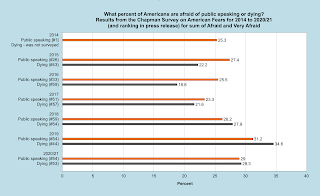
There were seven Chapman surveys, and the six more recent ones included the fear of dying. As shown above via a bar chart, public speaking wasn’t anywhere near the most common fear. Also, in the three most recent surveys fear of dying outranked the fear of public speaking. You can find their other fear lists online for 2015, 2016, 2017, 2018, and 2019.


I blogged about that 2014 survey a day before the Washington Post article in a post titled Chapman Survey on American Fears includes both zombies and ghosts. But along with a phobias category that survey also has eight fears about crime, as also are shown above in a bar chart. One of those (identity theft/credit card fraud) was feared by 49.7% of Americans, or almost twice the 25.3% for public speaking.


On December 6, 2021 I blogged about how Most Americans are not terrified of public speaking. By using the detailed results from those Chapman surveys we can calculate Fear Scores, and for 2020/21 will find that on a scale where 1 = Not Afraid, 2 = Slightly Afraid, 3 = Afraid, and 4 = Very Afraid the fear of public speaking is scored just barely over Slightly Afraid, at 2.023.  


How could we honestly make the fear of public speaking look significant? Forget about that #54 ranking, and convert the percentage to a number. The 2020 U. S. Census found there were 258.3 million adults 18 years and older. Just multiply that huge number by 0.29, and you get that there are 74.9 million people who fear public speaking.  


The Pinocchio image was cropped, Photoshopped, and colored from the 1899 book, Le Avventure di Pinocchio at the Internet Archive.