Showing posts with label pausing. Show all posts

Sunday, July 12, 2026

Full-body pauses are a key to charisma


I have been skimming through a 2022 book by Zoe Chance titled Influence Is Your Superpower: The science of winning hearts, sparking change, and making good things happen. There is a preview at Google Books. Her passage starting on page 86 about full-body pauses being a key to charisma says that:


“Full-body pauses – moments when you’re not walking, fidgeting, or making any dramatic hand movements, but you are breathing easily, your hands comfortably by your side – are especially helpful. Not just during your presentation but also before and after. This key to charisma is so simple that almost no one teaches or practices it, yet it works for speakers and performers of all kinds.


Here are some opportunities for a full-body pause in a formal talk or performance situation.


When someone else is speaking or performing, you pause with your whole body and focus your attention on them. Maybe an audience member is asking a question. Maybe a junior employee is speaking up at the meeting. Maybe your bandmate is playing a solo. Whoever should have the audience’s attention should have your attention too. You’ll be tempted to look around at other people, or look down or away. If you do, you’re fracturing the group’s attention, and fractured attention is harder to collect when it’s your turn to speak. When it’s someone else’s turn to be charismatic, don’t distract others or let yourself get distracted.


When it’s your turn to speak or perform, thank the person introducing you, if there is one, then shift your focus to the audience. Take a full-body pause for one complete breath, smile, and you’ll have the audience’s full attention when you begin. When you’re on a panel or in an informal meeting, the pause needn’t be so obvious, but taking that movement to shift your attention will catch theirs. Now all eyes are on you.


When you finish your turn in the spotlight, take a moment to thank the audience before you leave. If there is applause, pause to bask in it for at least one breath, letting the audience’s attention rest fully on you. You have been focused on everyone else, charisma blazing, and they felt it. Now, humbly and gratefully, you receive. We tend to imagine that rushing offstage shows humility, but it conveys a tacit apology – I’m sorry I wasted your time. Instead, take a moment to appreciate your audience with a pause that says, Thank you for your time. I’m grateful for it, and I enjoyed being with you, too. You might nod, bow, put a hand to your chest, or even blow a kiss if you’re that kind of person and it’s that kind of event.”


The car key image was adapted from one at OpenClipArt.


Tuesday, July 15, 2025

A long, excellent, recent discussion of filler words in the book Like, Literally, Dude by linguistics professor Valerie Fridland


The president of the Pioneer Toastmasters Club, Brian Reublinger, told me about a 2023 book by linguistics professor Valerie Fridland titled Like, Literally, Dude: Arguing for the good in bad English. Linguistics is descriptive rather than prescriptive. English professors, public speaking coaches, and other pedants will tell us what we should be doing. For example, there is an article on filler words by Joel Schwartzberg in the February 2019 issue of Toastmaster magazine on pages 14 and 15 titled Drop Those Crutches. In contrast, linguists tell us what we are doing, why we do it, and where it came from. I got Like, Literally, Dude from my friendly local public library and am enjoying reading it. You can find excerpts from it at Google Books.  


Chapter 2 on Pages 65 to 97 is titled Umloved. It has the following section titles:

What the uh?

 The ums of antiquity?

A Freudian um?

Brain farts

Comprendo?

Men-o-pausal patterns

Staging an um-prising?

Umdone


On pages 80 and 81 the Comprendo? section says:


“Go to any public-speaking class and I can pretty much guarantee that they will not be advising you to ‘um’ more. As a matter of fact, pretty much any public-speaking course worth its salt will give you tips and pointers on how not to be disfluent, rather than give you gold stars for how many ums you can produce during one PowerPoint presentation. But that is why they pay linguists the big bucks and public-speaking coaches get crickets. Um Okay, maybe I have that backward. That’s why they should be paying us the big bucks. Because we linguists have read the psycholinguistic research that suggests we have been wrong to ban hesitation from our talk. Just because we have been conditioned by our speech teacher to avoid using them or lost our lunch money to Toastmasters International, we find little scientific evidence that suggests they actually deserve such a negative reputation. In fact, the most fascinating area of hesitation research is not on why we ‘um’ but on how our ums and uhs might actually be a speaking superpower.


How is this possible? Because our ums and uhs, along with other signs of disfluencies like false starts (sa – say what?) seem to signal to our listeners to be on alert that there is something requiring greater cognitive effort happening. Why would this be useful from a comprehension standpoint? Because it leads us to expect the unexpected; we don’t get sidetracked by anticipating easy words or simple sentences, because we know disfluencies tend to accompany harder linguistic choices. Let’s unpack this a bit by looking at what some of this research can tell us. 


Our hesitations seem to act as pretty significant comprehension aids for our listeners. For instance, in one research study, participants were aske to move a mouse to select an object from two choices on a computer screen after hearing a prompt. The trick was that one of the objects had been previously mentioned during the study and the other had not. When the experimental instructions included an um before the name of the object to select, participants were not only more likely to be faster at identifying the unmentioned object, but they also started moving the cursor in that object’s direction before the um was even finished. It seemed the um clued the listener in to which word was more likely to be said (the unmentioned one) because they understood um’s role of marking something unfamiliar. This effect did not occur when the researchers used a same-length background noise instead of the filled pause. The um made them do it."   


[When we skip to page 86 we find something I blogged about on February 13, 2014 in a post titled Adding a few uhs and ums improved recall of plot points in stories]:


"This advantage for memory and speed has been well studied – experiments testing disfluency effects on comprehension have pretty consistently illustrated recall and processing-time benefits when a filled pause is part of the stimuli. And the benefits are not just on word recall – we also seem to remember stories better when uh or um enter the picture. In an experiment [Ref. 86] testing how well people performed at recalling specific parts of the story Alice in Wonderland, participants showed better recall when they heard recordings with filled pauses occurring before some plot points, such as’ Meanwhile, … uh …, the cook keeps hurling plates and other items at the Duchess.’  Equivalently timed coughing inserted into the passages at the same points, though, didn’t help them out in recalling those plot points later. In fact, the coughs seemed to impair recall. So it is specifically the uh that does the trick.”


Chapter 3 on pages 99 to 123 is titled What’s Not to Like? It has sections titled:


Like, why?

The trouble with like

Approximately something

Laser pointers

The plot thickens

Old dogs, new tricks

What women like

To like or not to like?


It begins as follows [pages 99 to 104]:


“Walk into any middle school in America and there’s one word you’ll hear echoing down the hallway that has taken on more than its fair share of shade. No, it doesn’t rhyme with ‘luck’ or ‘hit.’ This one rhymes with ‘hike’ and should be wildly familiar to anyone who’s seen the movies Valley Girl or Clueless. While ‘fer sure’ and ‘totally gnarly’ have faded into the SoCal sunset, the presence of like has only expanded, punctuating every sentence from Los Angeles to New York.


The frequent use of like may sound juvenile, but it has taken over our linguistic nooks and crannies in almost every variety of global English. It appears at the beginning of sentences, in the middle of clauses, and now it even introduces quotes. The funny thing is, despite its pervasiveness, hardly anyone claims to like this new type of like. Even those who admit to using it themselves rarely remark on it as a positive attribute. Case in point: When I ask my college students to name the things that bug them the most about language, like is always at the top of the list, comically appearing in the very sentence that denigrates it: ‘I hate how people, like use like all the time.’ Once the offending word is mentioned, the students can’t stop noticing how often it pops up in everyone’s speech for the rest of the class period – and then the rest of the day, week, month, and year. The fact is, like it or not, like use is here to stay. But before condemning it as a sign of impending linguistic ruin, let’s take some time to consider why like might have entered our speech in the first place. As I tell my students, maybe, just maybe, there is more to like than we might at first believe.     


Like, why?


The expanded use of like is so widespread that news outlets ranging from The Atlantic to Time to Vanity Fair to The New York Times have covered what seems to be its troubling and meteoric rise. One online college advice site has a post headlined ‘How to Stop Saying Like and Immediately Sound Smarter’; a speech-improvement service calls it ‘The Like Epidemic,’; the Chronicle of Higher Education asks that we ‘Diss Like’; and in Vanity Fair Christopher Hitchens called it ‘The other L-word.’ Across global English varieties, concerned parents worry about this troublesome habit. One mother, echoing the apprehensions of many, appeals for help from the advice expert at the UK’s The Guardian, fretting that her teenager’s like use sounds uneducated and will affect her success in the future. Teachers also report that its prevalent use in class is becoming problematic. In fact, a friend of mine, who is a middle school teacher recently told me that it’s her students’ number one verbal tic. This collective hand-wringing leaves little doubt that we have little love for like. So then why do we continue to use it?  


Ask most parents and they’ll probably say it has something to do with adolescent laziness or linguistic rebellion. Ask most employers and they’ll probably say it has to do with a shift from a more formal workplace to a casual, less professional setting. Ask most linguists, though, and they’ll probably tell you we’re missing the mark. Like used in such contexts is not much different from other markers that we have used through the centuries to help us organize and structure our speech. In other words, there is nothing that unique or concerning about it.  


Though we might not realize it, English has an arsenal of pragmatic-oriented features of speech, such as so, you know, actually, and oh. As with our now beloved ums and uhs, these discourse markers don’t directly contribute to the literal (semantic) content of a sentence. Instead, when added, they contribute to how we understand each other by providing clues to a speaker’s intentions. For instance, when I say. ‘Oh, I finally got a job!’ my use of oh is a shorthand way to prompt a listener to mimic my surprise. Discourse markers provide the social greasing of the conversational wheel. Without them, our speech would sound less conversational and more computer-like. In fact, try having a conversation without using any discourse markers. Not only will you find it quite difficult, but others will find you a less appealing speaker.


Discourse markers are by no means new or unusual Shakespeare made liberal use of them, and the epic poem Beowulf even begins with one (Hwoet!). Suggestively, historical texts that date back to the old English and Middle English periods (fifth to eleventh century and twelfth to fifteenth century, respectively) have shown evidence of words functioning similarly to modern discourse markers. For instance, the Old English word pa, meaning ‘then,’ served as a foregrounding discourse marker in narratives and was often associated with colloquial speech. As a matter of fact, some Old English scholars suggest pa occurred so often in some early texts that it can’t have carried much semantic content, a complaint that echoes our modern assessment of excessive like use. Less controversial, Old English hwoet, meaning ‘what,’ seems to have served as an attention-getting device roughly similar to the modern sentence’s initial so. As the opener to Beowulf, it’s a signal to the audience that something worth paying attention to will follow. In more recent times – at least if you consider the early modern period (fifteenth through seventeenth century) recent – interjections such as alas, ah, and fie, among others, similarly functioned to give a sense of a speaker’s intentions or emotions (alas, ‘tis true). Though charming to our ears, these DMs may well have been painful to parents of the early modern era.


Looking back, we find that the origins of the word like are similarly rooted in the Middle English and early modern period. The Oxford English Dictionary (OED) first notes the use of like in its adjectival and verbal functions – as lich (adjective) and lician (verb), respectively – as early as 1200, with noun, conjunction, and prepositional uses noted around 1400 – 1500. The use of like as a conversational marker shows up later, though much earlier than we might have expected. The OED cites a passage from a text written in 1778 (F. Burney’s Evelina II), where it is used to qualify the speaker’s subsequent remark, ‘Father grew quite uneasy, like, for fear of his Lordship’s taking offense.’ It also cites another example employing like in this way in 1840, in a magazine of the era: ‘Why like, it’s gaily nigh like, to four mile like.’ And hinting at the source of like’s vibe of hip vernacularity, the OED gives a more recent example from a beat-influenced magazine, where we locate like occurring in its now familiar spot at the beginning of a sentence – ‘Like how much can you lay on (i.e., give) me?’ (from Neurotica Autumn 45).”


Sunday, July 6, 2025

Three excellent articles on pauses – two with singularly misleading titles


On November 16, 2019 I blogged about Please don’t just tell us about ‘the pause’ – because there are several different types and lengths. There is an excellent article by John Zimmer at LinkedIn Pulse on July 1, 2025 titled Pauses in a speech: Why, When, How. He discusses pauses:


before you start

to signal that something important is coming

to let the message sink in

when moving to a new topic

for emphasis

to get your audience to reflect

when answering questions


There is a second article by Peter Dhu also at LinkedIn Pulse on June 30, 2025 titled The Value of Silence (The Pause) For Effective Speaking by Peter Dhu. He talks about long pauses before (The Pre-Pause) or after (The Post Pause) you say something, and pausing to create suspense or to grab attention.


There is a third article by Dave Hablewiz on February 27, 2024 titled The Power of the Pause: The Secret Sauce of Great Public Speaking. He divides pauses into two categories: incidental and intentional. Then he discusses different types of intentional pauses: Pre-emptive, Punchline, Audience, Thoughtful, Emphatic, and Indefinite. Dave has an embedded 25-minute YouTube video (with a transcript to follow from a Toastmasters District Conference) titled The Power of the Pause D2 Conference 2023.


Wednesday, August 2, 2023

Pausing can improve your public speaking


The August 2023 issue of Toastmaster magazine has a good article by Joel Schwartzberg on pages 18 and 19 titled 9 Surprising Ways You Can Benefit From a Pause. They are:


Pausing puts your mind in charge of your mouth.

Pausing gives the audience time to process.

Pausing draws and holds attention.

Pausing looks like thinking.

Pausing puts power behind key ideas.

Pausing controls speed.

Pausing lets you breathe.

Pausing defeats crutch words.

Pausing costs you nothing.


Why did I say good and not excellent? Because his second paragraph says:


“Read on to learn more about the great powers of the pause, including some that will almost certainly give you pause!”


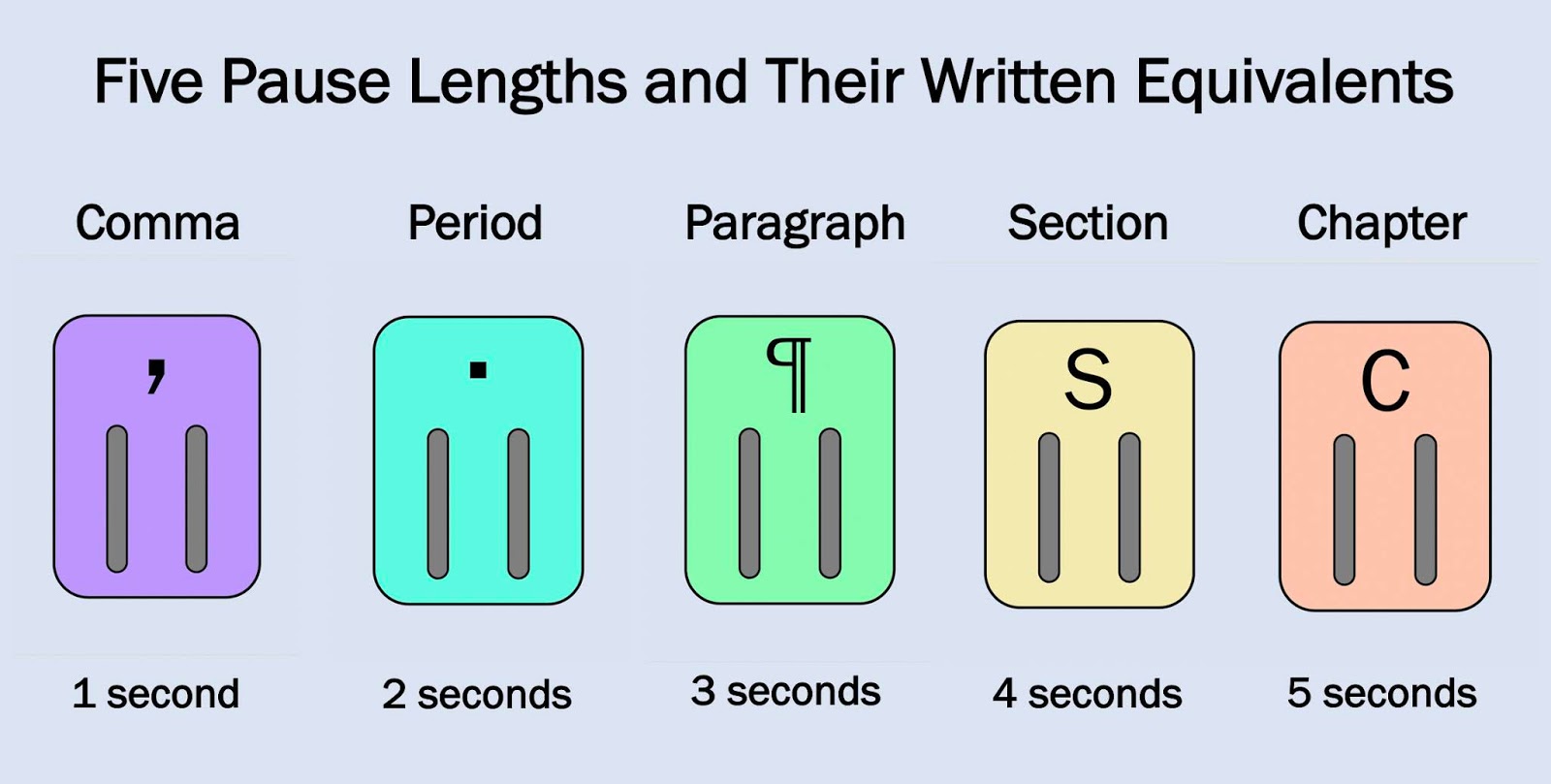
The Pause wrongly implies there is only one type. Back on November 16, 2019 I blogged about Please don’t just tell us about ‘the pause’ – because there are several different types and lengths. Five types (and punctuation lengths) are shown above. Also, at the top of page 19 in Joel’s article there is a photo overlaid with the same pause icon I showed at the top of this post.


There is another excellent article by Marsha Zinberg at The Write Touch on October 24, 2022 titled Pausing for Effect: Seven Reasons Pauses Enhance Your Speeches (and Eight Ways to Ace Them). She lists eight types:


Punctuation

Look at Me!

Remember This!

Have You Ever….?

Ta-Da!

Rimshot

What Just Happened? Or Where the Heck Am I?

Dying of Thirst.


Think about using different lengths of pauses when you speak in public.


Tuesday, December 6, 2022

Which filler words commonly occur in spoken English?


That’s a very curious question. I thought about it after looking on Wikipedia and finding a page titled Most common words in English that contained a list titled 100 Most Common Words [in Written English]. That list is shown above, as a table. Ah is not on it, but So is at #41.


I looked around and eventually found there was a book with an answer. It came out in 2001, was written by Geoffrey Leech, Paul Ryson, and Andrew Wilson (all from Lancaster University), and titled Word Frequencies in Written and Spoken English Based on the British National Corpus. That corpus has 100 million words, 90% of them written. Starting on page 144 of it there is List 2.2 – Rank frequency list: spoken English (not lemmatized).


The first and second fifty words from that list are shown above as a pair of bar charts. Two pure filler words (highlighted in red) appear in the Top Fifty: Er at #17 and Erm at #27. Well and So, which might be fillers too (highlighted in green), are #32 and #33. In the Second Fifty, Say, which also might be a filler word is at #83. But Ah isn’t there at all – which may disappoint Toastmasters whose club meetings have an Ah-Counter. That role is discussed by Kate McClare in her article in the June 2021 Toastmaster magazine titled Counting on the Ah-Counter.


How do the lists for spoken and written English compare? As shown above via a pair of tables for the Top 20, they are not the same, and only eleven of the spoken words are on the written list.


Corpus is a rather obscure word. The first definition in the Merriam Webster Dictionary is:     

“the body of a human or animal especially when dead”


The third is:

“a collection or body of knowledge or evidence - Especially: a collection of recorded utterances used as a basis for the descriptive analysis of a language”


Is that a corpus or a porpoise?


Saturday, October 8, 2022

You can learn about public speaking from the same old book used by Abraham Lincoln and Frederick Douglass


An article at New England Historical Society is titled The book that taught Frederick Douglass and Abraham Lincoln how to speak. I saw it mentioned on page 154 of David Gergen’s excellent 2022 book Hearts Touched with Fire – How great leaders are made. It opens his Chapter 9, titled The Art of Public Persuasion.


That 1797 book by Caleb Bingham is titled The Columbian Orator. You can find a .pdf version of the 1817 edition here at the Internet Archive. The Preface opens by stating:


“Notwithstanding the multiplicity of Schoolbooks now in use, it has been often suggested, that a Selection, calculated particularly for Dialogue and Declamation, would be of extensive utility in our seminaries.


The art of Oratory needs no encomium. To cultivate its rudiments, and diffuse its spirit among the Youth of America is the design of this Book.”  


Its Introduction, on pages 7 to 28, is titled General directions for speaking; extracted from various authors. The rest of that 300-page book has 83 speeches, eight by David Everett, six by William Pitt, four by James Hervey, three by George Washington, and two by Napoleon Buonaparte. That Introduction is well worth reading.

.

Pages 17 and 18 have the following advice about use of pauses:


“Now the common rule given in pausing is, that we stop our voice at a comma till we can tell one, at a semicolon two, at a colon three, and at a full period four. And as these points are either accommodated to the several parts of the same sentence, as the first three; or different sentences, as the last: this occasions a different length of the pause, by which either the dependence of what precedes upon us that which follows, or its distinction from it is represented.”


Back on November 6, 2019 I had blogged about Please just don’t tell us about ‘the pause’ – because there are several different types and lengths. I had not realized how old that advice was.


Wednesday, May 25, 2022

20 Excellent brief YouTube videos from Patrick Barry on poise, rhythm, optimism, being dynamic, and the unexpected


In my previous post I discussed Does your speech have ‘legs’? Erik Palmer’s PVLEGS is a checklist for evaluating speaking by public school students. In that acronym P stands for poise, so I next looked for videos on that topic. 


Patrick Barry teaches at the University of Michigan Law School. He has a public speaking series with twenty YouTube videos on the five topics of Poise, Rhythm, Optimism, Dynamic, and the Unexpected. They are not linked together in a coherent way, but I searched them out and organized them. (He also has a lot of videos about writing, which I will discuss later).  


There are a half-dozen about POISE in speaking from the Good with Words workshop series posted on March 30, 2018. Those total to just over 12 minutes:


Poise: build in pauses (2:34)


Poise: oxygen should be a part of your presentation (2:48)


Poise: you don’t win points for saying the most words (1:09)


Poise: interpersonal skills (2:10)


Poise: the virtue of clarity (1:09)


Poise: charisma (2:20)


There are seven more on RHYTHM:


Rhythm: rhetorical repetition (anaphora and epistrophe)(2:14)


Rhythm: that’s slavery (1:41)


Rhythm: parallel structure (“safe place. Real support.”)(2:44)


Rhythm: structure, specifics, stakes (0:41)


Rhythm: the rule of three (4:06)


Rhythm: constraints can be freeing (1:20)


Rhythm: order out of chaos (1:00)


There are three on OPTIMISM:


Optimism: smile more than you think appropriate (1:55)


Optimism: the smile of someone who has something to share(0:54)


Optimism: informed hope and entrepreneurs of ideas (2:16)


There are two on being DYNAMIC:


Dynamic: your mouth should not be the only thing that moves(3:23)


Dynamic: a bad presentation with good technology is still abad presentation (1:01)


And finally, there are two on the UNEXPECTED:


Unexpected: be surprising in a convincing way (2:28)


Unexpected: include a little mischief (1:32)


Tuesday, June 15, 2021

What mistakes should you run away from?


Tips on how to speak can either tell you what to do - or what not to do. At CNBC on May 20, 2021 there is an article by John Bowe titled Fear of public speaking? The biggest mistake to avoid – and 5 things to focus on, according to a speech expert. He says not to highlight your differences from the audience.


A second article by Fia Fasbinder at Inc. on January 19, 2017 is titled Troubleshooting TED: How to avoid 3 public speaking mistakes, which are Distracting Movement, Filler Words, and A Podium-Shaped Crutch.


A third article by Kathy Caprino at Forbes on November 16, 2011 is titled Why so many “experts” are terrible speakers: top 5 public speaking mistakes. They are failing to:


1]  meet the audience where they are

2]  make a heartfelt human connection

3]  show respect for the listener

4]  inspire follow-up thinking

5]  leave a lasting message of significance


A decade ago on April 1, 2011 I blogged about the first, in a post titled Where is your audience starting from?


A fourth article by Patricia Fripp on June 12, 2013 is titled Ten pitfalls to avoid in public speaking. Her list of things to avoid is:


1)    Unclear thinking

2)    No clear structure

3)    No memorable stories

4)    No emotional connection

5)    Wrong level of abstraction

6)    No pauses

7)    Irritating non-words

8)    Stepping on the punch-word

9)    Not having a strong opening and closing

10)  Misusing technology


The cartoon of a running man was adapted from one on page 61 of F. Fox’s Funny Folk, a 1917 book of cartoons you can find at the Internet Archive.


Saturday, November 16, 2019

Please don’t just tell us about ‘the pause’ – because there are several different types and lengths


When I looked at titles of YouTube videos, I found examples like the following five which implied there is one type  “The Pause”:  


But pauses really are plural. There are different types (and lengths) that are analogous to punctuation in written text, as is shown above. I discussed this before on May 31, 2018 in a post titled Pausing properly during your speech.

On page 29 of the July 2019 issue of Toastmaster Magazine there is an article by Bill Brown titled Silence is golden. Bill mentioned both a pause and  what he called a micro-pause, a silence no longer than a second. He also embedded Karen Friedman’s YouTube Video: Boring to Brilliant (-) Power of the Pause.

At the Presentation Guru web site on March 6, 2019 there is an article by John Zimmer titled The Power of the Pause, which also appeared as a post at his Manner of Speaking blog on November 12, 2019 with a longer, more descriptive title of Pauses in a speech: why, when, and how. John’s post has five sections titled:
A STORY FROM SPAIN

SILENCE IS GOLDEN…BUT NOT EASY

WHEN TO PAUSE

HOW TO IMPROVE YOUR PAUSES WHEN SPEAKING IN PUBLIC

THE MUSIC OF YOUR SPEECH

In the section titled WHEN TO PAUSE he describes seven situations, The pause:
 1]  before you start

 2]  to signal that something important is coming

 3]  to let the message sink in

 4]  when moving to a new topic

 5]  for emphasis

 6]  to get your audience to reflect

 7]  when answering questions


Then, in the section on HOW TO IMPROVE YOUR PAUSES WHEN SPEAKING IN PUBLIC he gave some advice:

“5.  If you are a fast talker who never pauses, try this. Take a novel from your bookshelf and read out loud for a few minutes. Every time you come to a comma, pause for a second. When you come to the end of a sentence, pause for two seconds. When you reach the end of a paragraph, pause for three seconds. Yes, it will feel artificial, and no, you should not normally pause like this. However, it will help make you more aware of pausing.”


How can you designate pauses in a script, like one that would go into a teleprompter? In her YouTube video, Learn the art of the pause!, at 3:00 speech language pathologist Jayne Latz gives an example of her Strategic Marking System (using slashes /) with the following Winston Churchill quotation:

“The three most difficult things a man can do // are to climb a building leaning toward him, // kiss a woman leaning away from him, // and deliver a good speech. ///”

Linguists already have other systems for transcribing speech that can be used for designating pauses. They use parentheses with a period (or periods) inside to denote pauses of various lengths, or put in the time, t, in seconds - like 2.0. To linguists a micropause is one too short to reliably measure, perhaps 0.2 or 0.5 seconds. That’s shorter than Bill Brown’s one-second micro-pause. At his Speech and Language Therapy Information web site on February 11, 2016 there is an article by Graham Williamson titled Appendix 1: Transcription Conventions with the following notations:

(.)  micropause  t < 0.5 sec. (comparable perhaps to an average syllable duration)

(..)  brief pause  0.5 sec. < t < 1.0 sec.

(…)  pause  1.0 sec. < t < 1.5 sec.

(2.0)  longer pause showing time in seconds

//  point at which current utterance is overlapped 
    by that transcribed below  
  

Thursday, May 31, 2018

Pausing properly during your speech


Samuel Clemens, whose pen name was Mark Twain, reportedly once had said that:
“The right word may be effective, but no word was ever as effective as a rightly timed pause.”


One way to think of pauses is the verbal equivalent of punctuation. As is shown above, they can have at least four different lengths, corresponding to commas, periods, paragraphs, and topics (sections). All those lengths typically are not mentioned in discussions of pausing. A post by Keith Bailey on February 12, 2013 at the Decker Communications blog titled Power to the pause mentioned three:
“When there should be a comma, pause for one second. Where there should be a period, pause for two seconds. When you see a new paragraph, pause for three seconds.”

Another post by Noah Zandan on February 19, 2013 at the Quantified Communication blog titled The power of pause similarly said:
“Great public speakers often pause for 2 – 3 seconds or even longer. Punctuation can be helpful for deciding where to insert pauses. We use commas and periods as signs to pause when we are reading. These are the same places to pause when giving a speech. An especially useful strategy is to vary the length of your pauses.”

An article by Patricia Fripp titled Public speaking – the importance of the pause shared Ron Arden’s explanation of three length ranges: ½ to 1 second, 1 to 2 seconds, and 3 to 7 seconds.   

Pauses can be used functions other than punctuation:
At the beginning of a speech

For dramatic effect

After you ask a rhetorical question

After you present data on a slide

For emphasis after you present a key point

After you deliver the punchline of a joke

To recover when you lose your place

Fripp’s article mentioned nine types of pauses, and an article by Esther Snippe on February 7, 2017 at SpeakerHub titled Speak volumes with your silence: 10 ways to use pauses has an infographic with ten.  

A four-minute YouTube video by Darren LaCroix titled Presentation coaching: the pause says that Toastmasters champions paused with purpose. Another four-minute YouTube video by Brian Tracy titled Public speaking tip: the power of the pause is also useful. I was amused by Brian’s constant gesturing, including his use of the ‘sternwheeler steamboat paddle’ gesture - which signals illegal formation in football and traveling in basketball.  

The Twain quote appears in an Introduction by biographer Albert Bigelow Paine to the 1923 edition of Mark Twain’s Speeches. The image of Mark Twain was adapted from a December 16, 1885 back cover of Puck magazine found at the Library of Congress.  

Wednesday, August 3, 2011

The pause that refreshes


It is also true about public speaking, even though it was an old slogan from 1929 used to sell Coca Cola. When used sparingly pauses can be devastating. We can pause anywhere in a speech - at the beginning, in the middle, or at the end. Stephen D. Boyd suggested that:

“One way to insure good eye contact is to look at your audience before you start to speak. Go to the lectern and pause, smile, look at the audience, and then speak.”

George Torok said that the pause is the One Thing to be a powerful presenter.

I still remember back when I was in high school (about 45 years ago) that Al Julius, then the news director at KQV-AM radio in Pittsburgh, used to close his commentaries with a simple:

"This-----is Al Julius."

That single five-second pause (where all you could hear was the teletype machine clattering faintly in the background) stood out like a mountain above an ocean of disc jockeys - who all were deathly afraid of leaving any dead air.

Sunday, January 16, 2011

Resolve to use dramatic pauses


On January 3rd Doug Savage posted this hilarious Savage Chickens cartoon. One of my resolutions for this year is to use more dramatic pauses. It’s easy to forget the power of pauses in public speaking. When I get nervous, I instead fill all those spaces with ums, ers, likes, and you knows.

Dramatic pauses also are critical in comedy. Jack Benny, who played a miser, was famous for the following routine:

“THUG: This is a stickup. Now, come on. Your money or your life.

(long pause)

THUG: (repeating) Look, bud, I said ‘Your money or your life.’

JACK BENNY: I’m thinking it over!”


Monty Python’s Flying Circus has a sketch where an accountant hesitates about explaining what happened to that very last penny.