Showing posts with label food. Show all posts

Friday, June 12, 2026

My dad told me to use a banana to clean my shoes, and I can’t believe it worked. Now, how do I get these chimps to stop following me around?


When I recently looked at Apple News on my iPhone I found an article by Pallavi Mehra at Apartment Therapy from June 4, 2026 with the clickbait title of My Dad Told Me to Use a Banana to Clean My Shoes, and I Can’t Believe It Worked.


What about side effects? That title should be followed by asking: How do I get these chimps to stop following me around?


The cartoon chimp and grass came from OpenClipArt.


Sunday, May 31, 2026

A book about what we eat with a global history of food


Via interlibrary loan from the Twin Falls Public Library I got a 344-page 2025 book by Pierre Singaravelou and Sylvain Venayre (editors) titled What We Eat: A global history of food. There are 88 brief un-numbered chapters with the following titles, which I have been skimming:


Acheke, Bagels, Baguette, Banh Mi, Barbecue, Beer, Beet Sugar, Cassoulet, Caviar, Ceviche, Champagne, Charcuterie, Chicory, Chile con Carne, Chili Pepper, Chorba, Christmas Pudding, Coca-Cola, Coffee, Condensed Milk (Sweetened), Cornflakes, Couscous, Curry, Dafina, Dim Sum, Dogmeat, Doner Kebab, Feijoada, Fish and Chips, Fish Sauce (Nuoc Mam), Food Coloring and Preservatives, Freeze-Dried Foods, French Fries, Gin, Guacamole, Hamburger, Harissa, Hedgehog Stew, Hot Dogs, Hummus, Ice Cubes, Indomie, Injera, Ketchup, Lato, Maki, Margarine, Mate, Matzah, Mayonnaise, Naan, Noodles and Macaroni, Olive Oil, Orangina, Oyster, Palm Oil, Parmesan Cheese, Pepper, Pet Food and Treats, Pho, Pizza, Poke, Port Wine, Raki, Ramen, Rooibos, Roquefort, Rum, Sake, Salt, Sandwich, Sardines (Canned), Singapore Noodles, Soy Sauce, Spam. Sparkling Water, Suhi, Tapioca, Tea and Chai, Tikka, Tofu, Turkish Delight, Vanilla and Vanillan, Vodka, Whiskey, Wine, Yak Butter, and Yogurt.


It really should have been subtitled A Global History of Food and Drink, since there are 18 chapters about beverages.


This book is a good starting point for doing a speech about a food or foods, possibly including a demonstration. But not all the information in it is correct. The chapter on ramen has a paragraph on page 253 which claims that:


“A few years after the end of the American occupation, an invention enabled the dish to conquer households: freeze-dried ramen, launched by entrepreneur Ando Momofuku in 1958, who based his marketing on the official recommendations of the Ministry of Health. The Japanese were not eating enough wheat or meat, they argued. Momofuku’s first freeze-dried noodles, Nisshin Chikin Ramen, with their chicken broth, effectively compensated for all these shortcomings at a reasonable price.”


Noodle blocks in that ramen really were deep-fried, not freeze-dried. See the Wikipedia pages on Instant noodles and Ramen.


The food cartoon came from OpenClipArt.


Monday, May 4, 2026

Should we worry about getting cancer from eating burnt toast?


Not really. In 2025 Joe Schwarcz published a book titled Better Not Burn Your Toast: The Science of Food and Health. Although there potentially is an acrylamide hazard there is little risk. (I don’t like the taste so I just take a butter knife and scrape off the thin black burnt top layer). A more recent article by Joe Schwarcz at the McGill Office for Science and Society on April 24, 2026 titled Just How Much Should You Worry About Eating That Burnt Toast? discusses it:


“Acrylamide forms when the amino acid asparagine and some sugars, mainly glucose, fructose and galactose are heated together to a high temperature. Since asparagine and these sugars are present in many foods and since roasting, baking and frying are common cooking techniques, ingestion of acrylamide is unavoidable. But how much should we worry about its carcinogenicity? 


…. In rodents treated with acrylamide, usually in their drinking water, carcinogenic effects begin to be noted when they have consumed about 0.5 mg per kg body weight per day.


…. The acrylamide content of many foods has been determined in the lab and human exposure can be calculated from food frequency questionnaires. Typical human exposure turns out to be about 0.3 to 0.6 micrograms per kg body weight per day. This is a thousand times less than the minimal dose that can cause cancer in test animals!” [1 mg = 1000 micrograms]


There is another article from Joe Schwarcz in the Montreal Gazette on November 6, 2015 titled The Right Chemistry: No, eating a hotdog is not the same as smoking in which he discusses acrylamide from eating French fries:


“Before long scary headlines appear in the lay press: ‘Bacon poses same cancer risk as cigarettes!’ People panic and industry attempts to sooth fears with arguments about poor-quality research, cherry-picked data and calculations about the gross amounts of food that would have to be eaten for the claimed effect to arise: ‘One would have to consume over 150 pounds of French fries every day in order to increase the risk of cancer from acrylamide.’ or, ‘just because we can measure something does not mean the levels are toxic; for farmed salmon, PCB levels were about 3 per cent of the allowable limit of the Canadian Food Inspection Agency, the Food and Drug Administration, the World Health Organization and the European Union.’ ”


And there are also web pages titled Acrylamide and Cancer Risk both from the American Cancer Society and the National Cancer Institute.


Recent research is discussed in a massive (27-page pdf) article by Burhan Basaran, Burcu Cuvalci, and Guzin Kaban in Food magazine on January 11, 2023 titled Dietary Exposure and Cancer Risk: A Systematic Approach to Human Epidemiological Studies.  Their conclusions are:


“Acrylamide, whose presence in foods was shared with the public in 2002 and whose importance has been increasing in our lives since then, still contains many unknowns in terms of its formation mechanism, its level in foods and its effects on health. This uncertainty is a major concern when considering the potential risks of acrylamide. Therefore, more information should be obtained about all the factors that may be caused by dietary acrylamide exposure, and by managing this information, meaningful policies for public health should be produced. The high level of acrylamide in foods such as French fries, bread, biscuits and coffee, which have an important place in our daily life and which we can easily reach and consume throughout life, is an important issue that should be considered for our health. Therefore, many researchers have discussed various aspects of acrylamide, and research is still ongoing today.

In the light of the information obtained in this study, it is quite difficult to say clearly that there is a positive relationship between dietary acrylamide exposure and cancer types. In addition, no direct relationship was found with dietary acrylamide exposure on organs or systems. The lack of a standardized measurement method used by researchers also prevents the studies from being comparable. In this context, it seems that more research is needed to say whether exposure to acrylamide based on nutrition is a risk factor for developing various types of cancer. In order to obtain reliable results in explaining the relationship between dietary acrylamide exposure and cancer, it is very important that future research includes more people and foods. In addition, factors such as physical inactivity, harmful alcohol use, dyslipidemia, obesity and different chronic diseases should be considered as parameters in studies.

Additionally, databases should be established in order to evaluate dietary acrylamide exposure, and the accuracy of the information in the databases should be tested and revised according to the new information obtained. The relationship between dietary acrylamide exposure and cancer risk is unclear. It is necessary to develop new evaluation methods that detect acrylamide and other similar compounds that can lead to clinical pictures, which is the end point of the disease, such as cancer. In this respect, acrylamide and other similar compounds should be included in health policies, and researchers should be supported in terms of information and resources. In addition, legislation on foods with high levels of acrylamide should be developed.”

The image of burnt toast came from Wikimedia Commons.


Friday, April 17, 2026

In 2025 Rosie Grant published a book titled To Die For: A cookbook of gravestone recipes


Back on May 28, 2011 I blogged about How will you be remembered? I showed eight examples of gravestones at the Morris Hill cemetery. Some thoughtfully included a bench or seat.


Rosie Grant’s book To Die For: A cookbook of gravestone recipes shows another delicious way to be remembered – via almost 40 recipes on the back (or top) of gravestones. There is an article by Michele Hermann at Smithsonian magazine on October 10, 2025 titled A Recipe Engraved on a Gravestone Helps to Remember the Dearly Departed and Keep Part of Them Alive. It begins by showing a recipe for Spritz Cookies on top of a gravestone for Naomi Odessa Miller-Dawson in Brooklyn, New York. (Spritz cookies are extruded from dies on a cookie press).


There is another article by Sharyn Jackson in The Minnesota Star Tribune (and The Union Democrat) for January 10, 2025 titled Taking their beloved recipes to the grave which shows the Easy Potato rolls from page 104 of book and in my cartoon.


An earlier article by Todd Tanner at East Idaho News on May 29, 2021 is titled Family shares story behind fudge recipe on Utah headstone. It has Kay’s Fudge, which is shown beginning on page 84 of the book.


Another earlier article by Sam O’Brien at AtlasObscura on October 31, 2023 titled The Family Recipes That Live On in Cemeteries includes Bonnie June Rainey Johnson’s No-Bake Chocolate Oatmeal Cookies, shown beginning on page 13 of the book. And it also includes Ida Kleinman’s Nut Rolls recipe (from Rehovoth, Israel) shown beginning on page 96 of the book and originally written in Hebrew.


The gravestone cartoon was adapted from one at OpenClipArt.


Thursday, March 12, 2026

Chemistry professor Joe Schwarcz explains how the Costco rotisserie chicken lawsuit is frivolous


There is an article by Vaidehi Mehta at FindLaw on February 2, 2026 titled Lawsuit over Costco’s preservative-free rotisserie chicken ruffles feathers. He said:


“Their legal arguments center on the idea that Costco’s ‘no preservatives’ promise is deceptive because it conflicts with how the product is actually formulated. They allege that sodium phosphate and carrageenan function as chemical preservatives (by buffering pH, chelating metal ions, reducing fat oxidation, preserving texture, and extending shelf life), so a reasonable consumer would not expect a product advertised as having ‘no preservatives’ to contain these ingredients.”


But when you look up the Wikipedia articles on sodium phosphate and carrageenan you will find neither is described as being a preservative.


Joe Schwarcz is a chemistry professor and runs the McGill Center for Science and Society. His latest article collection book from 2025 is titled Better Not Burn Your Toast: The Science of Food and Health. Another article by Joe Schwarcz at the McGill Office for Science and Society on February 4, 2026 is titled The Frivolous Costco Chicken Lawsuit. He begins by explaining:


“Let’s start with the fact that sodium phosphate and carrageenan are not preservatives! Preservatives are substances added to food, other than salt, sugars, vinegar or spices, that prevent spoilage by curbing the growth of bacteria, molds or fungi.” 

Then he goes on to explain what sodium phosphate and carrageenan are and how they function. He ends by pointing out that the high sodium content from salting the chicken instead is a valid dietary concern.

An image of a rotisserie chicken was cropped from this one at Wikimedia Commons. 


Monday, January 26, 2026

What did Egyptian laborers who built the pyramids eat?


There is a 2025 book by Sam Kean titled Dinner with King Tut: How rogue archeologists are re-creating the sights, sounds, smells, and tastes of lost civilizations. It has eleven chapters that discuss the following dates:


Africa – 75,000 years ago

South America – 7500 BC

Turkey -6500s BC

Egypt – 2000s BC

Polynesia – 1000s BC

Rome – AD 100s

California – AD 500s

Viking Europe – AD 900s

Northern Alaska – AD 1000s

China – AD 1200s

Mexico – AD 1500s


There is also an article by Sam Kean in Nautil Us on July 9, 2025 titled How to Make the Bread That Fueled the Pyramids. Similarly, beginning on page 128 of the book he says about Egypt in the 2000s BC:


“From the most wretched servant to the most exalted prince, people in ancient Egypt ate bread and drank beer with every meal. These staples were so vital to their diet that, in Egyptian hieroglyphs, the combined symbols for bread and beer actually meant meal or sustenance.


During pyramid construction, bakeries the size of football fields stood near the worker villages. Every morning, battalions of men and women would grind up bushels of emmer – the main grain eaten in Egypt – into flour on stone hand mills called querns. Still more bakers mixed and kneaded the dough, probably with their feet. To bake the bread, rather than waste time making thousands of mud ovens, crews used conical clay molds. They’d dig holes in the ground, fill them with glowing embers, drop the molds in upside-down, plop some dough in, then cap each mold with a second one and heap hot ash over the top. The endless rows of these devices made the lot behind the baking huts look like giant egg cartons.


Timing was critical. The glowing embers had to be ready the same time as the dough was, and the bread had to finish just as the construction crews and other laborers were lining up for meals. Given the immense scale, there was a factory feel to the operation, and someone like Amon was as much a foreman as a baker, equally concerned with workflow and worker training as he was flour quality or seasoning.


….Blackley shows me his replica mold. It’s scorched black and much heftier than I expect – fifteen inches across and probably twenty pounds.


As a treat, Blackley has also baked a loaf for me to sample. It’s a foot wide and sand colored with a springy crust. It consists of just a handful of ingredients – salt, yeast, coriander, emmer flour – and its blunted shape reminds me of NASA space capsules [like the Apollo] from the 1960s.  


….Beyond bread, Egyptian laborers were paid in beer as well – 1 1/3 gallons daily, roughly ten pints, which they happily sucked down given that temperatures on the hot sands could reach 130oF. (One scholar estimated that it took 231 million gallons of beer to build the largest pyramid). Even children drank beer, largely because the alcohol killed microbes and rendered it more sanitary than the water in rivers (a.k.a. their sewers). Egyptian doctors also prescribed beer as medicine to remedy coughs, constipation, swollen eyes, and upset stomachs.”


The Giza pyramid image came from Wikimedia Commons.

Monday, December 22, 2025

We have always prepared French fries this way, but should we?


I recently got a 2024 book titled The Tried & True Cookbook by Alyssa Rivers from the Boise Public Library. Page 149 in it has a recipe for Air-Fryer French Fries, which also appeared online on October 14, 2023 at her The Recipe Critic web site titled Amazing Air Fryer French Fries.


In the book, her second step is to slice the potatoes into 1/4” strips. The third step is to:


“Rinse the fries in cold water, and pat them dry with a paper towel.”


A Note at the bottom of the page adds:


“Don’t skip rinsing the potatoes. This step is important because it gets rid of the starch, which allows the potatoes to get nice and crispy as they cook. Just be sure to dry them really well before cooking.”   


I have a criticism for that recipe critic. Why the heck are you wasting paper towels? You could just dump the potatoes into the bowl of your salad spinner (as is shown above), soak them in water to better remove starch, and dry them by spinning? But her list of Essential Kitchen Tools on page 14 of her Tried & True Cookbook does not list a Salad Spinner.


Similarly, most recipes I had seen for Boston Brown Bread call for that quick bread to be steamed in a coffee can for a couple hours and then sliced (as also is shown above). I never ever tried making it myself - until I saw page 244 in the 1998 book by Mark Bittman titled How to Cook Everything: Simple recipes for great food. He says instead to bake it at 300 F for an hour in 8” by 4” loaf pans. Back around the American Revolution our ancestors had to steam it, since they had no ovens in their kitchens – but we certainly do. Mark’s description for The Basics of Miscellaneous Tools says on page 5:  


“Salad Spinner: Nice item, and not only for drying salad greens. It’s excellent for dunking anything that you want to rinse and drain repeatedly. Not essential, but close.”


Think about how you cook, and don’t get stuck in a rut. On December 7, 2020 I had blogged about What are you doing in that recipe, and why are you doing it? Earlier, on March 12, 2019, I blogged about Does the Dalai Lama eat a bowl of oatmeal for breakfast? In that post I noted:


“It is dangerous to assume that everyone else obviously does things the same way as we do.”


Images of French Fries and Boston Brown Bread came from Wikimedia Commons.


Wednesday, October 1, 2025

Don’t just bring an empty plate when you are invited for dinner


There is a humorous blog post by Laurie Smale on September 22, 2025 titled Magic Minute Quirky Aussie Custom. He begins by stating an idiom:


“Just about every Australian newcomer I’ve met has been thrown by the perplexing Aussie request to ‘bring a plate’ when invited to an informal gathering among friends.”

There is an explanation at the Australian National University web page containing Bring a Plate in Meanings and origins of Australian words and idioms:


An invitation to bring a plate of food to share at a social gathering or fundraiser. There are many stories of new arrivals in Australia being bamboozled by the instruction to bring a plate. As the locals know, a plate alone will not do. In earlier days the request was often ladies a plate, sometimes followed by gentlemen a donation. First recorded in the 1920s.


And the Wikipedia page for a potluck says that:


“Other names for a ‘potluck’ include: potluck dinner, pitch-in, shared lunch, spread, faith supper, carry-in dinner, covered-dish-supper, fuddle, Jacob's Join, bring a plate, pot-providence and fellowship meal.”


Carrie Newcomer has an August 28, 2023 YouTube video of her song Potluck.


A related idiom is discussed by Martha Barnett at A Way with Words on June 14, 2013 in an article titled Ring the doorbell with your elbow. Why your elbow? Because both your hands are full!


An image of an Alberta potluck came from Wikimedia Commons. 


Thursday, August 21, 2025

Kidney beans just are the seeds from green beans


We can be surprised by something that we didn’t ever think about. I grew up in a city (Pittsburgh) and never considered if green beans and kidney beans were related. On the new books shelf at the Cole and Ustick branch of the Boise Public Library I found a 2024 book by Wendy Hutton titled Asian Vegetables: A Cook’s Bible. It contains the following description for green beans and kidney beans:


Green Beans [page 17]:


“Green Beans are probably the most widely eaten fresh beans in the world. Also known as haricot beans, French beans or in the U.S. as string beans, they are native to Mexico and Guatemala. Green beans are now eaten throughout Asia, although in some countries they are less popular than long beans. If left to mature, the almost negligible seeds inside the young green pods will swell to form legumes. When these are dried, they turn red and are known as kidney beans (see page 20).”


Kidney Beans [page 20]


“Kidney Beans are the mature seeds of the common green bean (see page 17). In India, where several types of kidney beans are grown, they are known as rajmah. Usually available dry, the beans are dark red in color when fully matured. Fresh kidney beans are sold already shelled in India and Indonesia.”


I have made Three Bean Salad from canned green beans, wax beans, and kidney beans.


Images of green beans and kidney beans (rajma) came from Wikimedia Commons.


Thursday, April 10, 2025

Alton Brown’s new Food for Thought book


I have long been a huge fan of Alton Brown, who created the Good Eats television show. He has a new book titled Food for Thought: essays and ruminations. On pages 109 and 110 there is an essay titled Children and Food, which you can find at Google Books. It discusses getting them to try foods by employing reverse psychology“oh, these are only for big people … grown ups.” And on pages 127 to 131 there is another essay titled …Fundamental, which you also can find at Google Books. That one describes a botched photocopying which  missed the part of a recipe at the bottom of an early page telling how to marinate the chicken. He instead added those ingredients at the end as a sauce.


There is another essay titled I Hack Therefore I Am which begins on page 151. On page 154 he tells a story about dehydrating foods:


“For instance, when I wanted to do a show about beef jerky and dehydrating in general, I discovered I couldn’t find a decent dehydrator for under $200, which seemed crazy. Also, I found that in order to achieve UL (Underwriters Laboratory) certification, dehydrators have to create enough heat to male the food safe, which means most such devices aren’t dehydrators at all but very slow roasters, or even kiddie ovens. So, again, no. But I really wanted to make beef jerky, a favorite of mine from my scouting days, and possibly the only thing I enjoyed of my scouting days other than those rakish red berets they introduced in 1972.


So, off to the hardware store. Despite my inability to make wood do what I want it to do, ditto my lack of welding skills, or basic machining skills, hardware stores have always been my cathedrals of problem-solving. My father’s father ran a hardware store and, while I was growing up, I had two or three I hung out in, sometimes for hours, especially on weekends when I was often left to my own devices. So, whenever in doubt … hardware. At the one nearest my house, they don’t even ask me anymore if I need help finding anything, because they know I have no idea what I need until I actually find it.


So, I was wandering around the store, and it was fall, so they were pushing the whole ‘time to check your furnace’ thing, and were running a special on square furnace filters. I noticed that, besides the hypoallergenic filters and the fiberglass filters, they also had cellulose based filters and that the cellulose is folded, kind of like a Japanese fan, with a lot of ridges. Interesting. After a few more turns around the store, I noticed that these very filters were the same size as the box fans on discount over in aisle four. Hmmm. I did some quick math, bought a fan, three filters, a couple of bungee cords, and headed out.


Once home, I deep chilled a flank steak, cut it into long strips, marinated said strips in a big zip-top bag for about an hour, drained them well, then lined them up in the grooves of two of the furnace filters. I stacked them on the fan with an empty filter on top and secured the stack to the fan with two bungees. I turned the contraption right side up, turned the fan to medium, and left it in the bathroom tub for twelve hours.


And thus was born the Blow-Hard 5000.”


That description takes license compared an earlier version. In the 2010 book Good Eats 2: The Middle Years he describes it on page 264 in Episode 132 from Season 9 titled Urban Preservation II: Beef Jerky:


“Me: Honey, I want to make beef jerky.

 Her: That’s nice honey.

 Me: So, I’m going out to buy one of those dehydrators.

 Her: Oh no, you’re not.

 Me: I’m not?

 Her: You’re not bringing one more piece of junk into this kitchen.

 Me: I’m not?

 Her: Everyone says you’re the MacGuyver of the kitchen.

         So go MacGuyver something.

 Me: Fine, I will.

 Her: Fine.


 I stormed off to sulk in the basement, and that’s where I found an old box fan that had served as our sole source of air-conditioning during culinary school. Then I saw a stack of furnace filters and a plan started to form. The resulting rig, christened the Blowhard 3000, was originally utilized in ‘Herbal Preservation’ (episode 90) as an herb-drying device [there called the Blowhard 2000]. Although it excels at that (and other) chores, jerky was in fact the original application.”  


The cartoon guy was adapted from Wikimedia Commons.


Monday, March 17, 2025

A Kringle is much tastier than a Pringle


A Kringle is much tastier than a Pringle. Their packages are shown above, along with a six-inch yellow ruler.


A Kringle is an iced Danish pastry ring made in Racine, Wisconsin. There is a brief description at Roadfood and a Wikipedia article. I frequently buy mine for $10 at Trader Joe’s and have a slice for breakfast with coffee.


Pringles are stackable, saddle-shaped (hyperbolic paraboloid) potato-based chips originally invented by Procter & Gamble in 1968. They are more notable for compact packaging than taste, and marketed in twenty flavors. Ingredients for Original ones are: dried potatoes, vegetable oil, degerminated yellow corn flour, cornstarch, rice flour, maltodextrin, mono and diglycerides, salt, and wheat starch. Conventional potato chips usually are tastier than Pringles.


Saturday, February 1, 2025

The most searched for Super Bowl foods by state


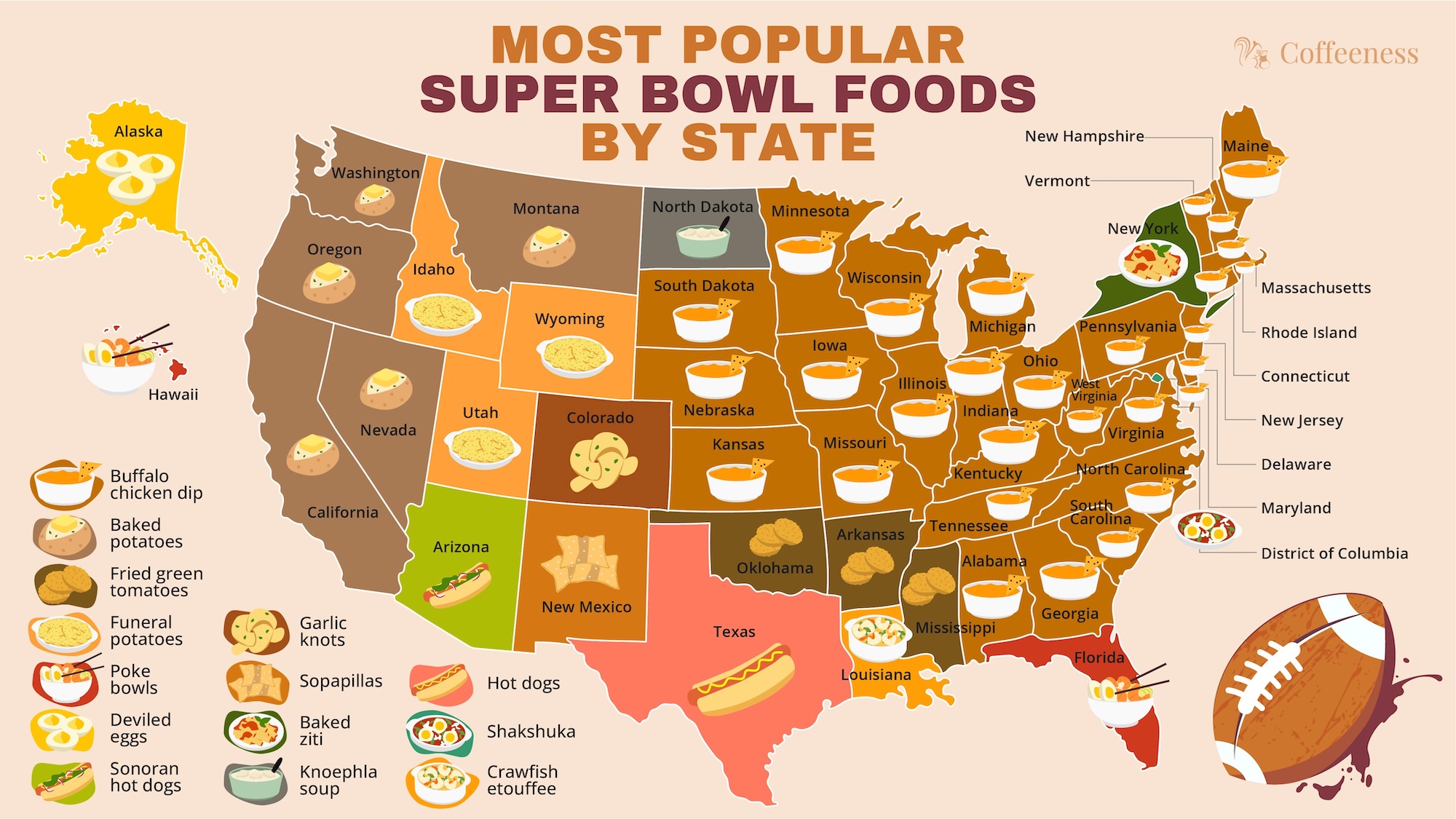
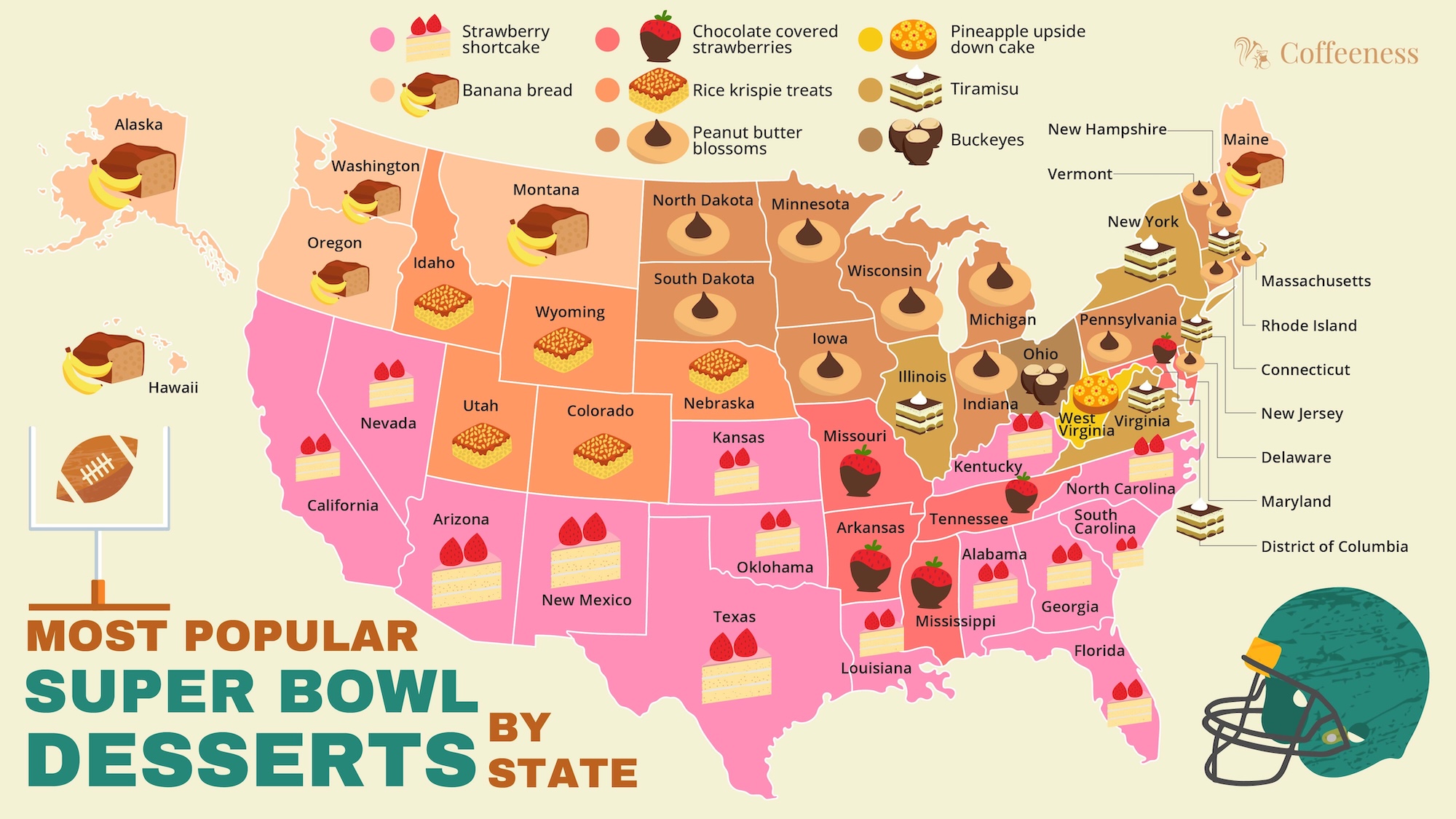
 February 9th is the Super Bowl, which is time to consume mass quantities of food and beverages. There is an article by CaLea Johnson at Mental Floss on January 27, 2025 titled The most popular Super Bowl foods by state, mapped. It shows results via two maps, one for foods and another for desserts. I have summarized them with the two bar charts shown above. Buffalo Chicken Dip was the most popular food ( in 29 states) and Strawberry Shortcake was the most popular dessert ( in 14 states).   


But these are not really the most popular foods. That article instead says:


“The coffee machine review site [Coffeeness] selected the most popular Super Bowl foods per state by analyzing search volume data from December 2023 to March 2024. Researchers looked at about 1300 food types and around 300 dessert-oriented keywords to determine state-specific preferences, with a focus on search trends leading up to and immediately following the big game.”


There is another article by Jessica Randhawa at the forked spoon on November 23, 2020 titled The Best Buffalo Chicken Dip Recipe (+Video).


Saturday, December 28, 2024

Do not take Trader Joe’s Everything But The Bagel Sesame Seasoning Blend to China, Saudi Arabia, Singapore, South Korea, Taiwan, or the UAE


Last week at Trader Joe’s I bought a bottle of their tasty Everything But The Bagel Sesame Seasoning Blend, as is shown above. Then at Pocket I saw a repeat of an article by Kelsey Ables at The Washington Post on July 12, 2024 titled This Trader Joe’s seasoning is a hot item. In South Korea it’s illegal. There also is another article by Yi Whan-woo at The Korea Times on July 15, 2024 titled Beware of poppy seed seasoning products.


As also shown above, poppy seeds are the very last ingredient in this blend (and are not even mentioned on the front label). There is yet another article from the U.S. Embassy & Consulate in the Republic of Korea on August 30, 2024 titled Information on Controlled Substances that explains:


“Please note that food products containing poppy seeds, including popular bagel seasoning blends, are considered illegal in Korea. Attempting to travel into Korea with these products could result in a criminal investigation resulting in fines, entry and exit bans, or even imprisonment.  


Still another article by Ocean Robbins at Food Revolution Network on December 25, 2024 titled Are poppy seeds good for you - or dangerous? notes that China, Singapore, Saudi Arabia, Taiwan, and the UAE also ban poppy seeds. Who knew?


Tuesday, December 3, 2024

To prepare food faster just make it thinner


Preserved Lemons


Preserved lemons are a Middle Eastern food ingredient. A typical recipe like one in the New York Times calls for slicing them part through in quarters lengthwise, as shown above, and packing them with salt in jars. But then you have to plan ahead and wait for an entire month. I never got around to trying that recipe.


But then I saw another one in a book from 2023 by Bee Wilson titled The Secret of Cooking. Her recipe instead calls for cutting the lemons paper thin using the slicer disk on a food processor. And they will be ready in a day.


Griddled Flatbreads


Many cultures long have quickly cooked flatbreads on griddles, like the corn tortilla shown above. There also are wheat flour tortillas (called piadina in Italy), and Indian chapatis (made from whole-wheat flour). Other grains are used elsewhere. In Brittany there are crepes made from buckwheat. In Scotland there are oatcakes. On the Mediterranean coast there are chickpea flour cakes called Socca in Nice. And In Norway there is lefse made with potatoes.


Schnitzel and its cousins


A common entrée is meat pounded thin, breaded, and fried. The classic Austrian one from veal is a Wiener schnitzel. The Israeli variant uses turkey. The Texas beef version is a Chicken-Fried Steak. The midwestern Pork Tenderloin is a deep-fried version served as a sandwich. And the chicken version is called a paillard.    


Images of cut and salted lemons, a tortilla, and schnitzel all came from Wikimedia Commons.  


Tuesday, November 12, 2024

I am not going to throw out my black plastic spatula


At the Food Network on October 25, 2024 there is an article by Christine Byrne titled Why you might want to throw away your black plastic kitchen utensils and takeout containers. And there is another article by Kristin Toussaint at Fast Company on November 1, 2024 more emphatically titled Why you should get rid of your black plastic spatula immediately. But there is still another article by Gideon Meyerowitz-Katz at Slate on November 4, 2024 titled I’m not throwing away my black plastic spatula. Potentially toxic flame retardants are a possible problem.


I agree with Gideon Meyerowitz-Katz. The problem here is a difference between a hazard (a potential problem) and a risk (a real problem). Getting bit by a rabid unicorn is a hazard, but the risk is negligible. There is yet another article by Steven Novella at Science-Based Medicine on July 5, 2023 titled Aspartame and Cancer that explains how these two concepts differ:


“The difference between hazard and risk is important to understand in terms of this research. A good analogy I often go to is – a shark in a tank is a hazard, meaning that it can potentially cause harm in the right circumstance. But as long as you don’t swim in the tank with the shark, the risk is zero. Something happening chemically may be a hazard, but we need to know how the substance is metabolized, will it get to the target tissue and in what dose, and what compensatory mechanisms are there? A potential hazard can be of zero risk depending on exposure.”