Showing posts with label Seinfeld. Show all posts

Friday, December 26, 2025

Ignore an executive coach who doesn’t know the difference between a joke and a study


There is an article by Mike Hawkins in the December 2025 issue of Talent Development (TD) on pages 62 to 64 titled Overcome Your Fear of Public Speaking. In the second paragraph he claims that:


“Studies on glossophobia have found that some people would rather be in the casket than give the eulogy at a funeral.”


But, of course, that was not a study but rather a very well-known joke from comedian Jerry Seinfeld, told on his TV show for May 20, 1993. I blogged about it in a post on April 8, 2018 titled Misquoting Jerry Seinfeld and inflating fear five times. We should ignore Mike.


An image of Jerry came from Wikimedia Commons.


Wednesday, October 8, 2025

A flawed article by Dr. Cheryl Mathews on what public speaking anxiety statistics say


There is a flawed article by Dr. Cheryl Mathews at SpeakCalmHQ on September 10, 2025 that is titled The Biggest Myth About The Top Fear: What Public Speaking Anxiety Statistics Really Reveal. She discusses the 2024 Chapman Survey of American Fears to point out that public speaking is not the number one fear. But Cheryl also creates a couple new myths. Her six takeaways are:


1] Public speaking is not the top fear Among Americans despite popular myths.

2] The real number one fear for most people is corrupt government officials.

3] Only a minority – about 29% - experience strong anxiety about public speaking.

4] Most people’s public speaking anxiety is mild and manageable.

5] Severe speaking anxiety can hurt careers and quality of life, but there’s help out there.

6] Accurate, recent public speaking anxiety statistics come from Chapman University surveys.


She says other highlights are:


Corrupt government officials. Over 65% of Americans are very afraid or afraid.

Death. Number two in the fear rankings.

Public speaking anxiety. Number 59 out of a long list, with only about one quarter of Americans affected by significant speech anxiety.  


If you look at the 2024 Chapman fears list for Very Afraid plus Afraid, you will not find Death listed at #2, or at all. That #2 is from the Jerry Seinfeld joke. Dying is listed as #51 at 31.6%. People I Love Becoming Seriously Ill is #2 at 58.4%. And People I Love Dying is #4 at 57.8%. On October 24, 2024 I had blogged about how In the tenth Chapman Survey of American Fears for 2024, public speaking only was ranked #59 of 85 fears at 29.0%.


Dr. Mathews has a section titled Breaking Down Public Speaking Anxiety: Three Main Groups that begins with a pie chart for public speaking fear that I’ve instead shown above as a bar chart. Her Group 1 is Not Afraid or only Slightly Afraid (71%). Her Group 2 is Afraid or Very Afraid (29%). Group 3 is Very Afraid (Phobic, 12%). But Phobic is not quite the same as Very Afraid! Back on December 8, 2019 I blogged about how a Toastmasters press release confuses a fear of public speaking with a phobia. In that post I pointed out that along with being intense a phobia is also persistent and interfering.


Cheryl’s fourth takeaway is that most people’s public speaking anxiety is mild and manageable. I have discussed that another way, via a fear score, in a blog post on June 1, 2025 titled An article on stage fright by David Pennington claimed public speaking was the #1 fear in a Chapman Survey, but ignored their nine other surveys where it was ranked from #26 to #59. On a scale from 1 to 4, the Fear Score for public speaking was always around 2 – just Slightly Afraid. The first sentence of Cheryl’s article asked: “What scares Americans the most?” What she discussed instead was What do the most Americans fear?


Near the end Cheryl has a brief section titled What About the Global Population? which states:


“We don’t have a lot of data globally. However, we can assume from these global anxiety surveys that the percentages above generally reflect patterns in other countries and across the global population.”


The 2024 Chapman survey found 29.1% of Americans feared public speaking. But back on August 15, 2012 I blogged about how Surveys show that public speaking isn’t feared by the majority of adults in nine developed and eleven developing countries. Only 13% in nine developed countries feared public speaking/performance. And just 9.4% in eleven developing countries feared public speaking/performance. That 13% is less than half, and 9.4% is only a third of what the Chapman survey found.  


The grim reaper cartoon was adapted from this one at OpenClipArt.


Friday, April 18, 2025

A sticky story on the glue you lick to seal envelopes


There is an interesting article by Joe Schwarcz at the McGill Office for Science and Society on March 26, 2025 titled A Sticky Story. He states that:


“The adhesives that are used on envelopes and stamps have very stringent safety requirements. That shouldn’t be surprising. After all, some of the stuff may be swallowed, so it has to be regulated as a food. Gum arabic from the acacia tree, dextrin from corn starch and the water-soluble resin, polyvinyl alcohol are the adhesives most commonly used. There are also additives for flexibility and spreading quality which include glycerin, corn syrup, various glycols, urea, sodium silicate and emulsified waxes. Preservatives such as sodium benzoate, quaternary ammonium compounds and phenols are also included. These substances may not taste great, but they are not poisons.”


The final episode from the 1995 season of Seinfeld titled The Invitations is not realistic:


“Disregarding George's suggestion to use glue for the wedding invitations since the adhesive in the envelopes takes a lot of moisture to work, Susan keeps licking envelopes until she passes out. George returns to his apartment, finds that Susan has collapsed, and takes her to the hospital. After the examination, a doctor informs George that Susan is dead from licking the envelopes, since the adhesive is toxic.”


Sunday, January 21, 2024

Ten quotes to motivate speaking in public – five of which are incorrect


On January 8, 2024 there is a post by Rosemary Ravinal at her The Master Communicator Blog titled 10 timeless quotes to motivate your public speaking. But five are partly or completely incorrect. For a well-researched and real quotation, we can definitively describe (as shown above) Who said it, What he said, When he said it, and Where he said it.  


Quote #1, attributed to John F. Kennedy, is that:


“The only reason to give a speech is to change the world.”


It was featured in a post by John Zimmer at his Manner of Speaking blog on May 21, 2013 titled Quotes for Public Speakers (No. 164) – John Kennedy. He said it was often attributed to Kennedy. Nick Morgan said in a comment that he could not give a definitive reference. (Nick authored a 2005 book titled Give Your Speech, Change the World: How to Move Your Audience to Action).


Quote #2, attributed to Dale Carnegie, is:  


“Talk to someone about themselves, and they’ll listen for hours.”


Both the Who and What are wrong. A Google Books search finds the correct quote, from the 2022 edition of How to Win Friends and Influence People [originally published back in 1936] instead is:


“ ’Talk to people about themselves,’ said Disraeli, one of the shrewdest men who ever ruled the British Empire. ‘Talk to people about themselves and they will listen for hours.’ “


Benjamin Disraeli (1804 – 1881) died before Dale Carnegie (1888- 1955) was born.


Quote #3, attributed to Steve Jobs, is:  


“The most powerful person in the world is the storyteller. The storyteller sets the vision, values, and agenda of an entire generation that is to come.”


This one is correct. An article by Carlos Silva at Medium on July 27, 2021 titled The Most Powerful Person in the World – (According to Steve Jobs) says he stated it about Pixar in the summer of 1994 at NeXT. A longer version is:


“The most powerful person in the world is the storyteller. The storyteller sets the vision, values, and agenda of an entire generation that is to come. Disney has a monopoly on the storyteller business. And you know what? I am tired of that bullshit, I am going to be the next storyteller!”


Quote #4, attributed to Leonardo DiCaprio, is:  


“Don’t wait around for someone else to tell your story. Do it yourself by any means necessary.”


The Who is definitely wrong. When I did a Google search, I couldn’t any reference to that actor. Instead, it appeared in an article by Erica Lies at Vulture on March 11, 2014 titled Highlights from Lena Dunham’s Keynote Address at SXSW.


Quote #5, attributed to Chris Anderson, is:  


“Your number one task as a speaker is to transfer into your listeners’ minds an extraordinary gift – a strange and beautiful object that we call an idea.”


This one is correct. Those exact words appear a minute into his eight-minute video titled TED’s secret to great public speaking.


Quote #6, attributed to Maya Angelou, is:  


“I’ve learned that people will forget what you said, people will forget what you did, but people will never forget how you made them feel.”


She did not say that first, as was discussed by Garson O’Toole at Quote Investigator on April 6, 2014 in an article titled They may forget what you said, but they will never forget how you made them feel.


Quote #7, attributed to Eleanor Roosevelt, is:  


“No one can make you feel inferior without your consent.”


It was discussed by Garson O’Toole at Quote Investigator abbreviated as QI, on April 30, 2012 in another article titled No one can make you feel inferior without your consent. He stated:


“In conclusion, QI believes that Eleanor Roosevelt can be credited with expressing the core idea of this saying by 1935. Within five years the graceful modern version of the maxim was synthesized [ on page 84 in the September 1940 Reader’s Digest]. QI does not know if Roosevelt or someone else was responsible for this. But QI does believe Roosevelt’s words were the most likely inspiration.”


Quote #8, attributed to Jerry Seinfeld, is:  


“According to most studies, people’s number one fear is public speaking. Number two is death. Death is number two. Does that sound right? This means to the average person, if you go to a funeral, you’d be better off in the casket than doing the eulogy”


That’s not quite what Jerry said. He didn’t say “Does that sound right?” I blogged about that quote on April 8, 2018 in a post titled Misquoting Jerry Seinfeld and inflating fear five times. What he really said in his show on May 20, 1993 instead (and also appears at IMDB) was:


“According to most studies, people’s number-one fear is public speaking. Number two is death. ‘Death’ is number two! Now, this means to the average person, if you have to go to a funeral, you’re better off in the casket than doing the eulogy.”


There is another later version on YouTube from the 1998 DVD Jerry Seinfeld [Live on Broadway] I’m telling you for the last time which instead says:


“I saw a thing, actually a study that said speaking in front of a crowd is considered the number one fear of the average person. I found that amazing. Number two was death. Death is number two? This means to the average person, if you have to be at a funeral, you would rather be in the casket than doing the eulogy.“


 Quote #9, attributed to Mark Twain, is:  


“There are two types of speakers: those that are nervous and those that are liars.”


Mark Twain didn’t say that. Yet another article by Garson O’Toole at Quote Investigator on March 5, 2020 titled There are two types of speakers: Those who are nervous and those who are liars discussed how the quote first appeared in 1998, although Twain had died back in 1910. I discussed it in a May 12, 2020 blog post titled Did Mark Twain really say there were just nervous speakers or liars? I found another reference from 1984.


Quote #10, attributed to Oprah Winfrey, is:  


“What’s the most important message you want to leave your audience with – and why should they care? Every listener instinctively wants to know one thing: What’s in this for me?”


That is a correct quote, which appeared at the Oprah web site in an article titled How to Talk to a crowd that Rosemary linked to.


Monday, March 28, 2022

Don’t start an article with a tired old statistic and joke


At Training on March 7, 2022 there is a decent article by Sheryl Lindsell-Roberts titled From Stage Fright to Stage Might and subtitled 9 tips to keep in mind before your next foray into the presentation spotlight. Those tips are:


Know your audience

Use presentation aids sparingly

Engage your audience from the start

Practice, then practice some more

Bring notes

Use pauses to your advantage

Avoid distractions

Get in the zone

Look them in the eyes and “listen’


Under the third tip, to engage your audience from the start, she says to get your audience’s attention with something like a shocking statistic or headline. But the first two sentences of her article, don’t follow her advice. They are:


“Would you believe that speaking in public is the No. 1 human fear of people, while death is No. 7? So at a funeral, would you rather be lying in the casket than delivering the eulogy? – Jerry Seinfeld”


The survey and joke both are very old news, as shown above via a time line. That ranking comes from a survey almost five decades old. Back on October 27, 2009 I blogged about the 1973 Bruskin survey in a post titled The 14 Worst Human Fears in the 1977 Book of Lists: where did this data really come from? And the Seinfeld joke is from 1993, almost three decades ago. I blogged about it in an April 8, 2018 post titled Misquoting Jerry Seinfeld and inflating fear five times. What would be startling instead? On September 26, 2021 I blogged about how Fear of public speaking was only ranked #54 of 95 fears in the 2020/2021 Chapman Survey of American Fears.


Friday, February 11, 2022

Is the fear of public speaking second only to the fear of death?


Not really. But I found nine articles and four books with that claim. When I looked for what they had to document it, I came up empty. None had any details and references or links to the surveys or studies they mentioned (when and where they were done, or even what percentages had those two fears).


An article by Anita Chaudhuri in the February 5, 2006 Sunday Times titled Everything is possible claimed:


“People often list speaking in public as their biggest fear, second only to death.”


Sylvia McLaren-Tishler’s 2008 book Public Speaking for the Terrified! Pocket Tips says:


“Hello and welcome to Public Speaking for the Terrified! Did you know that public speaking ranks as the number one human fear, second only to death!”


A second article by Barbara Quint in the September/October 2014 issue of Online Searcher titled

Playing to your strengths claimed:


“While studies have shown that a major­ity of people consider public speaking a horror second only to death—and some even push death down into the Miss Congeniality slot— there are still people like a cousin of mine.”


A third article by Cameron Kahler at Business 2 Community on October 21, 2014 titled The 5 Cs' of Powerful Presentations stated that:


“In fact public speaking is the second most feared thing after death!”


A 2014 book by Sharon Lowe titled The Mind Makeover: The answers to becoming the best you yet says:


“Researchers tell us that public speaking is second on the list of what people fear most (number one is death).”


A fourth article by Amy Lemire at LinkedIn Pulse on March 13, 2017 titled What some fear more than death: public speaking: 5 of my top 10 ‘world class’ presentation skills tips states that:


“It has often been said that some people list 'death' as their #1 fear, and their #2 fear is public speaking.”


The fifth paragraph in a fifth article by Ben James at LinkedIn Pulse on November 18, 2019 titled How to improve your public speaking preparation claimed:


“Research tells us that public speaking is the second biggest fear for the general public, second only to death!”


Chapter 1 in a 2020 book by Amy Lemire Simatos titled From Zero to Speaker Hero: how to achieve fame, fortune, and fun as a speaker and presenter begins:


“What is your top fear? I ask this question at every presentation skills workshop I deliver within the first five minutes. As I add the audience responses to the flipchart, I hear laughter. Some of it is the nervous type when you are feeling awkward. Other participants say their responses amidst the others. It always seems to be the same responses, or a variation in some way.


As I write the responses they come up as:

#1 – The fear of death

#2 – The fear of public speaking


The other responses commonly are: heights, snakes, and spiders. I inform the audience they are right according to recent studies. The fear of public speaking is ranked #2 of our greatest fears, and the fear of death is #1. Yes, according to most public surveys, people fear death almost as much as they fear public speaking. To this day, I have never had anyone in my audience challenge me on that conclusion.”   


A sixth article by Julie Bobell at Speak with Purpose on November 17, 2020 titled Being able to speak in front of others is a learned skill states that:


“It is true that public speaking is the second most feared phobia, after the fear of death.”


Chapter 5 of a 2021 book by Michael D. Butler titled Finding the Speaker’s Edge has the heading:


“The Second-Most Feared Thing in the World is Public Speaking, Surpassed Only by the Fear of Death.”


 A seventh article by Sue Ludwig at the NANT Blog from the National Association of Neonatal Therapists on June 12, 2021 titled The secret sauce for public speaking: there’s only one you says:


“I was understandably nervous the first time I spoke in front of an audience. There’s a reason the fear of public speaking is second only to death.”


The first sentence in an eighth article by Michael O’Keefe on November 28, 2021 titled Public speaking for teachers states that:


“Public speaking, it is commonly said, is one of the most pervasive fears (in some surveys, second only to death).”


A ninth article by Michael Pollick at Wisegeek on January 27, 2022 titled What Are Some Public Speaking Tips? begins:


“For many people, only the fear of death trumps the fear of public speaking.”


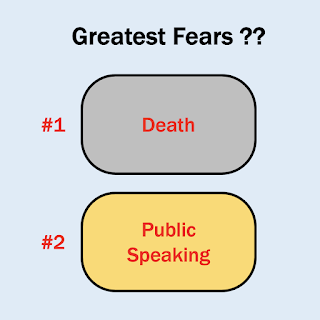
What’s going on here? Why do people think fear of death is #1 and fear of public speaking is #2? I am unaware of any recent studies (or surveys) that list fear of death at #1 and fear of public speaking at #2. In his Seinfeld TV show on May 20, 1993 Jerry had told this joke:


“…. According to most studies, people’s number-one fear is public speaking. Number two is death. Death is number two! Now this means to the average person, if you have to go to a funeral, you’re better off in the casket than doing the eulogy.”


Some didn’t realize that he was joking, and had changed death to #2 from the #7 in a survey reported in the 1977 Book of Lists.


I think the authors of those dozen articles or books mentioned above were confused. They had flipped the joke over to claim that death is #1 and public speaking is #2. That’s what happens when you don’t do careful research. Back on July 30, 2012 I blogged about Is fear of public speaking the greatest fear in the entire galaxy? In that post I mentioned fifteen surveys. Public speaking was first in five. Death never came first – the highest it came was third.


The headstand Y image was adapted from a print at Wikimedia Commons.


Saturday, October 30, 2021

100 of the funniest quotes from the past century


At the Reader’s Digest web site there is an article by Lucie Terkel on October 26, 2021 titled 100 Funniest quotes from the past 100 years. There are 26 categories, as follows:


advice and criticism (3)

aging (3)

bores (4)

cats (4)

death (3)  

dogs (4)

drink (3)

education (3)

emotions (3)

enemies (3)

egotists (4)

families (4)

food (3)

friends (3)

gossip (3)

happiness (3)

health (3)

intelligence (4)

marriage (7)

money (6)

optimism and pessimism (3)

parenting (8)

politics (3)

stupidity (4)

success (3)

work (6)


For example, three on death are:


“Always go to other people’s funerals; otherwise they won’t come to yours.” - Yogi Berra


“I don’t believe in reincarnation, and I didn’t believe in it when I was a hamster.” - Shane Richie


“According to most studies, people’s number one fear is public speaking. Number two is death. Death is number two. Does that seem right? That means to the average person, if you have to go to a funeral, you’re better off in the casket than doing the eulogy.” - Jerry Seinfeld


The cartoon of a female speaker was adapted from this one at Wikimedia Commons.


Wednesday, June 2, 2021

Bursting the silly claim that 98% of people fear public speaking


On December 20, 2016 I blogged about Bursting the overblown claim that 95% of Americans fear public speaking at some level. On February 7, 2017 I also blogged about Bursting a hilariously overblown claim that 99% of the world fears public speaking. But, as shown above there are three others who relatively recently have claimed (without citing any sources) that 98% fear speaking, and only the remaining 2% do not.


At LinkedIn Pulse on March 22, 2017 Dawn Kiddie has an article titled Overcoming the worlds Number 1 Fear… which says:


“Most people (98% in fact), fear public speaking more than DEATH, making this the Number 1 Fear in the world, It even has a scary name name... Glossophobia!”


At Medium on June 25, 2019 Claire Burn has another article titled Effective Public speaking: Tips to Write a Spellbinding Presentation! which says:


“ ‘Public Speaking’. Two words that strike fear into the heart of 98% of the human population. And if you’re part of the 2% that are NOT uncomfortable with these words, I hate to be the one to tell you this, but… you’re probably a superhero.”


At Speaker Nation on October 22, 2020 there is an article titled 13 Steps to Successful Public Speaking which concludes by stating:


“We hope that by giving you this framework you can see that public speaking is not the fear-inducing, complicated monster that 98% of the population is terrified of, but rather a fun and powerful way to share ideas and spread your message around the world.” 


Even worse, in Eran Katz’s 2010 book titled Where Did Noah Park the Ark? Ancient memory techniques for remembering practically anything (which you can find at Google Books) he claims on page 180 that:


“During one of his comedy routines, Jerry Seinfeld talked about an American survey that asked people what they are most afraid of. Ninety-eight percent replied that public speaking scared them the most. The rest opted for death.”


But that quantified version of a well-known joke is complete rubbish. The original just has ranks. I had discussed it on March 2, 2013 in a blog post titled I read it in a book, so it must be true.


How does the claim that only 2% do not fear public speaking compare with real survey data on U.S. adults? Results from the annual Chapman Survey of American Fears were reported from 2014 to 2019. They asked about four levels of fear: Very Afraid, Afraid, Slightly Afraid, and Not Afraid. (A small percentage replied Don’t Know. Also, for 2014 they asked similarly about Somewhat Afraid rather than Slightly Afraid). 


Mean percentages from those six surveys are shown above in a bar chart. Just 10.4% were Very Afraid, 16.1% were Afraid, and 33.9% were Slightly Afraid. 38% were Not Afraid, which is nineteen times larger than the claimed 2% discussed above. Note that in their press releases Chapman reported just the sum for Very Afraid plus Afraid, which has a mean of 26.5% and is 3.7 times less than the claimed 98%. And, even if we add the 33.9% for Slightly Afraid the grand mean for that Sum of All Fears is only 60.4%, or 37.6% below the claimed 98%. On September 19, 2019 I blogged about how Fear of public speaking doesn’t happen to everybody – or all the time. For that post I didn’t have the 2019 Chapman data, but got similar results.  


Detailed results from all six surveys are shown above in a larger bar chart. For Not Afraid there is the widest range, from 34.1% to 41.9%.


Thursday, July 19, 2018

Advice about feedback from Comedians in Cars Getting Coffee


At Netflix I have been enjoying watching the current (tenth) season of Jerry Seinfeld’s TV show Comedians in Cars Getting Coffee. In Episode 2 Dave Chapelle says:

“For most people, not caring about the scrutiny of other people is one of the hardest things to do. I would even say harder than public speaking itself.”

In Episode 5 there is a longer exchange between Brian Regan and Jerry about evaluations by critics. It’s way more useful advice than the 1993 comedy routine public speaking coaches keep repeating:

“Jerry:  It is one of the comforts of comedy, I think, that almost never do people who are really good not get anywhere. Almost never.

Brian:  And I think it’s because of the objective response.

Jerry:  Right.

Brian:  No one can take away the laughs.

Jerry: Right.

Brian:  If it was just acting, it’s subjective and someone could say, ‘they’re not that good. They don’t have this. They don’t have that.’ But if you go on stage and make people laugh, nobody can say, ‘They’re not laughing.’

Jerry:  That’s what’s so funny to me when you get a negative review, which we all get from time to time. And you want to say…’They’ve already voted. I’m sorry. I’m sorry you didn’t like it, but the vote – We took a vote that night, and out of 2,000 people – I know you got this job at the newspaper, but it doesn’t mean anything.’

Brian: ‘It’s too late.’ You’re gonna go back and tell those people not to go in the past to the show they laughed at. Don’t. If you have a time machine, I’m telling you, don’t get in it and go back to Friday.

Jerry:  Yeah.

Brian:  I’m trying to make the audience laugh, and then – I’m not trying to please some guy at a typewriter, you know?

Jerry:  Here we go again. There’s no typewriters any more, okay? Speaking of time machines, you need one. And set it to ‘present.’ “

The microphone image came from Wikimedia Commons.

Wednesday, May 23, 2018

The Statistic Brain web site now requires a ~$20 per month subscription. There are better ways to spend your time and money.


The last time I went to the Statistic Brain web site I was surprised to find that they have changed their business model and no longer allow public access. Instead they offer Student Access (for $9.99/month), Standard Access (for $19.99/month), and Business Access (for $99.99/month).

They have a web page on OUR METHODOLOGY (subtitled How Do We Ensure Accurate Data). Based on the oft-quoted example of their (top ten) Fear/Phobia Statistics page, it is NOT how they did their research. What they actually did was create a lie to match a Jerry Seinfeld joke. So, my mental image for them is that of a disreputable saloon, as shown above.   


An early version of that web page archived by the Wayback Machine is shown above. I blogged about it on December 7, 2014 in a post titled Statistic Brain is just a statistical medicine show. A more recent version with those baseless numbers showed up again on May 8, 2018 in a post by Jessica Teteak titled I’ll take death over public speaking at the Rule the Room Public Speaking blog.


What are some better ways to spend your time and money than a subscription to Statistic Brain? First, visit your friendly local public library and get a card. Ask the librarian about how to use their database collection. Second, visit your nearest state university library and see what options they have for visiting residents. You may be able to get an inexpensive card. I discussed using university libraries in a pair of blog posts. One from August 7, 2017 is titled Spotting fake news and finding reliable information for speeches. Another from February 24, 2015 is titled How to do a better job of speech research than the average Toastmaster (by using your friendly local public and state university libraries). Third, if you graduated from a university, look at the web site for their library. They may even have remote database access for alumni, like Brown University does.

The image of a saloon was modified from one at the Library of Congress.  

Sunday, April 8, 2018

Misquoting Jerry Seinfeld and inflating fear five times


In his Seinfeld TV show on May 20, 1993 Jerry told this joke:

“…. According to most studies, people’s number-one fear is public speaking. Number two is death. Death is number two! Now this means to the average person, if you have to go to a funeral, you’re better off in the casket than doing the eulogy.”

On March 2, 2013 I blogged about how I read it in a book, so it must be true – and discussed a book which had misquoted death as instead being third. Doug Staneart has another version where death is fifth. It was at Ezine Articles on November 15, 2005 in an article titled Anxiety in Public Speaking. Mr. Staneart says:

“Speaking in public is often cited as the number one fear of adults. The Book of Lists places the fear of death in fifth place while public speaking ranks first. Jerry Seinfeld said, ‘That would mean at a funeral, people are five times more likely to want to be in the casket than giving the eulogy.’"

He has other more vague versions in two of his books. One shows up in an excerpt from Chapter 1 of his 2002 book Fearless Presentations in a web article titled 10 Ways to Eliminate Public Speaking Fear:

“A number of years ago in an episode of Seinfeld, Jerry Seinfeld talked about a poll that had been conducted in which Americans said that their number one fear was public speaking, and that the fear of death was number five. He said, ‘…that would mean that at a funeral, people are five times more likely to want to be in the casket than giving the eulogy.’ “

In his 2013 book Mastering Presentations, Mr. Staneart says:

“I often quote Jerry Seinfeld when I begin a seminar or class on presentation fear, because in one of his stand-up routines, he points out that the fear of public speaking is the number-one fear in America, and the fear of death is number five. ‘So, you are five times as likely to want to be in the casket rather than up giving the eulogy.’ “


Where did fear of death rank in that Book of Lists? On October 27, 2009 I blogged about The 14 worst human fears in the 1977 Book of Lists: where did this data really come from? As shown above in a bar chart, the fear of death in the 1973 Bruskin survey ranked seventh not fifth. Also, it is clearly wrong to multiply by the rank. Since 40.6% feared speaking before a group and 18.7% feared death you instead would multiply by the ratio 40.6/18.7 = 2.17, not 5. 


Was there another survey where fear of death ranked fifth? Yes. On May 19, 2011 I blogged about America’s Number One Fear: Public Speaking – that 1993 Bruskin-Goldring Survey. As shown above in a bar chart, since 45% feared speaking before a group and 31% feared death you would multiply by the ratio 45/31 = 1.45, not 5.

The inflated man was derived from an August 1, 1900 Puck cartoon titled Pride goeth before destruction found at the Library of Congress.