Showing posts with label death. Show all posts

Friday, March 20, 2026

Mayor of Nampa, Idaho dies while speaking in public


An article by Michael Davis at Medium on January 4, 2023 titled Why Public Speaking ISN’T Your Number One Fear claimed:


“No one has ever died from giving a speech.”


But on May 31, 2017 I blogged about thirty examples in a post titled Spouting Nonsense – Nobody ever died from public speaking. Sadly, we just had another local example.


There is another article by Chris Bradford at the New York Post on March 19, 2026 titled Newly elected Idaho mayor Rick Hogaboam, 47, dies after collapsing mid-speech during town hall. And there is yet another article by Becca Longmire at People also on March 19, 2026 titled Idaho Mayor Rick Hogaboam, 47, Dies After Experiencing Medical Emergency While Speaking at Town Hall Meeting. There is a brief biography of Rick at the Office of the Mayor.


Wednesday, October 8, 2025

A flawed article by Dr. Cheryl Mathews on what public speaking anxiety statistics say


There is a flawed article by Dr. Cheryl Mathews at SpeakCalmHQ on September 10, 2025 that is titled The Biggest Myth About The Top Fear: What Public Speaking Anxiety Statistics Really Reveal. She discusses the 2024 Chapman Survey of American Fears to point out that public speaking is not the number one fear. But Cheryl also creates a couple new myths. Her six takeaways are:


1] Public speaking is not the top fear Among Americans despite popular myths.

2] The real number one fear for most people is corrupt government officials.

3] Only a minority – about 29% - experience strong anxiety about public speaking.

4] Most people’s public speaking anxiety is mild and manageable.

5] Severe speaking anxiety can hurt careers and quality of life, but there’s help out there.

6] Accurate, recent public speaking anxiety statistics come from Chapman University surveys.


She says other highlights are:


Corrupt government officials. Over 65% of Americans are very afraid or afraid.

Death. Number two in the fear rankings.

Public speaking anxiety. Number 59 out of a long list, with only about one quarter of Americans affected by significant speech anxiety.  


If you look at the 2024 Chapman fears list for Very Afraid plus Afraid, you will not find Death listed at #2, or at all. That #2 is from the Jerry Seinfeld joke. Dying is listed as #51 at 31.6%. People I Love Becoming Seriously Ill is #2 at 58.4%. And People I Love Dying is #4 at 57.8%. On October 24, 2024 I had blogged about how In the tenth Chapman Survey of American Fears for 2024, public speaking only was ranked #59 of 85 fears at 29.0%.


Dr. Mathews has a section titled Breaking Down Public Speaking Anxiety: Three Main Groups that begins with a pie chart for public speaking fear that I’ve instead shown above as a bar chart. Her Group 1 is Not Afraid or only Slightly Afraid (71%). Her Group 2 is Afraid or Very Afraid (29%). Group 3 is Very Afraid (Phobic, 12%). But Phobic is not quite the same as Very Afraid! Back on December 8, 2019 I blogged about how a Toastmasters press release confuses a fear of public speaking with a phobia. In that post I pointed out that along with being intense a phobia is also persistent and interfering.


Cheryl’s fourth takeaway is that most people’s public speaking anxiety is mild and manageable. I have discussed that another way, via a fear score, in a blog post on June 1, 2025 titled An article on stage fright by David Pennington claimed public speaking was the #1 fear in a Chapman Survey, but ignored their nine other surveys where it was ranked from #26 to #59. On a scale from 1 to 4, the Fear Score for public speaking was always around 2 – just Slightly Afraid. The first sentence of Cheryl’s article asked: “What scares Americans the most?” What she discussed instead was What do the most Americans fear?


Near the end Cheryl has a brief section titled What About the Global Population? which states:


“We don’t have a lot of data globally. However, we can assume from these global anxiety surveys that the percentages above generally reflect patterns in other countries and across the global population.”


The 2024 Chapman survey found 29.1% of Americans feared public speaking. But back on August 15, 2012 I blogged about how Surveys show that public speaking isn’t feared by the majority of adults in nine developed and eleven developing countries. Only 13% in nine developed countries feared public speaking/performance. And just 9.4% in eleven developing countries feared public speaking/performance. That 13% is less than half, and 9.4% is only a third of what the Chapman survey found.  


The grim reaper cartoon was adapted from this one at OpenClipArt.


Friday, December 3, 2021

A cartoon with a very dark speech topic - What your last day on earth feels like


The December 1, 2021 Pearls Before Swine comic strip had Zebra visited by a neighbor from the Fraternity of Crocodiles, with the following dialogue:


Larry: Hullo zeeba neighba. Leesten. Crocs want offer you honor of give speech at ‘Association of Predators’ annual meeting.

Zebra: What would you want me to talk about?

Larry: What you last day on earth feel like.

Fred: We need better sales pitch.


Pearls Before Swine began back on January 7, 2002. A month later parodies of TV nature shows (like Wild Kingdom) began with lions attacking zebras. One had Lions, Hyenas, and Vultures, others had Cheetahs, Butter, a Going-Away Party and even a Zebra with a Walkman.


On April 8, 2007 the Crocs cheered while Zebra was watching a nature documentary. On September 15, 2021 the crocs had a ‘good book’ titled Die Zeeba Die.


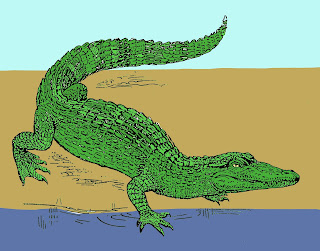
My cartoon of a crocodile was adapted from a Pearson Scott Foresman image at Wikimedia Commons.


Sunday, June 13, 2021

Is public speaking the safest activity in the world?


I doubt it. But at Medium on January 27, 2020 there is an article titled What is the safest activity in the world? – Frances Cahill. She said the following:


“I have been researching the dangers of public speaking on your behalf, prompted by the usual reaction to someone being asked to speak.

 I’ll just die!

 After many years, I can confidently state that never in recorded history has ‘Public Speaking’ been registered as a cause of death!

 Never!

 I know you are thinking but when I start to panic – my heart rate goes up and my breathing starts to become labored!

 True! But if you die – it will be from a heart attack or high blood pressure, aneurysm blowing – all the other stark realities of terror.

 You won’t die because you are speaking in public!”


She never gave any evidence that public speaking was safer than any other activities though. I  instantly thought of four other activities which also may be relatively safe:


Birdwatching

Flower Gardening

Sleeping

Watercolor Painting


Except for sleeping they involve walking around, which like public speaking, possibly can lead to falling and being hurt (or killed). How common are falls? The U.S. Centers for Disease Control and Prevention (CDC) has a website called WISQARS, which is an acronym for the Web-based Injury Statistics Query And Reporting System. 


There is a WISQARS page for Leading causes of nonfatal emergency room visits. As shown above for 2019, Falls (8,049,882) by far are number one in the Top 20 causes. Birdwatching, Flower Gardening, and Watercolor Painting all might involve walking around outside, and even more risk of falling than Public Speaking.  


There is another WISQARS page for Leading causes of deaths. As shown above, heart disease is the number one cause of death (659,041 people) followed by Malignant Neoplasms (cancers, 599,601). Hypertension (high blood pressure) is twelfth, and Aortic Aneurysm is twentieth. Although sleeping may be safer (since you won’t fall), people do die in their sleep. An article at Healthline titled Sleep apnea mortality statistics and the importance of treatment says:


“The American Sleep Apnea Association estimates that 38,000 people in the United States die each year from heart disease with sleep apnea as a complicating factor.”


That’s only about 5.8% of the heart disease deaths.


Back on May 31, 2017 I blogged about Spouting Nonsense – Nobody ever died from public speaking. In that post I pointed out that a few people indeed had died of heart attacks and strokes while speaking in public. Some others were assassinated. It also goes the other way. On September 27, 2020 I blogged about how In 1912 a speech may have saved Teddy Roosevelt’s life.


I recently saw Cahill’s claim discussed on June 7, 2021 in a Public Speaking with Peter George podcast.


The 1908 image of prominent political orators came from the Library of Congress.


Sunday, September 27, 2020

In 1912 a speech may have saved Teddy Roosevelt’s life


Strange things can happen while getting ready to give a speech. On the evening of October 14, 1912 former president Theodore Roosevelt had stepped out of a hotel in Milwaukee and into an open car that would take him to the Milwaukee Auditorium where he was scheduled to speak. Then an unemployed saloonkeeper, Jacob Schrank, who stood just five feet away. fired one shot from a .38 revolver at Roosevelt’s chest.  


The combination of his heavy army overcoat, glasses case, and the folded fifty-page text of his speech slowed down the bullet, and it did not penetrate the lung. He decided to go on and deliver his speech. Roosevelt opened by stating:


“Friends, I shall ask you to be as quiet as possible. I don’t know whether you fully understand that I have just been shot – but it takes more than that to kill a Bull Moose.”


The incident is described both in an article by Patricia O’Toole in Smithsonian Magazine for November 2012 titled The speech that saved Teddy Roosevelt’s life and more recently by Christopher Klein on July 21, 2019 at History.com in another article titled When Teddy Roosevelt was shot in 1912, a speech may have saved his life.


Roosevelt followed his own advice from an address in Paris at the Sorbonne on April 23, 1910 in which he famously had said:


“It is not the critic who counts; not the man who points out how the strong man stumbles, or where the doer of deeds could have done them better. The credit belongs to the man who is actually in the arena, whose face is marred by dust and sweat and blood; who strives valiantly; who errs, and comes short again and again, because there is no effort without error and shortcoming; but who does actually strive to do the deeds; who knows the great enthusiasms, the great devotions; who spends himself in a worthy cause; who at the best knows in the end the triumph of high achievement, and who at the worst, if he fails, at least fails while daring greatly, so that his place shall never be with those cold and timid souls who know neither victory nor defeat.”


An image of a revolver came from Wikimedia Commons.


Thursday, September 24, 2020

Spouting Nonsense – Nobody ever died from public speaking (without having an underlying health condition)


On May 31, 2017 I blogged about Spouting Nonsense – Nobody ever died from public speaking. I described about thirty people who had died while speaking. At Buffalo 7 on September 10, 2020 there is an article titled The power to overcome presentation anxiety is already within you with a narrower claim that:

“Nobody ever died from talking on stage. Not without underlying health conditions, anyway.”


But in my previous post I already had included two people who had no underlying health conditions. Inijero Asanuma was stabbed with a samurai sword on October 12, 1960, and Malcolm X was shot on February 21, 1965.


I did some more searching and found three other examples of shootings described in Wikipedia. On June 29, 1992 Mohamed Boudiaf (the seventh president of Algeria) was shot by one of his bodyguards while he was giving a televised speech in Annaba. On April 23, 1993 Lalith Athulathmudali (a former Cabinet Minister of Sri Lanka) was shot while he was addressing a gathering in Kirulapana. On December 19, 2016 Andrei Karlov, the Russian Ambassador to Turkey, was shot while he was speaking at an art exhibition in Ankara.  


An image of the grim reaper was adapted from Wikimedia Commons.    


Monday, February 17, 2020

Don’t be dogged by making a blanket statement


At the GQ website on February 12, 2020 there is an article by Clay Skipper titled How to overcome insecurity, according to Hollywood’s favorite therapist. It contains an interview with Dr. Barry Michels which has useful Jungian advice on confidence and self-doubt. But it also contains a hilariously overconfident statement that:

“This is why public speaking is the number one fear in every single survey that's ever done. It actually ranks higher in people's minds than death.”

Blanket statements are dangerous. You have to do a lot of serious research before you can confidently say either EVERY or NONE rather than just SOME. The best known survey contradicting his statement is described in another article by Geoffrey Brewer at Gallup on March 19, 2001 titled Snakes top list of Americans’ fears. That one did not include death though.

Chapman University is in Orange, California – just a 35 mile drive from Hollywood. The most recent 2018 Chapman Survey of American Fears ranked dying (death) at #54 (27.9%) and public speaking at #59 (26.2%). On January 27, 2020 I blogged about Why do we often hear about the 2014 Chapman Survey of American Fears, but not about the other four done in 2015, 2016, 2017, and 2018? The 2014 survey had ranked fear of public speaking at #1, but did not include death. The 2015 survey ranked public speaking #26 (28.4%) and death #43 (21.9%).

An image of a dog wrapped in a blanket came from Tashdeed at Wikimedia Commons.

Sunday, December 29, 2019

The mystery novel Twelve Angry Librarians features a keynote speaker dying at the lectern


I just finished reading the 2017 novel Twelve Angry Librarians by Miranda James (who really is Dean). This book is the eighth in his series of a dozen Cat in the Stacks mysteries. On page 82 Dr. Gavin Fong, the keynote speaker at the annual meeting of the Southern Academic Libraries Association, takes a drink from a poisoned bottle of water, collapses, and dies right at the lectern.

The problem for both Chief Deputy Kanesha Berry and Athena College interim library director (and amateur sleuth) Charlie Harris is that job-hopping Gavin previously made so many enemies that a dozen people have excellent motives for killing him. After another 177 pages we finally find out who done it.

Tuesday, April 30, 2019

Public speaking really isn’t very dangerous


At xkcd  on April 26, 2019 Randall Munroe had a cartoon titled Dangerous Fields. As shown above, it ranked the probability that you will be killed by what you study. I have added public speaking (in red) - which isn’t really very dangerous. Relatively few people have died, but not none as some have claimed. On May 31, 2017 I blogged about Spouting Nonsense – Nobody ever died from public speaking. In that post I reported just finding about thirty people.

On April 8, 2018 I blogged about Misquoting Jerry Seinfeld and inflating fear five times. In that post I discussed how a Seinfeld joke had played with results from a 1973 survey and moved death up to supposedly being the number two fear.

Monday, February 11, 2019

Should those be your last words?


As shown above, today’s Savage Chickens cartoon from Doug Savage is titled Death is Annoyed. He is so upset he gives that chicken until Thursday to come up with a better ending.

People best remember the first (primacy) and last (recency) things you say. At Wikipedia they both are in an article titled Serial-position effect. Fred E. Miller discussed both in his NO Sweat Public Speaking blog back on December 5, 2009 in a post titled The Law of Primacy and Recency.


Wednesday, May 31, 2017

Spouting Nonsense - Nobody ever died from public speaking


One of the sillier statements you may find is in a June 1, 2012 article from Dale Carnegie by Kristina Schneider titled Fear Not, Master Public Speaking with Confidence which claimed:

“....Nobody ever died from public speaking.”

Similar claims have appeared elsewhere in books, articles, and blog posts. In his 2011 book, No Sweat Public Speaking, Fred E. Miller said of small-town newspapers:

“Read a few of the death notices and you’ll find that people die from a variety of causes. I’ve yet to see where anyone died from giving a presentation!”

In the 2008 edition of the textbook iSpeak (public speaking for contemporary life)
Paul E. Nelson, Scott Titsworth, and Judy C. Pearson said:

“The authors of this book have over 90 years of combined teaching experience. We have heard thousands of classroom speeches. So far, not one student has died while speaking. Nor have we ever heard of one who did.”

On January 12, 2009 in an article at Ezine Articles titled Fear of Public Speaking - Is It Justified? Nancy Daniels said:

“To my knowledge, no one has died from public speaking.”

On April 15, 2017 in his Mindful Presenter blog Maurice DeCastro posted on Public Speaking Skills - 20 Tips to help you to manage your nerves more broadly claimed:

“To my knowledge no one has ever died from either speaking in public or worrying about speaking in public.”

Perhaps their knowledge is like a short rubber band, and it does not stretch very far.

Has anyone died from worrying about public speaking? Probably! In a magazine article titled Communication Apprehension: What Have We Learned in the Last Four Decades Professor James C. McCroskey told an anecdote about suicides by students at Pennsylvania State University back when he was teaching there. 14 were recorded, and all but one currently were enrolled in the required public speaking classes. Back on October 18, 2009 I blogged about that in a post titled Some college students really do fear public speaking more than death. 

Recently I was told instead that only three people had died from public speaking.   A Google search led me on Google Books to the 2011 book Network Marketing for Dummies by Zig Ziglar and John P. Hayes which indeed had said:

“As far as I have been able to discover, only three people have lost their lives in the process of public speaking. They are Arthur MacArthur, the father of General Douglas MacArthur, who died of a heart attack while on the dais addressing a reunion of his Civil War unit; Alben W, Barkley, former vice president of the United States, who died suddenly while making a speech; and a woman who was running for Justice of the Peace in a small New York town. Some estimates tell us that roughly 15 billion people have occupied the earth since Adam and Eve. That means the odds are five billion to one that you will survive your talk.” 

I found it very curious that all three of Mr. Ziglar’s examples were in the United States. So, I did some Google and Bing searches on phrases like “died while giving a speech,” “died while speaking,” “died after speaking,” and “Heart attack while speaking.”

Here are the results: I found 15 people in the U.S. (5 times more than Mr. Ziglar reported), and a total of 30 people from various countries (10 times more than Mr. Ziglar reported). When possible I have supplied the birth and death dates and other pertinent details.

BRAZIL

Writer and orator Jose Carlos de Patrocinio (October 8, 1854 to January 29, 1905) died during a speech in honor of the aviator Alberto Santos-Dumont at the Teatro Lincio on Rio de Janeirio due to hemoptysis.  


CANADA

Adelaide Hunter Hoodless was an educational reformer (February 27, 1857 to February 26, 1910). According to Wikipedia:

“Adelaide travelled by train to Toronto to speak at St. Margaret’s College on ‘Women and Industrial Life’. Ten minutes after she began speaking, her voice faltered. She was given some water. She took a sip, said 4 more words and collapsed on the floor. Adelaide Hunter Hoodless's death was registered as the result of a cerebral hemorrhage.”


Roy Wagar school board official in Montreal (? to 1962):

“Wagar died during his speech at Monkland High School's graduation ceremony just a year before Wagar High School opened its doors.”


FRANCE

Corinne Erhel, French politician (February 3, 1967 to May 5, 2017):

“Erhel died while she was giving a speech at a meeting in support of Emmanuel Macron for the 2017 French presidential election.”


GERMANY

Johann Theodor von Ravenstein, army officer (January 1, 1889 to March 26, 1962). According to notes on page 201 of Samuel W. Mitcham’s 2007 book, Rommel’s Desert War: The Life and Death of the Afrika Korps, after retirement:

“...he devoted himself to his many interests and hobbies, and was very active in the Lutheran Church. He dropped dead of a heart attack during a speech to his parish on March 26, 1962.” 


INDIA

Moolayil Narayana Menon Vijayan, Indian orator and writer (June 8, 1930 to October 3, 2007):

“Vijayan suffered a massive heart attack and died during a recorded speech at Thrissur Press Club.”


IRELAND

Jerome Hynes, chief executive of the Wexford Festival Opera (September 30, 1959 to September 18, 2005):

“He was addressing staff, casts and crews in the foyer of the Theatre Royal in Wexford on Sunday night and was introducing incoming artistic director David Agler, when he collapsed suddenly. He died shortly afterwards.”


JAPAN

Inejiro Asanuma, socialist politician (December 27, 1898 to October 12, 1960):

“Asanuma was assassinated by 17-year-old, Otoya Yamaguchia, militant nationalist, during a televised political debate for the coming elections for the House of Representatives.   While Asanuma spoke from the lectern at Tokyo's Hibiya Hall, Yamaguchi rushed onstage and ran his yoroi-doshi  (a traditional samurai sword) through Asanuma's ribs on the left side, killing him.”


SPAIN

Carmen de Burgos, journalist, writer, and human rights activist (December 10, 1867 to October 9, 1932). According to Spanish Women’s Writing 1849 to 1996 (edited by Catherine Davis, 2000), page 121:

“It was during a public speech in favour of the Republic in 1932 that she collapsed with heart failure. Her dying words are reported to have been: ‘I die happily because I’m dying in the midst of a triumphant Republic. Long live the Republic! Gentlemen: shout with me, Viva la Republica!’ ”

TURKEY

Vahap Özaltay, first Turkish professional football player (1908 to June 10, 1965):

“Özaltay died of a heart attack while giving a speech at Altay Sport Club’s general congress in 1965.”


UNITED KINGDOM

Ruth Rendell was the author of numerous murder mystery novels. In a 2013 Penguin article about an incident in the early 1950s she said:

“I had resigned from a job as a journalist on the Chigwell Times after I wrote a report of a local tennis club’s dinner without going along, thus missing the fact that the after-dinner speaker died in the middle of his speech!” 


William Friese-Greene, photographer and inventor (September 7, 1855 to May 5, 1921) got up to speak at a meeting of the cinema industry in London but soon became incoherent. He was helped to return to his seat, but shortly afterward slumped forward and died.


Sir Montague Maurice Burton, founder of a clothes shop chain (August 15, 1885 to September 21, 1952) died while speaking after a dinner in Leeds.


Raymond Arthur Pobgee, mayor of Peterborough from 2000 to 2002 (? to April 7, 2005)
reportedly collapsed and died from a heart attack during a Peterborough city council meeting regarding a financial mistake in the city’s plans for secondary schools. His last words were:

”It has been a long sad story.”


Chris Harman, socialist activist and journalist (November 8, 1942 to November 7, 2009) died:

“following a cardiac arrest while lecturing at the Socialist Days conference of the Center for Socialist Studies  (CSS) in Cairo, Egypt.”


UNITED STATES

In his 2004 book Staying Up, Up, Up in a Down, Down World, Zig Ziglar identified that woman who was running for Justice of the Peace in a small New York town as Barbara Helleen, who reportedly suffered a heart attack while speaking to the Women’s Club of Rosendale, New York.

William Barton Rogers, geologist, physicist, and first president of the Massachusetts Institute of Technology 1862 - 1870 (December 4, 1804 to May 30, 1882):

“He died after collapsing during a speech at MIT's 1882 commencement exercises. His last words were ‘bituminous coal.‘ “


Aaron Macy Powell was a Quaker social reformer active in the Anti-Slavery Society (1832 to May 13, 1899) who died in Philadelphia at the Race Street Meetinghouse as described in the Personal Reminiscences of the Anti-slavery and Other Reforms and Reformers on page 211 ( at Google Books):

“Near the close of the meeting, during which there had been much expression of unity with the presence by courtesy, of Friends from the far West and England, he rose and said: ‘It has been very gratifying to me to observe in the portion of the morning session which I was privileged to attend, and again this afternoon, the tendency to a spirit of unification among Friends. We each have to live a life’ - He ceased speaking, and was observed to be falling forward. A friend facing him and near him, instantly supported him; and hands as kind as brothers’ hands could be, laid him upon the seat from which he had risen, and used every means for his restoration. A physician present in the meeting, pronounced further efforts unavailing, - the spirit had departed.”


Charles Brantley Aycock, governor of North Carolina 1901 - 1905 (November 1, 1859 to April 4, 1912):

“Aycock died of a heart attack while making a speech to the Alabama Education Association in Birmingham on April 4, 1912. The subject of Aycock's speech was 'Universal Education'. After he had talked for a few minutes, Aycock spoke the words: 'I have always talked about education -.' Here he stopped, threw up his hands, reeled backward, and fell dead.”


Arthur MacArthur Jr., army general (June 2, 1845 to September 5, 1912):

“On September 5, 1912, he went to Milwaukee, to address a reunion of his Civil War unit. While on the dais, he suffered a heart attack and died there.”


Timothy Lester Woodruff, Lieutenant Governor of New York 1897 - 1902 (August 4, 1848 to October 12, 1913): 

“In 1913, after an incredibly active political and business life in New York, Woodruff died suddenly after suffering a stroke while delivering a speech.”


A. R. Ponder, businessman (? to September 9, 1931). Ponder had resided in San Antonio, TX for the past 20 years. He collapsed and died while giving a speech at the opening of a new bank in Asherton, Texas.


Edward Everett Eslick, U.S. representative from Tennessee (April 19, 1872 to JUne 14, 1932) died at the Capitol while addressing the House of Representatives regarding a World War I bonus bill. 


Alben W. Barkley, U. S. vice president 1949 -1953 (November 24, 1877 to April 30, 1956):

“In an April 30, 1956, keynote address at the Washington and Lee Mock Convention, Barkley spoke of his willingness to sit with the other freshman senators in Congress, he ended with an allusion to Psalm 84:10, saying ‘I'm glad to sit on the back row, for I would rather be a servant in the House of the Lord than to sit in the seats of the mighty.’ He then collapsed onstage and died of a heart attack.”
You can listen at YouTube to a recording of the last words from His Last Speech.


Malcolm X, minister and activist (May 19, 1925 to February 21, 1965) was assassinated by three gunmen while beginning to speak in a rally at a ballroom in New York City.


John Jarvis Seabrook, African-American pastor and educator (April 12, 1899 to May 1, 1975). While speaking to the Austin, TX city council he collapsed, suffering a fatal heart attack.


Ezekiel Candler Gathings, U.S. Representative from Arkansas (November 10, 1903 to May 2, 1979):

“Gathings died in West Memphis on May 2, 1979, after suffering a heart attack while speaking to a local business group.”


Donald E. McCullough, Yuba City, California automobile dealer (1936 to April 13, 2005):

“He died while speaking at a Save Beale Air Force Base fundraiser.”


 Allison ‘Tootie’ Montana, chief of New Orleans Mardi Gras Indians (December 16, 1922 to June 27, 2005):

“Tootie was making a speech at the New Orleans City Council Chamber against the NOPD abuse of the Mardi Gras Indians. In the middle of his speech Tootie suffered from a heart attack that took his life. ”  


Gene Edward Franchini, former chief justice of the New Mexico Supreme Court (May 19, 1935 to November 4, 2009). According to his obituary in the ABA Journal, he collapsed and died while giving an annual speech on ethics and the role of a judge to an audience of about 100 - mostly first-year students at the University of New Mexico School of Law in Albuquerque.

Although death while speaking in public is rare, it certainly is not unheard of. My list likely is an underestimate, since countries such as China, Indonesia, and Russia are missing.

Tuesday, May 30, 2017

Best newspaper story about a death while speaking in public


It was the obituary for the English writer of murder mystery novels, Ruth Rendell (February 17, 1930 to May 2, 2015). She didn’t die while speaking - that incident happened back in the early 1950s. But her obituary in The Guardian said that:

“...she had been a journalist on the Chigwell Times, but resigned after it emerged that her report of a local tennis club dinner had been written without attending the event, meaning she missed the death of the after-dinner speaker during his speech.”

She had told a similar version in a 2013 article at the Penguin web site. I don’t have access to the Chigwell Times, so I have not been able to find the name of the after-dinner speaker.

Monday, October 10, 2016

Missing the boat when chasing a joke


On May 20,1993 a broadcast of the TV comedy Seinfeld opened with a routine including the following oft-repeated joke:

“....According to most studies, people’s number-one fear is public speaking. Number two is death. Death is number two! Now, this means to the average person, if you have to go to a funeral, you’re better off in the casket than doing the eulogy.”

Chapter 4 of Joseph M. Reagle, Jr.’s 2015 book, Reading the Comments: Likers, Haters, and Manipulators at the Bottom of the Web opens with the following paragraph (on page 73) that apparently was meant to reference my May 19, 2011 blog post titled America’s Number One Fear: Public Speaking - that 1993 Bruskin-Goldring Survey:

“The fear of public speaking is supposedly so great that comedian Jerry Seinfeld once quipped that people at a funeral would ‘be better off in the casket than giving the eulogy.’ Is the basis for this quote true? Richard Garber, the blogger behind Joyfully Public Speaking, investigated and found that on a 1993 survey that asked people about their fears, 30 percent of those surveyed said they feared death, and 45 percent reported a fear of public speaking. However, although more people did report a fear of public speaking, they were never asked to compare it to death (Ref.1). Yet this quibble is easily forgotten in light of the keen anxiety many feel when they speak in public. They are afraid of disparaging comments that might arise in others’ thoughts or, worse yet, comments that might be furtively exchanged between their peers. In fact, professionals make a living studying ‘communication apprehension’ and treating ‘glossophobia’ from the Greek glossa (tongue) and phobos (fear).”

He incorrectly referred to this blog as being titled Joyfully Public Speaking. But his Reference 1 for chapter 4 actually referred to another blog post:

“1. Richard I. Garber, ‘The Fourteen Worst Human Fears in the 1977 Book of Lists: Where Did This Data Really Come From?,’ Joyful Public Speaking, October 27, 2009...” 

Did that 1993 survey inspire Seinfeld’s joke? Probably not. The report about that survey was published privately sometime in February 1993, and the joke appeared on May 20, 1993. The 1993 Bruskin/Goldring report was quite obscure, but the 1977 Book of Lists was a popular book with wide circulation. We can easily imagine a comedian looking in it for inspiration.  

Reagle’s version of part of the Seinfeld joke is a slight misquote that you would:

“...be better off in the casket than giving the eulogy.”

He didn’t bother to point out that death wasn’t number two in either survey. It was seventh in the 1977 Book of Lists, and fifth in the 1993 Bruskin-Goldring survey. 

Sunday, September 25, 2016

Death vs. Public Speaking?


On March 19, 2015 Chad Biggs had a post on the blog for Red Sky (PR) here in Boise titled Death vs. Public Speaking? How to Harness Your Nerves. He opened by trying to scare folks with the claim that:

“It seems ridiculous. An anomaly. A statistical error. But according to research from two Bruskin/Goldring research studies more than 15 years apart, public speaking is the number one fear of Americans. That tops heights, illness and even death.”

He followed those words with a bar chart borrowed without attribution from my May 19, 2011 blog post titled America’s Number One Fear: Public Speaking - that 1993 Bruskin-Goldring Survey. But actually the previous survey was done by Bruskin (not Bruskin/Goldring) back in 1973 - exactly twenty years earlier and not the vague more than fifteen. My post had ended by mentioning Geoffrey Brewer’s March 19, 2001 article on the GALLUP web site titled Snakes Top List of Americans’ Fears. Public speaking came second in both their 2001 and 1998 surveys.

Another of my blog posts on April 2, 2014 discussed how a YouGov survey of U.S. adults found they most commonly were very afraid of snakes, heights, public speaking, and being closed in a small space. For A Little Afraid public speaking came first, and for the sum of Very Afraid and A Little Afraid it came third, after snakes and heights.

On October 30, 2015 I blogged about how According to the 2015 Chapman Survey of American Fears, adults are less than Afraid of federal government Corruption and only Slightly Afraid of Public Speaking. That survey ranked public speaking #26 out of 89 fears.So the #1 fear claim really doesn't hold water.

An image of the martyrdom of King Louis XVI came from the Library of Congress.

Thursday, September 22, 2016

Public speaking is not the most common fear for adults in British Columbia


Back in June there was a poll about fears. Insights West conducted online interviews with 802 adult residents of British Columbia, between May 31 and June 3. They reported detailed results on June 17, 2016 in an article titled Terrorism, heights, snakes are top fears in British Columbia. The margin of error is plus or minus 3.5 per cent.

Residents were asked about the following 26 fears (shown here in alphabetical order):

Birds
Being the victim of a crime
Blood
Clowns
Confined Spaces
Crowds
Darkness
Death
Dogs
Fish
Flying (Airplane/Helicopter)
Germs
Ghosts
Heights
Insects
Mice
Needles/Getting shots
Nuclear war
Open spaces
Open water (Ferry/Boat/
Public speaking
Snakes
Spiders
Strangers
Terrorism
Water/drowning


For each category, they were asked to choose how afraid they were on a scale from 1 to 4 where (0 = not sure, or don’t know):

1]   Not Afraid At All
2]   Not Too Afraid
3]   Somewhat Afraid
4]  Very Afraid


A bar chart shows results for Very Afraid. (Click on it to see a larger, clearer view). Terrorism (16%) was the most common fear, followed by nuclear war (15%) and snakes (14%). Heights and spiders (11%) tied for fourth place, while Being the victim of a crime and Public speaking (10%) tied for fifth place.


A second bar chart shows results for Somewhat Afraid. Heights (29%) was the most common fear, and Being the victim of a crime (28%) was second. Terrorism (27%) was third. For fourth place (26%) there was a three-way tie between Confined spaces, Public speaking, and Snakes. For fifth place (22%) there was another three-way tie between Death, Nuclear war, and Spiders.


 A third bar chart shows results for Not Too Afraid. Strangers (38%) was the most common fear. Germs (37%) was second, and Being the victim of a crime (36%) was third. Death (35%) was fourth. For fifth place (33%) there was a three-way tie between Terrorism, Water/drowning, and Insects. For sixth place (32%) there was another three-way tie between Confined spaces, Heights, and Public speaking.


A fourth bar chart shows results for Not Afraid At All. Open spaces (86%) was the most common unfeared item, and Fish (85%) was second. Birds (81%) was third, Clowns (79%) was fourth, and for fifth (69%) there was a tie between Ghosts and Open water (ferry/boat/ship). 31% had no fear of Public Speaking or Snakes.


A fifth bar chart shows results for the sum of Very Afraid and Somewhat Afraid. This sum was reported in the first online article about this survey on June 14th titled Terror attacks top list of B.C. residents’ fears, poll shows. Terrorism (43%) was the most common fear followed by a tie for second place (40%) between Heights and Snakes. Being the victim of a crime (38%) was third, Nuclear war (37%) was fourth, and Public speaking (36%) was fifth.


A sixth bar chart shows results for the grand sum of Very Afraid, Somewhat Afraid, and Not Too Afraid. Terrorism (76%) was the most common fear, and Being the victim of a crime (74%) was second. Heights (72%) was third, and there was a tie for fourth (68%) between Public speaking and Snakes. For fifth (65%) there was another tie between Nuclear war and Death. 

We commonly see claims that more people fear Public speaking than Death. This survey didn’t find that for Not Too Afraid, where Death (35%) was fourth - while for sixth place (32%) there was a  three-way tie between Confined spaces, Heights, and Public speaking.

For Very Afraid, Public speaking (10%) tied for fifth place, and Death (8%) was sixth. For Somewhat Afraid, there was a three-way tie for fourth place (26%) between Confined spaces, Public speaking, and Snakes. For fifth place (22%) there was another three-way tie between Death, Nuclear war, and Spiders.