Showing posts with label Pathways. Show all posts

Sunday, June 16, 2024

Rubrics for evaluating informative and persuasive speeches from the National Communication Association


In education jargon a rubric is a set of criteria for assessing a type of work. Back on May 8, 2010 I blogged about Rubrics and figuring out where you are. In that post I discussed a general Competent Speaker Speech Evaluation Form available from the National Communication Association (NCA). NCA also has two other more specific rubrics which you can download, covering informative and persuasive speeches.


Their two-page Informative Speech Rubric has six sections (totaling 100 points) covering the following topics:


Outline: (10 points) Outline format, references


Introduction (20 points) Attention getter, Background and audience relevance, Speaker credibility, Thesis, Preview


Body (30 points) Main points, Evidence and Support, Organization, Language, Transitions, Sources


Conclusion (10 points) Signals conclusion, Reviews purpose/thesis and main points


Delivery (15 points) Eye contact, Verbal delivery, Nonverbal delivery


Overall Impression (15 points) Topic, Adapted to Audience, Preparation and Practice


And their two-page Persuasive Speech Rubric also has six sections (totaling 100 points) covering the following topics:


Outline: (10 points) Outline format, references


Introduction (20 points) Attention getter, Background and audience relevance, Speaker credibility, Thesis, Preview


Body (30 points) Main points, Evidence and Support, Organization, Language, Transitions, Sources, Toulmin, Persuasive Appeals


Conclusion (10 points) Signals conclusion, Reviews purpose/thesis and main points, Call to action, Memorable close


Delivery (15 points) Eye contact, Verbal delivery, Nonverbal delivery


Overall Impression (15 points) Topic, Adapted to Audience, Preparation and Practice, Time Limits, Quality and relevance of aids, Was persuasive


These rubrics are referenced in their web pages under Basic Course & General Education under a tab for Academic & Professional Resources, then Teaching and Learning, and finally Assessing the basic course.


Toastmasters doing informative or persuasive speeches may find these rubrics useful, since they are more detailed than those in Pathways, like one for Persuasive Speaking.


My You Are Here image was adapted from this one at Wikimedia Commons.


Tuesday, September 12, 2023

More about the Toastmasters Pathways Level 2 project on Understanding Your Communication Style


On February 4, 2020 I blogged about The Toastmasters Pathways Level 2 project on Understanding Your Communication Style. Then I was working in the Presentation Mastery path. Now I’m working on Visionary Communication, and doing the styles project once again. The project has a twelve-item quiz for determining how you rank on the four communication styles shown above – Direct, Analytical, Initiating, or Supportive. I’ve shown them with a character from the original Star Trek TV series who displays that style. You can remember them via the acronym DAIS (which also is the term for a raised platform larger than a podium). The division into styles is a useful tool for thinking about how you communicate, but it should not be taken too seriously.


Recently there have been two articles in Toastmaster magazine about this project. The first, by Bill Brown, is on page 9 of the May 2022 issue, and is titled Understanding Your Communication Style. The second, by Greg Glasgow, is on pages 20 to 23 of the June 2022 issue and is titled Direct, Initiating, Supportive, or Analytical? Mr. Glasgow’s article has a section titled A Short Style History which begins with a paragraph stating:


“The concept of communication styles has been around for a long time. In 1928 the American psychologist William Moulton Marston published Emotions of Normal People, a book in which he described four primary behavioral styles: dominance, influence, steadiness, and compliance. From this book a world of different communication style families was born.”


But he omits stating the acronym DISC, which is how these styles currently are described, or telling us that there are doubts about them. My blog post discussed more history, and referred to a New York Times article on September 17, 2019 by Emma Goldberg is titled Personality Tests Are the Astrology of the Office, and subtitled Psychometric tests like Color Code, Myers-Briggs and DiSC have become a goofy part of corporate life. There is another article by David Burkus on April 6, 2020 titled Personality Tests are Useless (Most of them anyway). He also has a thirteen-minute YouTube video titled Personality Tests Are Useless | DISC, Myers-Briggs(MBTI), Enneagram and almost all the others.


The division into four styles used by the Pathways project is not the worst classification. That dubious honor goes to the one in the Wikipedia article on Behavioral communication. As shown above, it says the four styles are Assertive, Aggressive, Passive, and Passive-Aggressive. Assertive is the only desirable one. They must never have heard the Sesame Street song One of These Things (Is Not Like the Others). This classification also turned up in an article by Julia Martins at Asana on June 6, 2023 titled The 4 communication styles every manager should know.


Even worse there is another version with five styles in an article by Don Weber at Entrepreneur on February 2, 2023 titled How your communication style affects your sales performance. As shown above, it adds a Manipulative style and renames Passive as Submissive.


The three or four styles other than Assertive surely would be summarized by Daffy Duck with his famous catchphrase - that You’re Despicable. (The image of Daffy came from Wikimedia Commons).  


Saturday, July 23, 2022

Could you trim a presentation to less than half of its previous length?


In the Presentation Mastery path, Level 5 of that Toastmasters education program has a required project titled Prepare to Speak Professionally that calls for giving an 18-to-22 minute keynote speech. Ken Jenkins gave his masterful keynote speech titled Why Don’t You Act My Age? at the July 20 meeting of the Pioneer Toastmasters club in Boise.


He derived it from a presentation titled Reconnecting Across the Years: Generational Collaboration in Toastmasters which he had given for a one-hour breakout session in May 2021 at the District 15 Toastmasters Conference. You can view a 52-minute YouTube video of that presentation, and download a 26-page pdf of his PowerPoint presentation. He also has a single page handout titled The Generations in Toastmasters – A Brief Overview, which shows the seven generations, the ranges for their birth years, and their current ages.   


For his July 20 speech, he skipped the PowerPoint, and instead just gave us a half-page handout titled Generations and Their Ages in 2022 listing only their current ages. Ken cut out many details, and successfully fit his material into the allotted time.  


As shown above, the definitions Ken used for those generations differ from those you can find at Wikipedia for the Greatest (G.I.), Silent, Baby Boomer, Generation X, (Generation Y) Millennials, and Generation Z.


Wednesday, November 17, 2021

A superficial Pathways project: Introduction to Toastmasters Mentoring


Level 2 of the Pathways educational program from Toastmasters International has a mandatory project titled Introduction to Toastmasters Mentoring, which can be downloaded here. It discusses the roles of the mentor and protégé, that mentoring can be virtual, and the differences between mentoring and coaching. But it is rather superficial, implying (as shown above) that the process just involves a more experienced mentor and an inexperienced protégé (aka mentee).


The mentor gets a Mentor Assignment Notice (Item 1163C, 11/2018) which you can find here.


Toastmaster magazine has lots of useful articles about mentoring, which add additional useful information not in that introductory Pathways project. For example, since over two decades ago there also has been a variation known as reverse mentoring. Back in May 2014 John Cadley had quipped that:


“If you’ve ever had to ask a 6-year-old how to work your smartphone, you’ve been reverse mentored.”


Here is a list of authors and titles for 21 magazine articles from the last decade (and one from Leadership Central). For those posted at the magazine web site I have included a link. Others can be viewed by downloading the .pdf file for an issue and looking at the listed page numbers.   


Karen Ince, September 2021: Page 11 - The advantages of an atypical mentorship


Jennifer Blanck, February 2021: Pages 14 and 15 - The value of virtual connections


Stanley Aruyaru, October 2020: Pages 20 and 21 - Mentorship in Toastmasters and Medicine


Deepak Menon, November 2019: Page 2 - Magical Mentoring


(Not identified), April 2019 at Leadership Central - Happy mentoring!


Dana LaMon, April 2018: Pages 20 and 21 - The meaning of good mentoring


Bill Brown, February 2018: Page 15 - Finding the Ideal Mentor


Mitch Mirkin, September 2017: Pages 12 and 13 - UCLA Mentor Steve Yu


Jennifer L. Blanck, December 2016: Page 29 - Online Mentoring


Jim Kokocki, December 2015: Page 2 - What does mentorship look like?


Alex Malley, May 2015: Page 14 - My top five tips for the budding mentor


Kristen Marble, May 2015: Page 15 - The two-way street of mentorship


Paul Sterman, September 2015: Page 28 - Mentoring Matters


Caren Neile, October 2014: Pages 26 and 27 - E.J. Burgay: A mentor to remember


Julie Bawden-Davis, May 2014: Pages 16 to 19 - Harness the power of mentoring


John Cadley, May 2014: Page 30 - Be a mentor!


Jennifer Przbylo and Nina Vasan, October 2013: Page 21 - How to be a great mentor


Jennifer L. Blanck, May 2013: Pages 16 to 19 - The many dimensions of mentoring


Aletta Rochat, May 2012: Pages 28 and 29 - Anyone can be a mentor


Bob Calandra, October 2011: Pages 14 and 15 - The benefits of mentoring


Maureen Zappala, July 2011: Pages 16 to 18 - Intergenerational collaboration


Bob Armstrong, January 2011: Pages 14, 15, 23 - The joy of mentoring


There also is a collection of Meet My Mentor articles here.


Thursday, July 23, 2020

Getting rid of distracting unintentional movements


The Pathways educational program from Toastmasters International has a required project at Level 2 in the Presentation Mastery path on Effective Body Language:

“The purpose of this project is for the member to deliver a speech with awareness of intentional and unintentional body language, as well as to learn, practice, and refine how he or she uses nonverbal communication when delivering a speech.”


Four decades ago I had prescription safety glasses supplied by my employer with plastic frames, similar to those from the Navy shown above. Even after I added self-adhesive foam pads to their nosepieces they inevitably would slide down. About every five minutes I had to push them back up. That was my unintentional and distracting body language.


More recently I got titanium frames with very comfortable silicone rubber nosepieces that swivel. These glasses are comfortable and they stay put.


As shown above, a woman with hair that blows in her face on a windy ocean day will keep having to brush it out of her eyes. During a speech that unruly hair is another type of unintentional and distracting body language to avoid.


Back on August 1, 2015 I blogged about How to confuse your audience with inconsistent hand gestures. In the YouTube video by Brian Tracy on How to overcome your fear of public speaking, when he says the word small his gesture says large (and vice versa).

Still another way to distract people is by hiding your gestures. If you are short and stand behind a lectern, then your audience may not be able to even see your elbows - and your hand gestures might mostly be invisible. On the video shown above the camera repeatedly zooms from a frame three heads high (showing from the head to below the elbows) to one only two heads high. Using brackets around the times in seconds for zooming in, the frame changes a dozen times - at [22], 39, [52], 64, [77], 94, [113], 121, [138], 154, [163], 170. Of those 194 seconds 77 or ~40% are spent zoomed in too closely.

In an online Zoom meeting (typically via a laptop computer) you can hide your gestures by sitting too close to the web camera. If you move back, then you need to speak louder since you are further from the microphone. (Or you can get a wireless Bluetooth headset).     

Wednesday, February 19, 2020

Excellent articles and videos about moderating a panel discussion from Kristin Arnold


Back on June 11, 2018 I had blogged about How should you stage a panel discussion at a conference? At Level 5 in the new Pathways educational program at Toastmasters International one elective project is to Moderate a Panel Discussion, as is briefly described in their evaluation form.

In my previous post I had linked to an article by Kristin Arnold in the April 2015 Toastmaster magazine on How to moderate a panel discussion. But I omitted both her next article in the November 2016 Toastmaster titled 10 Ways to add more pizzazz to your panel discussion and her previous article in the March 2014 Speaker magazine on Moderating Panel Discussions.

In addition to her Powerful Panels blog, Kristin has written another two dozen articles on a wide variety of topics at LinkedIn Pulse, titled as follows:

8 roles of a panel moderator - January 28, 2019

Both her Toastmaster magazine articles also mention a free, seven-part video course, which you can watch on YouTube in almost exactly an hour (once you click to skip those darn ads):

How to moderate a panel discussion [1]: definition of a panel - 3:36
How to moderate a panel discussion [2]: moderator’s role - 6:29
How to moderate a panel discussion[3]: clarify the starting conditions – 6:55
How to moderate a panel discussion [4]: selecting great panelists – 5:22
How to moderate a panel discussion [5]: preparing for the panel - 12:35
How to moderate a panel discussion [6]: moderating the panel – 16:43


In the second part Kristin mentions at 2:40 that panelists shouldn’t be ‘Dashboard Dogs’ – almost identical bobbleheads as shown above. But if there are greatly different opinions, you instead might wind up intervening in a dogfight between two like The Donald and Hillary Clinton.

This and That images from the National Bobblehead Museum came from Adam Moss at Wikimedia Commons.

Tuesday, February 4, 2020

The Toastmasters Pathways Level 2 project on Understanding Your Communication Style says there are four communication styles. Where did they come from?


Last week I gave a speech for the Understanding Your Communication Style project in Level 2 of Pathways. The project can be downloaded here. That project contains a 12 item quiz for determining your communication style(s). My results are shown above in a bar chart, with references to characters from Star Trek. Taking the quiz was useful. At 50%, my most predominant style was Direct (for which the best adjective is decisive) – and is to be expected for someone who spent a couple decades doing engineering consulting on failure analysis, involving figuring out why stuff busted or rusted. At 42% my second style was Analytical (logical) – reasonable for one who spent his decade long first career as a metallurgist doing research at two large corporations. The other 8% was Initiating (enthusiastic). I got a zero for Supportive (approachable), although long ago I was a medic in the Air Force Reserve (from 1972 to 1978). The project was useful for getting me to stop and think about whether I should continue with the Direct and Analytical styles I had while working - now that I have been retired for a couple years.     


As shown above, the project mentions four styles, which can be described by boxes and with the acronym DAIS. When I see four boxes arranged to form a rectangle, then I also expect to see an explanation using perpendicular axes for two factors at low and high values. 


As shown above, I have added them for another four different types used in the Wikipedia article on Behavioral Communication. Their four styles are: Assertive, Passive, Passive-Aggressive, and Aggressive. But only the Assertive style can be considered positive. The other three can best be described via Daffy Duck’s catchphrase: “You’re despicable!”


I got curious, and searched to locate where the four styles in the Pathways project came from. I found an article by Sean Ellis at Life Coach Directory on November 29, 2018 titled Style is everything (for effective communication) which said those communication styles were aligned with four behavioral styles in the DISC model, as shown above. The behavioral styles came from William Moulton Marston (1893 – 1947), who also created the comic book character Wonder Woman. How did the DISC model wind up in Toastmasters? When I looked on the Toastmasters International web site I found DISC mentioned in the Accredited Speaker profile page for Dr. Dilip Abayasekara (who was President in 2005-2006) – he is a certified DiSC (R) trainer. DISC also is mentioned in an article by Mitch Mirkin titled Communication Guru Lisa B. Marshall on pages 12 and 13 in the August 2016 issue of Toastmaster magazine. I found two other articles by Dr. Abayasekara. One at Squarespace is titled The behavioral connection to effective communication. Another is a newsletter titled How does your preferred behavioral style affect your communication style?

Of course, there are many other ways to describe behavior. There is a 21-section article at BusinessBalls on Personality Theories and Types. Another article by Richard C. Emmanuel titled Do certain personality types have a particular communication style? in the International Journal of Social Science and Humanities (Vol. 2, No. 1, April 2013) has a table listing sixteen different sets of four types for a time span ranging from the Bible and the ancient Greeks up to the 21 st century.  

Three recent articles have cautioned about DISC and other models. At Medium on February 2, 2019 there is an article by Ron Soak titled A warning against using DiSC/Myers-Briggs profiling in the workplace. An article in The New York Times on September 17, 2019 by Emma Goldberg is titled Personality Tests Are the Astrology of the Office, and subtitled Psychometric tests like Color Code, Myers-Briggs and DiSC have become a goofy part of corporate life. But what happens when we take them seriously? A post by Steven Novella, MD, at his Neurologica blog on January 17, 2020 is titled Personality Test Pseudoscience – Swedish Edition.


Dr. Novella links to an article by psychologist Dan Katz at the Swedish Skeptics Society titled How Swedes were fooled by one of the biggest scientific bluffs of our time. It is about a popular book by Thomas Erikson titled Surrounded by Idiots: the four types of human behavior and how to effectively communicate with each in business (and in life). As shown above, Erikson had restated DISC into four colors. For 2018 the Swedish Skeptics Society named Erikson as Fraudster of the Year. So, DISC just is pop psychology drivel that should not be taken seriously.


There is nothing that limits us to four types though. Dan Katz’s article mentions the Big Five personality model (shown above), which is described both in a Wikipedia page and in section ten of the previously mentioned BusinessBalls article. The Big Five has a rational basis.     


How about six types? Dr. Taibi Kahler developed a Process Communication Model with six, as shown above. They are described briefly on a Wikipedia page and explained by him in a six-minute YouTube Video. He has described the history in a long article from 2013 titled Forty Five Years and Counting … on You.


If you would prefer a mystical discussion using even more styles (nine), then there is the Enneagram of Personality shown above (using this diagram). Nine items might be rationally explained by using perpendicular axes for two factors at low, medium, and high values (like a Tic Tac Toe game board). But that might imply the middle type somehow was more special, so the diagram is not drawn that way.

Whether you are rational or mystical you can find a classification of styles to like.

Friday, February 8, 2019

A new Engaging Humor path in the Pathways educational program at Toastmasters International


On February 5, 2019 Toastmasters International launched a new eleventh Path on Engaging Humor in their Pathways educational program. It includes four brand-new required projects: Know Your Sense of Humor, Engage Your Audience with Humor, The Power of Humor in an Impromptu Speech, and Deliver Your Message with Humor.

Last year there were negative comments at LinkedIn from some long-time Toastmasters that the first ten Paths in the new Pathways program had omitted materials present in the program previously used. Some replies said to wait, since there were more paths on the way.

Back on July 8, 2011 I blogged about how The Competent Communication manual is just the beginning of learning about public speaking in Toastmasters International. In that post I discussed the 15 advanced communications manuals.

One advanced manual is Humorously Speaking (226O), which contains five projects titled Warm Up Your Audience, Leave Them with a Smile, Make Them Laugh, Keep Them Laughing, The Humorous Speech. You can find a pdf from the Philippines here.  

Another advanced manual is The Entertaining Speaker (226A), which contains five projects titled The Entertaining Speech, Resources for Entertainment, Make Them Laugh, A Dramatic Talk, Speaking After Dinner. You can find a pdf from the Philippines here.  

Another advanced manual, which I just finished, is Storytelling (226K). It contains five projects titled The Folk Tale, Let’s Get Personal, The Moral of the Story, The Touching Story, and Bringing History to Life. You can find a pdf from the Philippines here. What else might be next? Perhaps there will be a Path about storytelling.  

The cartoon was derived from six images at Wikimedia Commons. From left to right they are:

Tuesday, June 26, 2018

Another overview of Toastmasters International’s Pathways paths and projects


On June 18, 2018 Toastmasters International had a press release about its new Pathways educational program titled Toastmasters modernizes its educational program with Pathways. This is the first complete redesign. In my district (District 15) that program first was available on March 20, 2018. I’m still trying to make sense of and understand those ten different paths. There is an eleven-page.pdf file on Paths and Core Competencies which discusses each of them separately. There also is a Frequently Asked Questions (FAQ) web page. Most people take the online assessment, select a path, and go on. But what I wanted to know was an overall view to show me both how many projects there were, and how long the speeches in each were. So I rearranged that information, and looked elsewhere on a web page at the web site for district 73 to find the speech lengths.


The previous ‘traditional’ program had two parallel tracks for leadership and communication, as shown above. (Click on that image to see a larger, clearer view). Contrast that with Pathways where they are integrated.


As shown above, there are four explicit core competencies covered to varying extents in those different paths. I have added two-letter abbreviations for those ten paths, which are: Dynamic Leadership (DL), Effective Coaching (EC), Innovative Planning (IP), Leadership Development (LD), Motivational Strategies (MS), Persuasive Influence (PI), Presentation Mastery (PM), Strategic Relationships (SR), Team Collaboration (TC), and Visionary Communication (VC).    


There are five different levels: [1] Mastering Fundamentals, [2] Learning Your Style. [3] Increasing Knowledge, [4] Building Skills, and [5] Demonstrating Expertise.


For Level [1] Mastering Fundamentals there are three required projects common to all ten paths: Ice Breaker, Evaluation and Feedback, and Researching and Presenting.  


For Level [2] Learning Your Style there also are three required projects, but they are not common to all ten paths.    


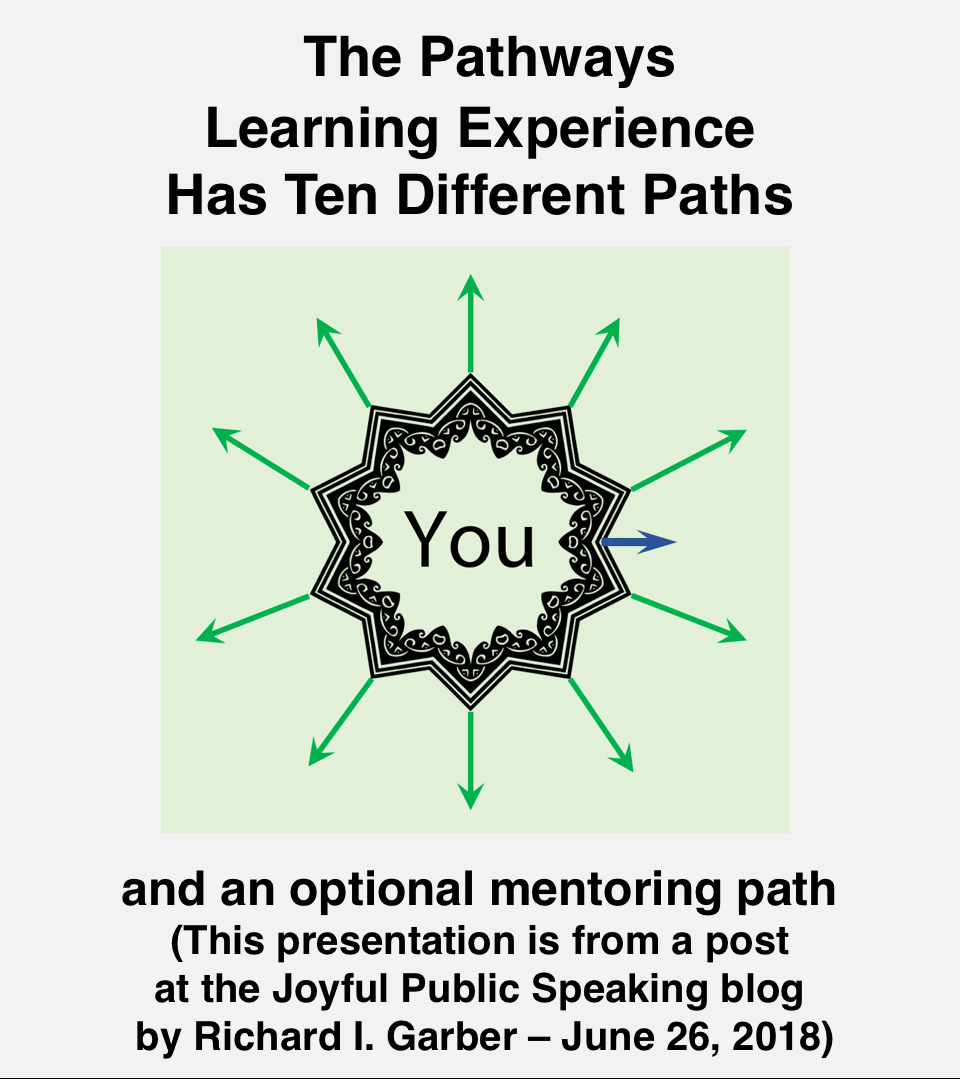
There is an optional Mentoring path with three more projects. It follows the Level 2 project, Introduction to Toastmasters Mentoring. So, as shown above, I will refer to it as Level 2-1/2 (in analogy to the 7-1/2th floor in the 1999 movie Being John Malkovitch. You can find descriptions for those other three projects, Prepare to Mentor, Mentoring, and Advanced Mentoring at district web sites (such as District 1). There is a Pathways infographic showing Mentoring along with the other paths.   
-->


For Level [3] Increasing Knowledge there also are three projects, one of which is required and is unique to each path. (The other two are electives).


Available choices of two elective projects for Level [3], Increasing Knowledge, are shown above.


For Level [4] Building Skills there is one unique required project, except for Motivate Others, which is shared by the Motivational Strategies (MS) and Team Collaboration (TC) paths. (There also is one elective).


Available choices of the elective project for Level [4], Building Skills, are shown above.


For Level [5] Demonstrating Expertise there again are three projects, two of which are required. The second one is Reflect on Your Path. (The third is an elective).


Available choices of the elective project for Level [5], Demonstrating Expertise, are shown above.


The vast majority (81%) of Pathways speeches are 5 to 7 minutes long, as is shown above in a table.


Contrast that with the old ‘traditional’ program, which as is shown above had a much larger variety of speech lengths.

For now I have left off discussing the final Distinguished Toastmaster projects.


Update July 1, 2018


Yesterday I attended the District 15 Division A Toastmasters Leadership Institute, since I will be continuing as Vice President – Public Relations for Saint Al’s Toastmasters. I attended an educational session about Pathways that revealed I’d missed something.


There is an optional Mentoring path with three more projects. It follows the Level 2 project, Introduction to Toastmasters Mentoring. So, as shown above, I will refer to it as Level 2-1/2 (in analogy to the 7-1/2th floor in the 1999 movie Being John Malkovitch). You can find descriptions for those other three projects, Prepare to Mentor, Mentoring, and Advanced Mentoring at district web sites (such as District 1). There is a Pathways infographic showing Mentoring along with the other paths.    


Update July 18, 2018

I have updated this post by incorporating information from the July 1 update.

This post has been viewed over 1430 times, presumably based on my having discussed it over at The Official Toasmasters International Members Group at LinkedIn. If you are in a Toastmasters Club and wish to use it, that's fine with me as long as you say that you got it from here and provide a link to this blog post.

If you would like to translate it to another language, or otherwise want to have the PowerPoint file the images came from to edit a presentation, just email me and I will be happy to email it to you.