Sunday, August 30, 2020

Spouting nonsense: Another 16 books refer to a bogus statistic that 74% fear public speaking (suffer from speech anxiety)


Back on October 9, 2017 I blogged about how It must be true, since I read it in a book. Unfortunately books sometimes are not always backed by careful research. In a another post on August 14, 2020 titled Toastmaster magazine is spreading nonsense from John Bowe about how common the fear of public speaking is I described how John Bowe’s 2020 book I Have Something to Say had incorrectly claimed (using baseless numbers originally posted by Statistic Brain) that:

“According to the National Institutes of Health, 74 percent of Americans suffer from speech anxiety.”

I wondered whether that nonsense also was in other books, so I looked at Amazon, on Google Books, and elsewhere. Sixteen other books had that baseless percentage, so they all get one of my Spoutly awards. In chronological order they are:

2013

Jared Bauman, Simple Steps to Master Public Speaking
“According to a recent fear of public speaking study performed by the National Institute of Mental Health, 74% of people suffer from some form of speech anxiety.”

Cindy Locher, Vanquish Your Fear of Public Speaking
“Fear of public speaking is the number one fear in America. If you're one of the 74% of Americans who fear public speaking, this five-step process can dramatically increase your comfort and confidence.”

2014

Cheryl R. Stinchcomb, Presentation Skills That Rock: captivating your audience in the digital era
“Can you believe that 74% of people suffer from speech anxiety?”

Jennifer Witter, The Little Book of Big PR
“According to the National Institute of Mental Health (NIMH), 74 percent of people have fear of public speaking.”

Bill Hoogterp, Your Perfect Presentation
“According to the National Institutes of Health, 74 percent of Americans suffer from a fear of public speaking.”

2015

Anthony Fasano, Engineer Your Own Success
His Table 6.1 reproduced the numbers from a Statistic Brain web page. (74% of people, 75% of women, and 73% of men suffer from speech anxiety).

Eamonn O’Brien, How to Make Powerful Speeches 2ed 
“According to the National Institute of Mental Health, this fear is so pervasive that 74 per cent of American adults (and the figures are worse elsewhere) admit to some degree of speech anxiety.”


D.J.D. Carducci and Lisa Kaiser, Shyness: The Ultimate Teen Guide
“According to a 2013 report from the National Institute of Mental Health, 74 percent of Americans fear speaking in public, far more than the 40 percent of us who are shy.”

2016

Thomas Miller, Fear Busters: 14 ways to kick fear to the curb
“Studies indicate that 74% of the population is afraid of public speaking and 68% fear dying.”

Kenny Nguyen, Gus Murillo, Robert Killeen, Luke Jones, The Big Fish Experience
“According to the National Institute of Mental Health, the fear of public speaking, which is called glossophobia, is the number one fear in America (that’s right, over spiders, heights, and even death). A whopping 74 percent of Americans are said to suffer from this fear.”

2017

Deborah Shames, Out Front
“This may not sound like a surprising admission, since 74 percent of the US population surveyed in 2013 shares a fear of public speaking.”

2018

Rick Lewis, Confident Under Pressure
“The National Institute of Mental Health reports that 74 percent of people suffer from speech anxiety.”

2019

Sara Latta, Scared Stiff
“According to statistics from the National Institute of Mental Health (NIMH), fear of public speaking is the most common phobia, with nearly three out of every four people (74 percent) surveyed saying they have this fear.”

2020

Cody Smith, Public Speaking Panic: how to go from stage-fright to stage-ready in less than 24 hours
“Not to mention, a whopping total of 74% of people suffer from speech anxiety.”

Alex Crickets, Public Speaking
“Entrepreneur.com has published research from the National Institute of Mental Health, which claims that 74% of adults suffer from a fear of public speaking.”

Michael J. Gelb, Mastering the Art of Public Speaking: 8 secrets to transform fear and supercharge your career
“Seventy-four percent of Americans suffer from glossophobia, the fear of public speaking.”

Back on March 1, 2015 I had blogged about A high mound of manure from Bill Hoogterp about fear of public speaking.

Friday, August 28, 2020

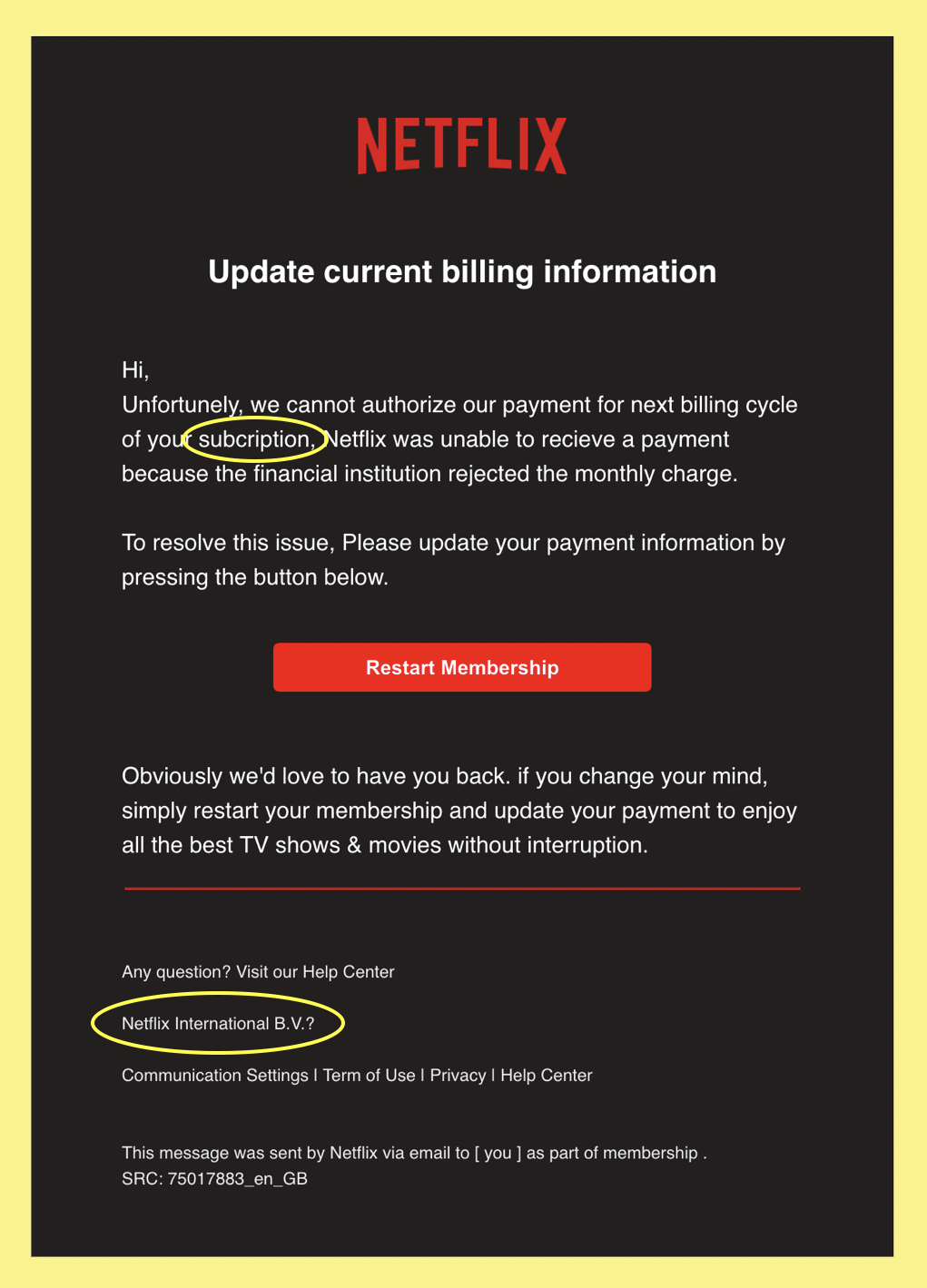
Another fraudulent ‘Nutflix’ email


Yesterday I received another phony email which pretended to come from Netflix.


As shown above, they misspelled the word subscription without the second s. They also had the sender identified as the Dutch Netflix International B.V., and had a question mark at the end.  

Wednesday, August 26, 2020

A little flexibility is crucial


Being too rigid can get you into trouble. A few days ago our laptop computer was misbehaving. Even though the AC adapter was plugged into an extension cord (as shown above) the battery was not charging. The little white LED on the left side of the laptop next to the power connector was staying dark. What had gone wrong?


As is shown above, the two nickel-plated blades on the plug for the AC adapter are quite rigid.


The mating female socket from another disassembled extension cord is shown above. A pair of flexible brass fingers surround each blade so contact can be made. The molded single socket on one side of the extension cord I had used apparently did not have enough flexibility. But when I put the plug into one of the dual sockets on the other side it made contact. Problem solved. I stuck the child-proofing insert in the single plug to remind me not to ever use it again.    

Monday, August 24, 2020

A touching two-minute speech at the Democratic National Convention


I did not watch much of the Democratic National Convention. Later on I watched videos of the very polished acceptance speeches from Joe Biden and Kamala Harris, and Barrack Obama’s 20-minute one.


I had missed this one by 13 year-old Brayden Harrington though. Then I saw an article by John Hendrickson in The Atlantic titled Stuttering Through It. A year ago Mr. Hendrickson had interviewed Biden about his stutter in an another article titled What Joe Biden Can’t Bring Himself to Say.  

Sunday, August 23, 2020

My Tall Tale for a Toastmasters speech contest


At our August 19, 2020 Zoom meeting Pioneer Toastmasters Club held a Tall Tales Speech Contest. I was one of three contestants and came in third. A Tall Tales speech is nominally three to five minutes long (but can run thirty seconds over or under those limits). Its subject should have a theme or plot, and be of a highly exaggerated, improbable nature. My contest speech about the stealthiest cover band in the country was cut down from a 5 to 7 minute humorous speech I had given way back in 2010. I still had some props based on thrift store purchases. Here is the script:


This story is absolutely true, like all the stories I tell you. I heard in Pittsburgh from a friend of Stan Ruckzynski. You’ve never heard of the Ruczynski brothers or their rock and roll band from Youngstown, Ohio. And you never heard them play. They only released one record on their own label. But that’s all right with them. They didn’t have to play to make money. But you probably have heard the name of their band hundreds of times - without ever realizing it.

The four Ruczynski brothers started a band called the Kielbasa Brothers in the late sixties. A kielbasa is a big, long Polish sausage. Their day jobs were making steel pipe at the Youngstown Sheet and Tube mill. Theo played guitar, Leo played bass, Dan played keyboards, and Stan played drums. Every weekend they played covers, versions of other people’s songs. Their gigs were in bars from Pittsburgh to Wheeling. But they never made enough money to quit their day jobs.


In 1975 Theo decided to get advice from the wisest man in the family. Their old uncle Thaddeus, or Tad, worked as an attorney for the Democratic political machine over in Pittsburgh. It started running things back in the mid 30’s and kept on going. They and Tad had their fingers in everything and knew how to make money. Tad listened to Theo and told him to change how you think. You need to become a record company, not just a band. Theo asked how will that help?


Tad explained, “We rename the band Dozens More. Then we trademark and copyright it. We start our own record company and release an album on an LP record. Every night I see TV ads for collections of golden oldies. They all say things like contains ‘Rock around the clock’, ‘ Leader of the pack’ and dozens more. Every time someone runs an ad that says the magic phrase Dozens More I send them an angry letter. It says they damaged us by infringing our trademark and copyright. I tell them they need to change their commercial to remove that phrase. Otherwise we’re going to sue them here in Pittsburgh.” When they ask around, they’ll find they can’t win. I play poker or golf with every judge in town. After a while I will agree to instead settle for some money, provided they don’t tell anyone else. Paying us will be cheaper and easier.


September 19, 1977 was Black Monday in Youngstown. That day Sheet and Tube closed the mill. They laid off 5000 people including all four brothers. That fall lots of Youngstown residents were sitting at home all day watching TV. The difference was that the Ruczynski brothers got paid from doing it. Each brother watched a different network to check out the commercials.


Record companies all over the country and the alphabet tripped over their trademark. Folks like: Atlantic, Columbia, Decca, Mercury, Vanguard, and Warner Brothers. Uncle Tad threatened to sue them all. Enough money rolled in so the brothers never worried about losing their homes. They kept changing formats to keep the album alive. There was a 8-track, and then a cassette, and finally a CD.


Their uncle said that when you pick a few dollars (just a tad) out of enough pockets it adds up to a very nice living. Things picked up further when record companies started running thirty minute long infomercials on late night TV. They definitely didn’t want to redo them. Eventually the story about how Dozens More operated leaked onto the WorldWide Web and blew their cover. But for two decades they were the stealthiest cover band in the country.

  
Very little of that story is true. There never ever was a band called Dozens More. But there really was a guy named Ruckzynski in the Air Force Reserve unit I belonged to in Pittsburgh.

The idea is based on the concepts of a copyright troll and a trademark troll. You do need to have a product to keep a trademark alive. I was making fun of how in trademark law there can be absurdly broad claims. For example, Amstar Corporation, who owned the Domino Sugar trademark once sued Domino’s Pizza to keep them from also trademarking a Domino.  

The image of Jack and the Beanstalk is from a WPA poster at the Library of Congress.

Saturday, August 22, 2020

Jumping from a fear to a phobia


I just ran across an article by Gary Waldon at CEOworld Magazine on August 19, 2020
titled 4 Key ways to get over your fears. His first key is titled Houston we have a problem, or do we? Gary asks:

“How much of a negative impact is your phobia having? My fear of sharks wouldn’t be much of a problem if I didn’t like the ocean. However, I love to surf and my fear was preventing me from indulging one of my true passions so I became motivated to face my phobia. If, as an example, you have a fear of public speaking, but aren’t required to address an audience in your everyday working life, your phobia likely won’t impact your career. Therefore, because the likelihood of you being in a situation where you have to face your fear is low, you will probably not be that motivated to address it and nor would you need to. Assess how much of a problem your phobia is on your life.”


He merrily jumps from a fear over to a phobia. But those are two very different concepts to psychologists and psychiatrists. As shown above via a Venn diagram, a phobia additionally is interfering, persistent, and intense. By definition a phobia always is a problem which interferes with your life. I blogged about this topic on December 8, 2019 in a post titled Toastmasters press releases confuse a fear of public speaking with a phobia.

The cartoon was adapted from one on a Career Change Jump at Wikimedia Commons.

Friday, August 21, 2020

Masks for singing, teaching and speaking


Cloth masks we wear to protect from Coronavirus pose a problem for singers. When you open your mouth to take a deep breath, the close-fitting cloth is sucked into your mouth.  

Yesterday I saw an article from West Virginia University at WVU Today titled The masked singers: How a WVU choir director composed the perfect masks for performance art. Kym Scott designed new masks with built-in frames. The cloth then sits further from the mouth. The new designs provide more volume inside. They still fit well enough to filter most droplets. The article links to a product web site called Sing-Safe. There is a $30 performers mask for singers, and a $28 teachers mask (also for public speakers).   

The cartoon of a glee club was cropped from an 1896 Puck magazine at the Library of Congress.