Sunday, June 10, 2018

Would you believe an airline pilot who said your flight time will be 1 hour and 27 minutes?


Two days ago Darren Fleming posted an article titled Flight time 1 hr and 27 min on The Official Toastmasters International Group at LinkedIn. It previously had appeared on March 1, 2016 both at his blog and at LinkedIn Pulse.  

He said:

“     I love the precision of flying. The captain makes an announcement that we will be pushing back from the terminal in 4 minutes and the flight will take 1 hour and 27 minutes to reach our destination.
      It gives the feeling of certainty. We know the captain is in control and knows exactly what is happening. They don’t say “I think the flight will be about an hour and a half’, or ‘I believe we’ll be taking off to the South.’ The captain is 100% certain.
     This is not arrogance, overconfidence or anything else. It's ownership. The Captain knows they are in charge and directs accordingly.
      As a passenger, I like knowing that the person flying me through the air is in control. They are not second-guessing or believing we will get there. They know and communicate that and we accept it.
      Do you communicate your message with the same level of authority?”


My thoughts are that the pilot is both arrogant and overconfident - someone who doesn’t know the difference between what a flight time calculator program spits out and reality. Flight time includes three different phases -  climbing to cruising altitude, level flight, and descending to land.

1 hour and 27 minutes rather than 26 or 28 is a precision of about 1.1%. That’s a message communicated with an unjustified level of authority. It assumes that during level flight headwinds won’t change, and he (or she) won’t have to change course to avoid turbulence, or go around a storm. And it assumes he won't be diverted by other traffic during descent prior to landing. An article in the Telegraph titled Are you being told the truth about flight times? by Hugh Morris and Oliver Smith on February 28, 2018 pointed out that it is normal to give high estimates for flight time – the URL says Are-airlines-exaggerating-flight-times-so-theyre-never-late.  

I’d be more likely to believe him if he just said 1 hour and 30 minutes.

Saturday, June 9, 2018

What you can learn about speechwriting for children (and their parents) from Fred Roger’s television show Mister Rogers Neighborhood


At The Atlantic web site on June 8, 2018 Maxwell King had an article about his forthcoming book titled Mr. Rogers had a simple set of rules for talking to children. Nine rules for translating into ‘Freddish’ are:

1]  State the idea you wish to express as clearly as possible, and in terms preschoolers can understand.

2]  Rephrase in a positive manner.

3]  Rephrase the idea, bearing in mind that preschoolers cannot yet make subtle distinctions and need to be redirected to authorities they can trust.

4]  Rephrase your idea to eliminate all elements that could be considered prescriptive, directive, or instructive.

5]  Rephrase any element that suggests certainty.

6]  Rephrase your idea to eliminate any element that may not apply to all children.

7]  Add a simple motivational idea that gives preschoolers a reason to follow your advice.

8]  Rephrase your new statement, repeating the first step.

9]  Rephrase your idea a final time, relating it to some phrase of development a preschooler can understand.

For example: 
“It is dangerous to play in the street”
would become
“Your favorite grownups can tell you where it is safe to play. It is important to try to listen to them, and listening is an important part of growing.”

There also is a documentary film which was reviewed at Rolling Stone by Peter Travers in an article titled ‘Won’t You Be My Neighbor?’ is a vital doc that shares Mister Roger’s enduring vision. It also was discussed on NPR. You can watch a trailer for that film on YouTube.

On February 21, 2018 I had blogged about Remembering Fred Rogers and the Children’s Corner. An image of a trolley car was adapted from this one at the Library of Congress.

Tuesday, June 5, 2018

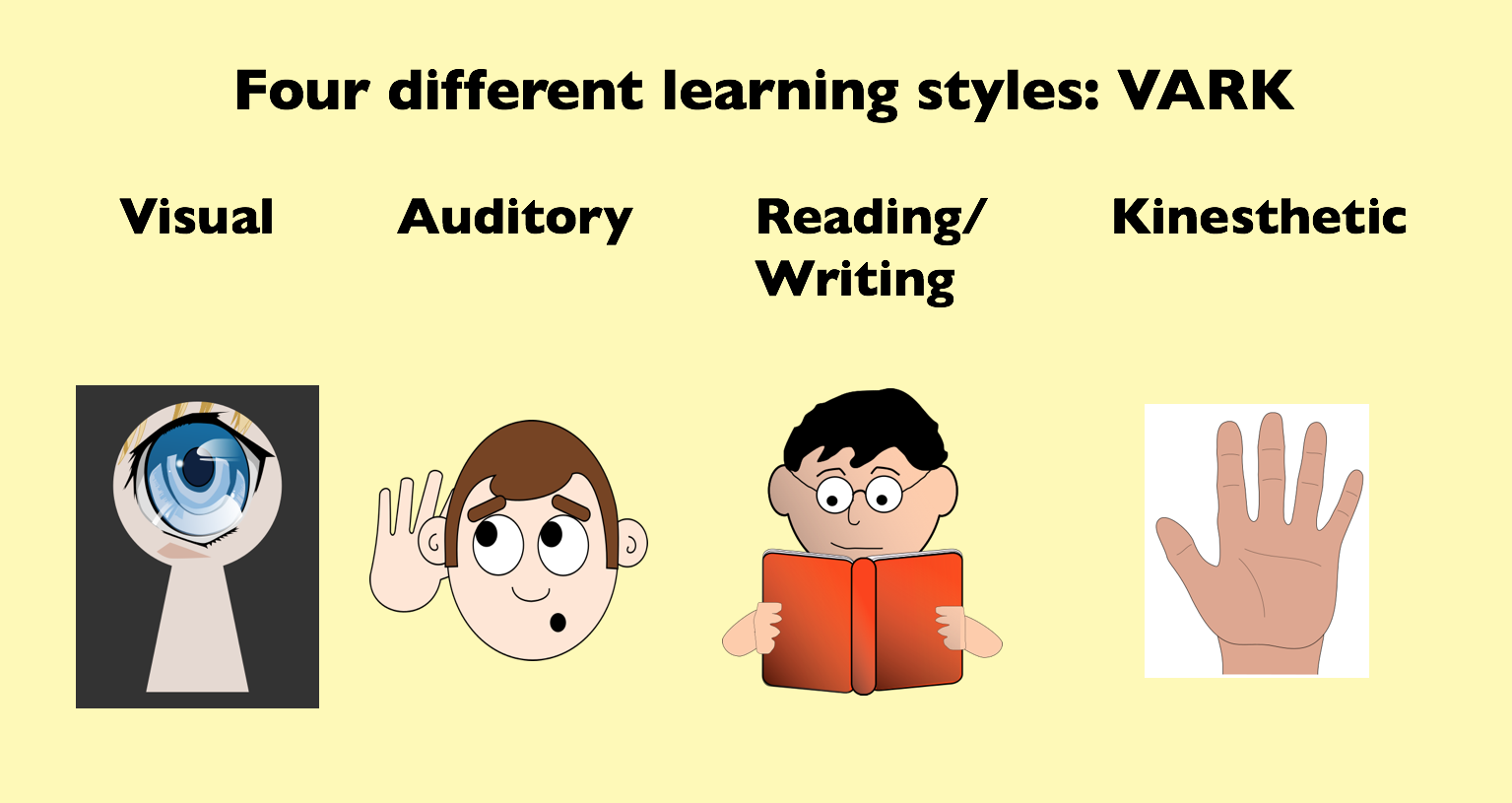
Speakers shouldn’t worry about their audience’s different learning styles


At The Atlantic web site on April 11, 2018 there was an article by Olga Khazan titled The Myth of ‘Learning Styles,’ subtitled a popular theory that some people learn better visually our aurally keeps getting debunked.  

At the Scientific American web site on May 29, 2018 there was another article by psychology professor Cindi May titled The Problem with “Learning Styles. She discussed a recent magazine article by Polly R. Husmann and Valerie Dean O’Loughlin that was in Anatomical Sciences Education magazine titled Another nail in the coffin for learning styles? Disparities among undergraduate anatomy students’ study strategies, class performance, and reported VARK learning styles. You can read the abstract at PubMed. They found that:

Results demonstrated that most students did not report study strategies that correlated with their VARK assessment, and that student performance in anatomy was not correlated with their score in any VARK categories. Rather, some specific study strategies (irrespective of VARK results), such as use of the virtual microscope, were found to be positively correlated with final class grade. However, the alignment of these study strategies with VARK results had no correlation with anatomy course outcomes. Thus, this research provides further evidence that the conventional wisdom about learning styles should be rejected by educators and students alike.”

Nick Morgan briefly discussed learning styles in a November 18, 2014 post on his Public Words blog titled Some myths of neuroscience and public speaking. He said:

“So let go of the idea that you’re required, as a good speaker, to sing to the auditory learners, put up slides for the visual learners, and dance for the kinesthetic learners. That’s bad pedagogy based on bad science.”


But you can’t expect people to learn how to do a dance like ‘The Bird’ from an 8-minute audio recording, like that by Morris Day and The Time. Instead you need to watch their 4-minute YouTube video.   

Monday, June 4, 2018

A presentation slide, presentation, or blog post needs a great headline rather than just a title


On May 29, 2018 at Synapsis Creative Tom Howell had an excellent blog post about The secret to writing slide headlines. I saw it mentioned by Rosie Hoyland in a very brief article on May 31, 2018 at Presentation Guru titled An effective slide begins with a headline. Newspapers (like the tabloids you find at supermarket checkouts) have mastered the art of creating compelling headlines.   

Tom’s first two points were that:
A] Headlines help you stick with one idea per slide

B] Headlines make the argument your slide supports

Then he gave Four Secrets for Writing Slide Headlines:
1.  Say who, what, when, where, and why

2.  Pretend your headlines are the only part they’ll remember

3.  Use simple, powerful language

4.  Use numbers

But presentations (and blog posts) also need headlines, as I have blogged about repeatedly under the label of speech titles.

At the beginning of his post Tom linked to a May 2006 article by Michael Alley et al. in Technical Communication titled How the design of headlines in presentation slides affects audience retention. Unfortunately he didn’t dig deeper and discuss designing assertion-evidence slides. On February 19, 2014 I had blogged about how Assertion-Evidence PowerPoint slides are a visual alternative to bullet point lists.

The tabloid headline Dwarf rapes nun; flees in UFO was the title from a 1985 novel by Arnold Sawislak, which was reviewed in an article at the New York Times titled The unholy grail of Granville Swift.  

Saturday, June 2, 2018

Yesterday’s Dilbert comic strip about motivational speakers


In the first two frames of yesterday’s Dilbert comic Alice says:
“The motivational speaker you hired was great!!! We all decided to quit our jobs and become motivational speakers.”

Other Dilbert comic strips about that topic had appeared on October 29, 2006, May 12, 1995, and May 15, 1993.

In her 2016 book Success Secrets for Today’s Feminine Entrepreneurs: Secrets from Today’s Top Feminine Leaders on Fulfillment, Satisfaction, and Abundance Anita M. Jackson said:
“Mom, Mom! I know what I want to be when I grow up! I want to be a motivational speaker!”

Herman Cain was an unsuccessful candidate in the 2012 U.S. Republican presidential primary, and a successful motivational speaker. But he reportedly said he preferred to be called an inspirational speaker – because only you can motivate yourself.  

UPDATE June 4, 2018

In today's comic when the pointy-haired boss asked how his presentation was, Dilbert replied that:

"The signal-to-noise ratio was impressively low."

But a low signal-to-noise ratio isn't good.

Thursday, May 31, 2018

Pausing properly during your speech


Samuel Clemens, whose pen name was Mark Twain, reportedly once had said that:
“The right word may be effective, but no word was ever as effective as a rightly timed pause.”


One way to think of pauses is the verbal equivalent of punctuation. As is shown above, they can have at least four different lengths, corresponding to commas, periods, paragraphs, and topics (sections). All those lengths typically are not mentioned in discussions of pausing. A post by Keith Bailey on February 12, 2013 at the Decker Communications blog titled Power to the pause mentioned three:
“When there should be a comma, pause for one second. Where there should be a period, pause for two seconds. When you see a new paragraph, pause for three seconds.”

Another post by Noah Zandan on February 19, 2013 at the Quantified Communication blog titled The power of pause similarly said:
“Great public speakers often pause for 2 – 3 seconds or even longer. Punctuation can be helpful for deciding where to insert pauses. We use commas and periods as signs to pause when we are reading. These are the same places to pause when giving a speech. An especially useful strategy is to vary the length of your pauses.”

An article by Patricia Fripp titled Public speaking – the importance of the pause shared Ron Arden’s explanation of three length ranges: ½ to 1 second, 1 to 2 seconds, and 3 to 7 seconds.   

Pauses can be used functions other than punctuation:
At the beginning of a speech

For dramatic effect

After you ask a rhetorical question

After you present data on a slide

For emphasis after you present a key point

After you deliver the punchline of a joke

To recover when you lose your place

Fripp’s article mentioned nine types of pauses, and an article by Esther Snippe on February 7, 2017 at SpeakerHub titled Speak volumes with your silence: 10 ways to use pauses has an infographic with ten.  

A four-minute YouTube video by Darren LaCroix titled Presentation coaching: the pause says that Toastmasters champions paused with purpose. Another four-minute YouTube video by Brian Tracy titled Public speaking tip: the power of the pause is also useful. I was amused by Brian’s constant gesturing, including his use of the ‘sternwheeler steamboat paddle’ gesture - which signals illegal formation in football and traveling in basketball.  

The Twain quote appears in an Introduction by biographer Albert Bigelow Paine to the 1923 edition of Mark Twain’s Speeches. The image of Mark Twain was adapted from a December 16, 1885 back cover of Puck magazine found at the Library of Congress.  

Tuesday, May 29, 2018

‘Et al.’ is a pedantic Latin phrase that doesn’t ever belong in the title of a blog post or a speech


‘Et al’ just is Latin jargon that doesn’t belong in the title of a blog post or a speech. It merely means ‘and others.’ That phrase belongs in a list of references at the end of a scholarly magazine article – where an article has more than three authors, so listing them all would be clumsy.  

But in posts at her Speechwriter-Ghostwriter blog Jane Genova has used it seven times just this year. They were:
May 27, 2018The psychotherapy brand – David W. Harder, et al.

May 2, 2018:  Kathleen Huebner, et al. – No, I do not wish you well

April 17, 2018The law, according to Jones Day, et al.

April 13, 2018Tronc layoff – Why writers, et al., have such tough time exiting comfort zone

March 28, 2018:  Thanh Cong Phan, et al. – perhaps they just wanted to be a “somebody”

February 27, 2018Alexa, et al. – voice tech eliminating traditional brands, consumer choice

February 3, 2018Unlike iGen, our tribe HAD TO meet up in-person – Charlotte Toal, M. Lynn Rickert, et al.

Every week I look at Speaking Pro Central, so I saw her latest post with it on their list of Trending Articles. It’s practically a tidal wave of pomposity!
-->