Showing posts with label ruts. Show all posts

Monday, December 22, 2025

We have always prepared French fries this way, but should we?


I recently got a 2024 book titled The Tried & True Cookbook by Alyssa Rivers from the Boise Public Library. Page 149 in it has a recipe for Air-Fryer French Fries, which also appeared online on October 14, 2023 at her The Recipe Critic web site titled Amazing Air Fryer French Fries.


In the book, her second step is to slice the potatoes into 1/4” strips. The third step is to:


“Rinse the fries in cold water, and pat them dry with a paper towel.”


A Note at the bottom of the page adds:


“Don’t skip rinsing the potatoes. This step is important because it gets rid of the starch, which allows the potatoes to get nice and crispy as they cook. Just be sure to dry them really well before cooking.”   


I have a criticism for that recipe critic. Why the heck are you wasting paper towels? You could just dump the potatoes into the bowl of your salad spinner (as is shown above), soak them in water to better remove starch, and dry them by spinning? But her list of Essential Kitchen Tools on page 14 of her Tried & True Cookbook does not list a Salad Spinner.


Similarly, most recipes I had seen for Boston Brown Bread call for that quick bread to be steamed in a coffee can for a couple hours and then sliced (as also is shown above). I never ever tried making it myself - until I saw page 244 in the 1998 book by Mark Bittman titled How to Cook Everything: Simple recipes for great food. He says instead to bake it at 300 F for an hour in 8” by 4” loaf pans. Back around the American Revolution our ancestors had to steam it, since they had no ovens in their kitchens – but we certainly do. Mark’s description for The Basics of Miscellaneous Tools says on page 5:  


“Salad Spinner: Nice item, and not only for drying salad greens. It’s excellent for dunking anything that you want to rinse and drain repeatedly. Not essential, but close.”


Think about how you cook, and don’t get stuck in a rut. On December 7, 2020 I had blogged about What are you doing in that recipe, and why are you doing it? Earlier, on March 12, 2019, I blogged about Does the Dalai Lama eat a bowl of oatmeal for breakfast? In that post I noted:


“It is dangerous to assume that everyone else obviously does things the same way as we do.”


Images of French Fries and Boston Brown Bread came from Wikimedia Commons.


Monday, September 18, 2023

A memorable speech by Charlie Munger on How to Guarantee a Life of Misery


Inspirational speeches (like commencement addresses) typically tell us how to be successful or happy. But on June 3, 1986 Charlie Munger, the Vice Chairman of Berkshire Hathaway, instead gave a 2012 word speech titled How to Guarantee a Life of Misery. You can read a full transcript on James Clear’s web site. Assuming a speech rate of 125 words per minute, his speech would have a TED Talk length of 16 minutes.


There is an article by Polina Pompliano at The Profile on May 27, 2020 titled The Profile Dossier: Charlie Munger, the Master of Mental Models. It discusses his use of inversion – flipping things over. Also, there is another article by Christopher Dwyer at Psychology Today on July 27, 2023 titled Could inversion improve your decision-making?


On January 12, 2014 I published a blog post titled Don’t just get on the bandwagon! Find your own speech topic and approach. The third approach I listed was to Flip Things Over. As an example, I referred to a post on June 24, 2008 titled Don’t be a “Flip Chart Charlie” – where instead of a How-To, I described How-Not-To.


The miserable cartoon was adapted from here at Openclipart.  


Monday, December 7, 2020

What are you doing in that recipe, and why are you doing it?


When following a cookbook recipe, you may get stuck in a rut and just put your brain on hold. My wife and I enjoy watching the America’s Test Kitchen TV show. A couple years ago I bought her a 982-page 2017 hardcover book -  The Complete America’s Test Kitchen TV Show Cookbook. I’ve been reading it, and noticed some questionable things.  


Let’s look at shrimp. My first example is shrimp burgers, on page 572. Their recipe also appeared in an article on July 29, 2019 at the Associated Press titled How to make a moist, chunky shrimp burger without the mush. It calls for 1-1/2 pounds of extra-large shrimp (21 to 25 per pound), peeled, deveined, and patted dry. Then those shrimp are pulsed to chop them in a food processor. Why did they need to be the more expensive extra-large variety? Wouldn’t large or medium shrimp have worked just as well? There also is a YouTube video titled How to make crispy shrimp burgers. It does instead call for large shrimp (26 to 30 per pound). My second example is a recipe on pages 454 and 455 for Indonesian-Style Fried Rice which also is at their web site. It also calls for extra-large shrimp but then cuts them crosswise into thirds. Again, large shrimp cut in half would work (or whole medium shrimp).


Pages 632 and 633 of the cookbook have a recipe for poached eggs. Under WHY THIS RECIPE WORKS it claims:


“A touch of vinegar lowered the boiling point of the water so that we were able to cook the eggs over more gentle heat.”


But the actual recipe has you put the eggs into the pan of boiling water and then immediately remove the pan from the heat. Therefore the boiling point is irrelevant. An article by Robert Keyzers at the Victoria University of Wellington on November 28, 2019 titled Why do we add vinegar when we are poaching an egg? explains instead that vinegar makes the water more acidic and thus helps coagulate the egg white. Another article at The Splendid Table on April 5, 2017 titled Perfect poached eggs with America’s Test Kitchen agrees. It says that:


“We also tried vinegar, which is something that people have been doing for generations. The reason why it actually makes sense : it lowers the pH of the water, causing the egg whites to set at a lower temperature.”     


There is a several decades-old story about blindly following a recipe from your grandmother for making a pot roast. She had called for cutting off both ends (shown above), so your mother also did that, and then so did you. An article at Snopes on November 9, 1999 titled Grandma’s cooking secret explains what went on. Grandma had to cut the ends off because she didn’t have a big enough pot to hold the original length of meat. A similar tale is told by Tom Jupile at the Chromatography Forum on November 21, 2005 in an article titled The original “grandma’s ham” story. Back on December 23, 2012 I blogged about Learning from two kinds of articles or books: recipes or mindless rules versus methods or ratios.


The image of a shrimp burger (from KFC in Vietnam back in 2007) came via Kham Tran at Wikimedia Commons.


Monday, December 18, 2017

Is it still cornbread if it has more flour than cornmeal?


I don’t think so. My idea of what cornbread should be comes from before I was five years old. Back then we lived in Knoxville, Tennessee. True southern cornbread has all (or mostly) cornmeal and minimal amounts of flour, no sugar, and the liquid is buttermilk.

But over at the Ada County Library I found the 1999 New England Cookbook by Brooke Dojny. On page 451 it had a recipe for Crusty Cornbread, Muffins, or Sticks which had 1-1/4 cups of flour and only 3/4 cup of cornmeal. I would call that corn-flavored bread, and consider it heresy.


The table shown above compares several versions of cornbread. (Click on it for a larger, clearer view). Two of them are from Bill Neal’s 1990 book, Biscuits, Spoonbread and Sweet Potato Pie. One for Northern Cornbread is from the 1997 Joy of Cooking, a fourth is from a web page for Bob’s Red Mill, and the heretical fifth is from the New England Cookbook.

What’s a corn stick? It’s the analog of a breadstick, made by pouring the batter into a cast iron pan with a series of cavities shaped like miniature ears of corn. See this web page on Understanding Corn Stick Pans.

Early experiences shape our views, and as I blogged about back in 2010, we decide Everybody does it this way, don’t they?

The image of cornbread came from Wikimedia Commons.

Thursday, March 30, 2017

What spices are in your speechwriting style?


I am a nerd, so I have been enjoying reading Ben Blatt’s 2017 book Nabokov’s Favorite Word is Mauve, which is subtitled What the numbers reveal about the classics, bestsellers, and our own writing.  The introduction describes how in 1963 Frederick Mosteller and David Wallace used statistics to figure out whether Hamilton or Madison wrote some of the disputed essays in The Federalist Papers.

A section that starts on page 164 is titled What’s Your Favorite Word, and it states Ray Bradbury said his favorites were ramshackle and cinnamon.

At the Grocery Outlet I recently bought a package of Cinnamon Spice Crisps (cookies from Germany). A smaller legend on the package described them as Traditional European Spekulatius Cookies. On the back of the package a mix of six spices was listed: cinnamon, coriander, anise, cloves, fennel seed, and cardamom.   

On page 170 Mr. Blatt defined “cinnamon words” as words where:

A]  It must be used in half an author’s books.

B]  It must be used at a rate of at least once per 100,000 words throughout an author’s books

C]  it must not be so obscure that it’s used less than once per million in the Corpus of Historical American English

D] It is not a proper noun


On pages 173 to 176 he presented tables with the top three cinnamon words for a hundred different authors. The table shown above is a sample of ten. From those three words, you can get a very good sense of what C. S Lewis, J. K. Rowling, Lemony Snicket, and J. R. R. Tolkien were writing about.

 He also defined more common “nod words” as words where:

A]   It must be used in all of an author’s books.

B]   It must be used at a rate of at least 100 per 100,000 words throughout an author’s books

C]   It must not be so obscure that it’s used less than once per million in the Corpus of Historical American English

D]   It is not a proper noun


The table shown above is a sample of the same ten authors for nod words. From those three words, you can only tell what J. K. Rowling and Lemony Snicket were writing about.


Mr. Blatt also discusses the top ten most popular three-word sentence openers. On pages 153 and 154 he shows tables with them for nine novels. I have shown a sample of three above for The Adventures of Tom Sawyer, To Kill A Mockingbird, and Pride and Prejudice.


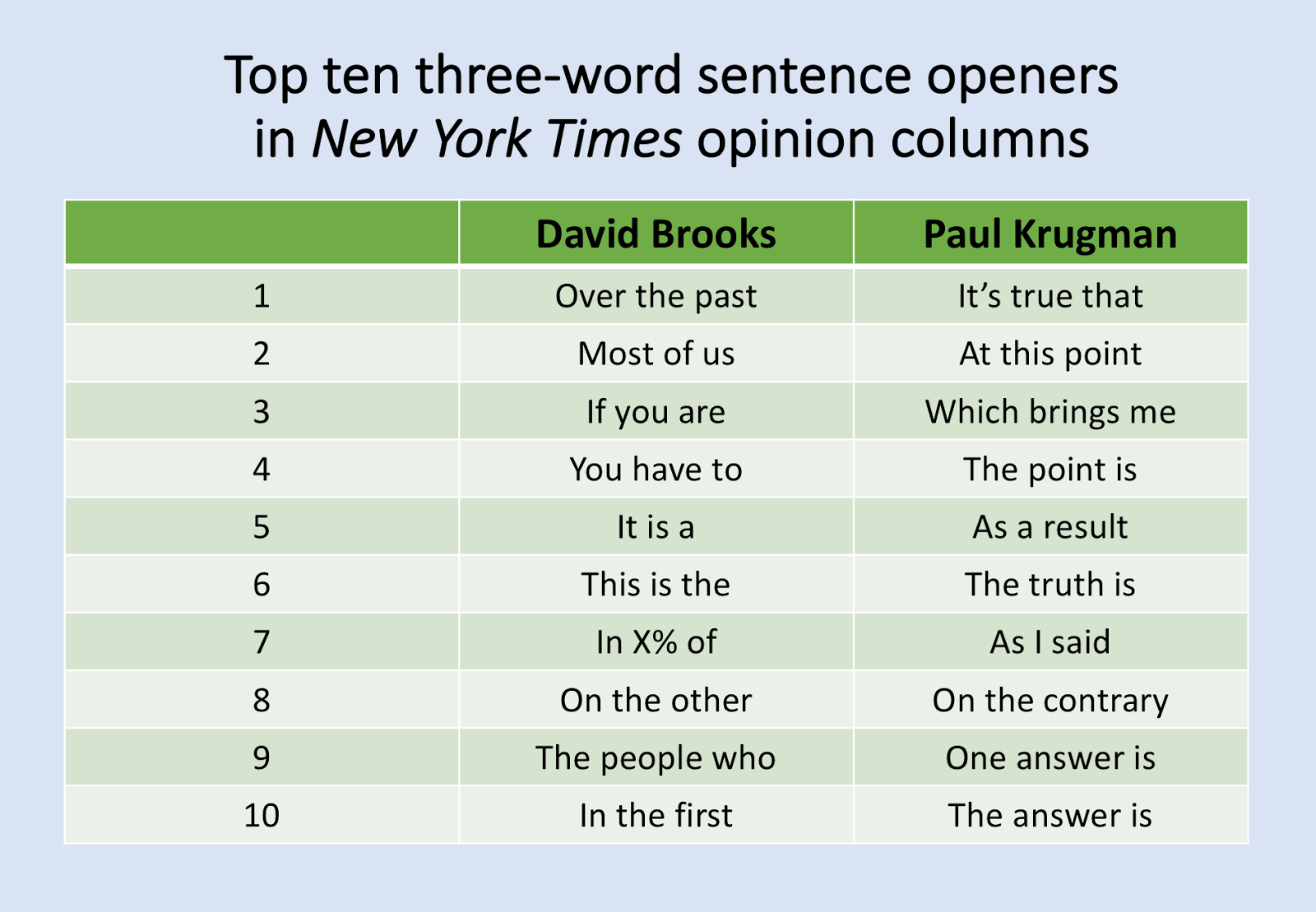
On page 148 he compared the top ten most popular three-word sentence openers for two New York Times opinion columnists – David Brooks and Paul Krugman. As is shown above, they have distinctly different styles.  

Another way of looking at writing is via a grade level formula. On page 107 Mr. Blatt mentions the Flesch-Kincaid Grade Level, for which the formula is:

0.39 x (total words/total sentences) 
+ 11.8 x (total syllables/total words) – 15.59

He mentions on page 108 that the Dr. Seuss book Green Eggs and Ham has a Flesch-Kincaid Grade Level of -1.3, in contrast with William Faulkner’s The Sound and the Fury at 20.

On page 109 he refers to an article in The Guardian on February 12, 2013 titled The state of our union is …dumber which showed the grade levels for our presidential State of the Union Speeches.

Friday, April 29, 2016

Find your own darn speaking style


Last week in Idaho City I saw the customized Chevrolet pictured above. What the builder of this coupé utility stake truck did starting from a Chevrolet Bel Air inspired the title for this post.

Back in 1959 Chevrolet began producing the El Camino (Spanish for “The Way”) - a coupé utility pickup. This vehicle isn’t an El Camino. Instead it’s a Mi Camino - My Way, like the Frank Sinatra song. The El Camino hid its spare tire either behind the passenger seat or under the bed. This vehicle has its two spare tires displayed very prominently.  

Last March I blogged about What’s your speaking style more like: Teppanyaki, Flambé,or Flying Greens? and in 2014 I blogged about Don’t just get on the bandwagon! find your own speech topic and approach.

Wednesday, January 22, 2014

Don’t just get on the bandwagon! Find your own speech topic and approach


It’s easy to get into a rut, and pick a stale speech topic or point of view. Here are some suggestions for getting more creative.


Look someplace great - either very big or very small


Don’t just do a wide open Google, or Bing, or Yahoo web search. (On Google you can limit to Adobe Acrobat files by adding filetype:pdf).

Look at the huge, free PMC (PubMed Central) database of almost three million biomedical and life sciences full-text magazine articles. A keyword search there on “storytelling” led me the the article about the Giant Inflatable Colon that I blogged about on January 15th. That keyword also led me to some articles on stories told by family physicians I blogged about last August.

Don’t just look around on the open web. Go to the web site for your public library. Then search in their databases for magazine articles. Use your library card as the key to unlock a better collection of information. Those databases even have subject indexes.

Or go look at the Alltop Speaking digital magazine rack of titles for the five most recent blog posts from about 80 different places. The title for this post was inspired by a post on Susan’s Blog.  

Look at the web archives for Toastmaster and NSA Speaker magazines. For example, the November 2013 issue of Toastmaster has an article by Denise Graveline on Speechwriting Secrets. Denise blogs as The Eloquent Woman, which is listed at Alltop Speaking. 


Find something local


Last April I saw a newspaper article about a memorial honoring Jesus Urquides, a Mexican-American pioneer. Over at the public library I found Max Delgado’s 2006 book Jesus Urquides: Idaho’s Premier Muleteer. There is a wild story about how he once used a cluster of 35 mules to carry a six-ton coil of wire rope for an aerial tramway 70 miles from Challis over the mountains to the Yellowjacket gold mine. (The mosaic shown above is on the Capitol Boulevard Bridge in Boise).   


Flip things over


Instead of a “How-to” speech, do a "How-not-to” speech. My first  blog post on flip charts was Don’t be a “Flip Chart Charlie.”

Louis L’Amour wrote a whole bunch of novels about cowboys in the old American West. Then he once went completely out of that formula. Louis flipped things from West to East (Siberia), from cowboy to Native American, and from old west to the present, and created Last of the Breed. 


Pick a different viewpoint


Take a very long or a very short view of things. What does an extreme close-up view of the frost on my car roof look like? The lens on my decade-old Nikon Coolpix 995 camera can swivel (for things like self-portraits), so I pointed it downwards,  sat it on a piece of 2”x4” lumber, set the self-timer, and used a flashlight for side lighting. I expected mainly to see hexagonal ice crystals, but there were also lots of rectangles. The area shown is about half the original image, and is only about 0.3-inch wide.     


Find a different graphic


Speaking of self-portraits, the most “far out” one I know of (shown above) was taken by NASA’s Curiosity Mars Rover. The cartoon of a bandwagon came from the Library of Congress web site, and is from way back in 1896.

UPDATE

Under Find something local I mentioned a newspaper article about Jesus Urquides. I looked up more information, and on February 5th I blogged about Mules over mountains - a wild mining story from old Idaho.

Sunday, December 12, 2010

Do something surprising!


It’s very easy to get into a rut and use the same cliches everyone else does. Why not do something surprising and go off in an entirely different direction?


Louis L’Amour wrote 89 novels, almost all of which were Westerns. I once read that the supply boats for offshore oil rigs on the Gulf coast used to deliver and swap them by the boxful.

Mr. L’Amour also tried turning that genre inside out. His novel Last of the Breed is an Eastern in which a Native American test pilot had been shot down over the Soviet Union, and then escapes from a prison in Siberia. He flees to the east toward the Bering Strait, pursued by a Yakut trapper.

The image of a fork in the Oxbottom Road is from Nigel Freeman.

Sunday, January 25, 2009

Get out of a rut and add some pep

One public speaking trap for folks in marketing, sales, or training is that constant repetition eventually can lead to a bored, emotionally disconnected delivery. An article by David Stoppard in Presentations magazine back in 2005 discusses how to Put Some Pep Back Into Your Speaking Style.
One of David’s suggestions is to change your persona. I saw this done yesterday morning at the Toastmasters Leadership Institute here in Boise. George Jolley of Boise Club (aka Club 61) was Toastmaster for the meeting, but appeared as “Ralph Smedley” (the founder of Toastmasters International who died in 1965).
Recently I experienced getting in a rut. I was trying to finish the Technical Presentations manual at Toastmasters. The fourth project was presenting a technical paper (in 10 to 12 minutes). I had been avoiding doing it, although I previously had given that paper (as much longer presentations) four different times.
The topic of the paper was corrosion failure analysis of fire sprinkler systems. I gave it at the annual NACE Corrosion conference in New Orleans back in 2004, and also at the SIEO/NACE Winter Symposium in Sun Valley, Idaho in January 2008. Between those two presentations to corrosion professionals I also gave it at two different chapter meetings of the Society of Fire Protection Engineers.
I had to completely reorganize the presentation for the nontechnical audience at Toastmasters. My focus had to switch from specific details to general concepts.
There are other possibilities for completely changing the style of a presentation.
You could try giving part (or even all) of your presentation in verse. In a recent blog post Nick Thomas discusses Speechwriting in verse? Well, you could do worse! If you can’t write poetry, you can even buy it from places like the Poem Store.
The next step up from poetry is to add music and turn your presentation into a song. If that is not difficult enough, then you also could try singing a capella, like in this segment with Stan Rogers performing part of his song, Northwest Passage. It sounds like an ancient sea shanty, but Northwest Passage was the title song of his last album (released in 1981).
Or, you even could package a song as a rap music video (complete with karaoke lyrics), like the very geeky Large Hadron Rap. This video is about the Large Hadron Collider (LHC) recently built by the European Organization for Nuclear Research (CERN). It is pretty amazing to see an abstruse topic like particle physics explained in less than five minutes.