Maria Bamford was included in Chris Salierno’s blog post, about 5 Comedians That Will Make You A Better Public Speaker. Maria grew up in Duluth, Minnsesota and moved to Los Angeles. She is both a comediene and a voice-over artist. Maria turns everday situations into surreal ones.
Watch her portray a troubled teen trying to sell her parents on becoming a roadie for a rock and roll band.
Here she outlines a generic political campaign speech, with a vague plan to eradicate sadness.
Maria has appeared on the syndicated Bob and Tom morning radio show. Here she describes working in an office as a temporary employee.
Watch her face as she discusses the Delilah evening radio show and internet dating.
Wednesday, January 11, 2012

Tuesday, January 10, 2012
Watching the comedians #1: Mike Birbiglia
Back on July 22nd of 2011 I read a post by Chris Salierno on his blog, The Curious Dentist, about 5 Comedians That Will Make You A Better Public Speaker. They were: Louis C.K., Mike Birbiglia, Paul F. Tompkins, Maria Bamford, and Patton Oswalt. I wasn’t familiar with them, but eventually I began looking at YouTube videos of them all to collect some examples that might help speakers learn.
In Comedy: A Means to an End you can see how Mike Birbiglia uses gestures and both variations in volume and rate to tell his stories. He also mentions how different oral storytelling and books are.
Watch him tell a profane story regarding a big mistake he made during a speech at the baseball MVP awards. The simultaneous translation for the deaf gets very curious after about two minutes.
Back in 2008 Mike also did an eight-minute routine on the Conan O’Brien show. He describes being examined and operated on for a bladder tumor when he was just nineteen. Mike turns a very serious topic into comedy, with some profanity. Watch how he describe a cystoscope by using the microphone stand as a prop.
In Comedy: A Means to an End you can see how Mike Birbiglia uses gestures and both variations in volume and rate to tell his stories. He also mentions how different oral storytelling and books are.
Watch him tell a profane story regarding a big mistake he made during a speech at the baseball MVP awards. The simultaneous translation for the deaf gets very curious after about two minutes.
Back in 2008 Mike also did an eight-minute routine on the Conan O’Brien show. He describes being examined and operated on for a bladder tumor when he was just nineteen. Mike turns a very serious topic into comedy, with some profanity. Watch how he describe a cystoscope by using the microphone stand as a prop.
Sunday, January 8, 2012
Don’t give a killer motivational speech

When I read the December 14th blog post by Ben and Kelly Decker on The Top Ten Best (and Worst Communicators of 2011 there was one name glaringly missing from their worst list. That was James Arthur Ray, who also wasn’t listed for either 2009 or 2010.
Mr. Ray is a well-known motivational speaker, author, and proponent of the Law of Attraction. A 2008 article in Fortune called him “The man who would be Robbins, Covey, and Chopra.”
On October 8, 2009, as part of a “Spiritual Warrior” program he led a “sweat lodge” program in a mostly enclosed sauna-like space heated by pouring water over hot rocks. Before it began he reportedly told participants that although they might feel like they were going to die they would not. But, three people did die - Kirby Brown, Liz Neuman, and James Shore. Mr. Ray literally gave a killer motivational speech.
James Arthur Ray eventually was tried in Yavapai County, Arizona. On June 22, 2011 he was found guilty on three counts of negligent homicide. Those events are discussed here. Finally, on November 18th, he was sentenced to two years in prison. His attorneys, whose fees already have cost him $5.6 million, are appealing that verdict.
Mr. Ray displayed an amazing combination of arrogance and ignorance. The hazards resulting from combinations of heat and humidity are well-known and thus preventable. For another example, see this simple chart. This August OSHA even released a free heat safety App. Yet, reportedly Ray didn’t even have a thermometer in the so-called sweat lodge he was running (and also, of course, no way of measuring humidity).
Friday, January 6, 2012
Using a metaphor to explain technology
Someone recently asked me about a backup solar power generator system they saw advertised for less than $2000. The large print emphasized that it had an 1800 watt inverter, along with 90 watt solar cells and a battery pack. They asked me what that all meant, and whether the system was worth buying for their rural home. I explained the system with the familiar metaphor of a bathtub and its piping.

The storage battery is like a bathtub full of energy. In the example shown above, it has a capacity of 900 watt-hours (a 12 volt, 75 amp-hour battery pack). The system includes an AC charger for the battery, so when the power goes off the tub is full.
While the AC power to our house is off, we can drain power from the battery (empty the tub) at some rate, and turn it into 120-volt AC power via the inverter. At night, if we kept 75 watts of lighting (five 15W compact fluorescents) plugged in for six hours we’d have drained off half of the battery capacity. After 12 hours in the dark, we’d have completely emptied the battery. (At the rated inverter power of 1800 watts, it only would take 1/2 hour for us to empty it).
The 90 watt solar cell panel is like a faucet for slowly refilling the tub during the day. That solar panel could keep up with any load of 90 watts or less, so if we started with a full battery it would stay charged until darkness fell. (With no load it would take 10 hours to recharge an empty battery).
This bathtub metaphor lets us think simply about how the battery capacity (tub size), solar panel size (faucet) and load (drain) determine system behavior. Whether this backup system makes sense for a home depends on the loads it will see over an entire day. We need to start from a careful load analysis.
Even an efficient full-size refrigerator could consume more than 1000 watt-hours per day. So, we probably would need either a smaller refrigerator, or a bigger generator system. But, for the first day of an outage the refrigerator might stay fairly cold even without being plugged in.

When we compare that backup system with a serious 1000 watt system for continuous use off-grid as shown above, we can see why the ad for that backup system emphasized the inverter size. That inverter really is the least expensive part of the system. An off-grid system could cost about $16,000 including an engine generator for use on cloudy days.
For continuous use, the solar panels have to be able to supply the average power being drained. That is why a realistic system is specified based on their output (1000 watts) rather than the inverter capacity (2500 watts). Also, note how much larger the battery is (15,000 watt-hours versus just 900 watt-hours).
The bathtub metaphor is useful for thinking about how a backup power system works. Reality is more complicated. Solar panels typically don’t produce their rated output, and there are energy losses both in charging the battery, and converting the output to AC. You can read lots more details in Home Power magazine, or on their web site.

The storage battery is like a bathtub full of energy. In the example shown above, it has a capacity of 900 watt-hours (a 12 volt, 75 amp-hour battery pack). The system includes an AC charger for the battery, so when the power goes off the tub is full.
While the AC power to our house is off, we can drain power from the battery (empty the tub) at some rate, and turn it into 120-volt AC power via the inverter. At night, if we kept 75 watts of lighting (five 15W compact fluorescents) plugged in for six hours we’d have drained off half of the battery capacity. After 12 hours in the dark, we’d have completely emptied the battery. (At the rated inverter power of 1800 watts, it only would take 1/2 hour for us to empty it).
The 90 watt solar cell panel is like a faucet for slowly refilling the tub during the day. That solar panel could keep up with any load of 90 watts or less, so if we started with a full battery it would stay charged until darkness fell. (With no load it would take 10 hours to recharge an empty battery).
This bathtub metaphor lets us think simply about how the battery capacity (tub size), solar panel size (faucet) and load (drain) determine system behavior. Whether this backup system makes sense for a home depends on the loads it will see over an entire day. We need to start from a careful load analysis.
Even an efficient full-size refrigerator could consume more than 1000 watt-hours per day. So, we probably would need either a smaller refrigerator, or a bigger generator system. But, for the first day of an outage the refrigerator might stay fairly cold even without being plugged in.

When we compare that backup system with a serious 1000 watt system for continuous use off-grid as shown above, we can see why the ad for that backup system emphasized the inverter size. That inverter really is the least expensive part of the system. An off-grid system could cost about $16,000 including an engine generator for use on cloudy days.
For continuous use, the solar panels have to be able to supply the average power being drained. That is why a realistic system is specified based on their output (1000 watts) rather than the inverter capacity (2500 watts). Also, note how much larger the battery is (15,000 watt-hours versus just 900 watt-hours).
The bathtub metaphor is useful for thinking about how a backup power system works. Reality is more complicated. Solar panels typically don’t produce their rated output, and there are energy losses both in charging the battery, and converting the output to AC. You can read lots more details in Home Power magazine, or on their web site.
Wednesday, January 4, 2012
That’s not the switch for the conference room lights!

Computerworld magazine has a featured blog called Shark Tank with stories about what really happens in the world of tech support. Six years ago they published a tale that can be told by dividing what happened into good news and bad news.
The bad news was that a secretary put in a frantic call lamenting how her computer display had gone blank - right as she was in the middle of typing a document her supervisor said he needed ASAP.
The good news was that the problem was fairly obvious. When the support person asked if the power light on her personal computer (down on the floor) also was off, she said yes. When did it go off? The same time that ALL the room lights went off.
The bad news was that the support person couldn’t get in touch with maintenance by phone.
The good news was that maintenance already was busy responding.
The bad news was that one of the company administrators had been giving a presentation in the conference room. He couldn’t find the light switch when he was ready to start projecting his PowerPoint. So, he stormed into the nearby custodial closet and decisively flipped a switch - which turned out to be the main circuit breaker for that entire floor.
The good news was that he couldn’t blame his secretary for being late because he’d caused the problem. Also, the maintenance man managed to keep from laughing while he showed the administrator where the light switch really was.
APPENDIX
The bad news was that turning off more than just the lights can have very unpleasant side effects. When you turn a water pump off, you can generate a large transient pressure in pipes or tubing - known as water hammer. I know of an incident where water hammer blew a rubber hose for chilled water off of a tapered push-on fitting on a piece of equipment. Naturally this happened in a room with a sunken floor. The pond already was a few inches deep before someone spotted the flooding, shut the water off, and got out a wet/dry shop vacuum cleaner.
The good news was that equipment had been idling so it didn’t overheat, and there were no other electronics down near the floor to get dunked and ruined.
Tuesday, January 3, 2012
Preparation is vital before you use a quotation

The right quotation can wow your speech audience with borrowed brilliance. The wrong one can make you feel like a monkey, and wish you hadn’t used it.
In a December 29th post on her Pivotal Public Speaking blog, titled Preparation - Vital, Bronwyn Ritchie quoted Pennsylvania State University head football coach Joe Paterno as saying that:
“The will to win is important. But the will to prepare is vital.”
I got a different message about preparation than she intended. Since November 9th, when he got fired over a child abuse scandal before he could retire, the coach had gone from famous to infamous. But, Bronywn is down in the Brisbane, Australia area and obviously hadn’t yet gotten the news. (She was horrified when I commented on her post). Even a quick look on Wikipedia before she used the quote again would have shown her that things had changed drastically.
She isn’t the only one to have used that quote recently. Scott MacDonald in Calgary, Alberta tweeted it on December 19th. Also, District 86 Toastmasters printed it on page 5 of the program for their Fall 2011 meeting held in London, Ontario on November 25 - 27, 2011. (They may have printed their program before the scandal was news).
Loyola University Chicago had placed the quote on the wall of their new Norville Center for Intercollegiate Athletics, which only opened on March 3, 2011. By mid-December they had covered it up with a poster while deciding how to permanently remove it.
The speak-no-evil image borrowed from that of the famous three monkeys came from Wikimedia Commons.

Sunday, January 1, 2012
Resolve to anticipate “shoelace failures” and plan around them

Every component or product has a normal way of wearing out and failing. For a shoelace, the failure location is at the top eyelet. That’s because most of the sliding motion during tightening occurs there, and the knot also is pulled tightest there. We aren’t at all surprised when a shoelace breaks at that location. If it failed at another location we would suspect something unusual had happened - like a knitting problem, or that cigarette ash had been dropped there and burned it.

Batteries in a presenter remote or a laser pointer will wear out and need to be replaced eventually. We can plan ahead to anticipate that normal problem. Carry a spare set of fresh batteries to keep that component from causing us a problem during a PowerPoint presentation.
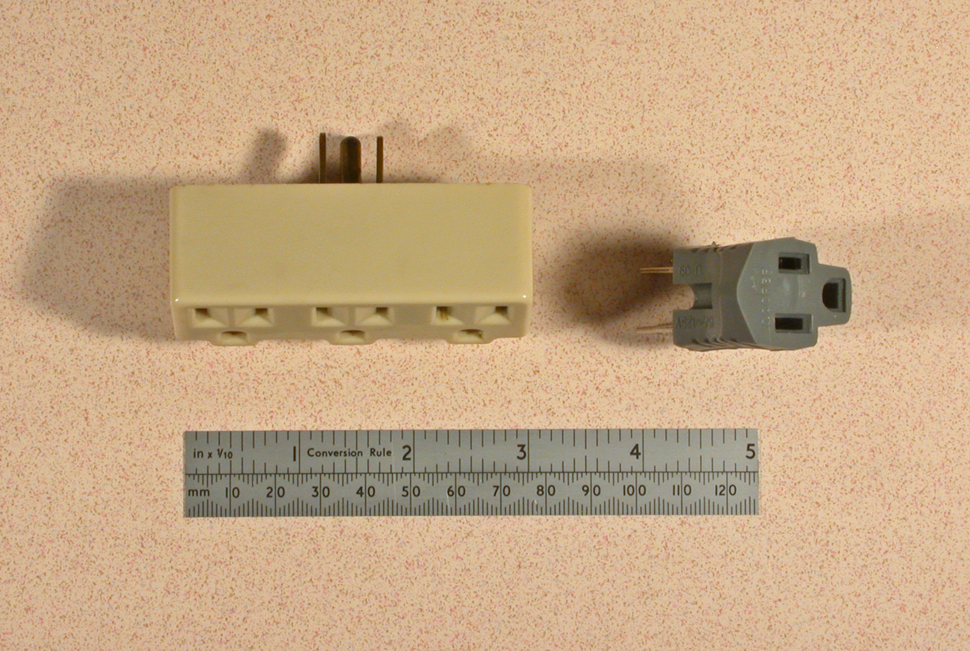
At the end of a post last February about checklists, I mentioned three other simple things I also carry along with an extension cord. One is a three-way adapter for my laptop and projector, and a second is a two-prong adapter (for ungrounded outlets sometimes found in historical buildings). A third a wooden block for tilting my projector upwards. (Long ago I usually could find an ashtray in the room, but not anymore).
Donald J. Wulpi’s book on Understanding How Components Fail used the example of a shoelace in his first chapter. You can see a preview at Google Books.
Subscribe to:
Posts (Atom)