Tuesday, February 2, 2021

Better audio at Zoom meetings: microphones and speakers


Audio is an important part of a Zoom meeting. I am a member of two Toastmasters clubs, so I have gradually learned how to use Zoom. A voice goes through a microphone, computer, Zoom software, and a speaker before you hear it. Anthony English has a seven-minute YouTube  video titled Zoom Audio Test (step by step tutorial). 


Desktop computers typically used modest speakers like the 3” wide ones shown above. But laptops have even smaller, tinnier speakers that only provide half-decent quality. Consider using external speakers.


A laptop computer typically has a tiny electret microphone located above the top of the screen, next to the webcam. When you move back from the camera, you also move away from the microphone and then may not be heard clearly.


This problem can be solved by instead using a lavalier (lapel) microphone clipped to your shirt, as is shown above.


Or you can get a headset with a noise-cancelling microphone and headphones. For $30 I got a Logitech H390 USB headset (shown above). It has an eight foot cord, which gives me room to move around. There also are wireless headsets.     


Anyhow, what is a lavalier? I’d heard of musketeers and grenadiers, so a lavalier might be a fierce Hawaiian warrior who throws balls of lava. But lavalier really is a jewelry term for something hung around the neck. It is named for the mistress of the French King Louis XIV – Louise de la Vallière.


An image of John Kasich wearing a lavalier microphone, and icons for microphone and speaker all came from Wikimedia Commons.


Monday, February 1, 2021

Better Zoom meetings: cameras and lighting

 Camera Distance


In a blog post on January 11, 2021 titled Keep your hand gestures visible when speaking at a zoom meeting, I discussed keeping far enough away from the laptop web camera, as is shown above. But there is much more to discuss both about cameras and lighting. I am a member of two Toastmasters clubs, so I have gradually learned how to use Zoom.


Privacy Shutter


The webcam on your laptop may have a sliding privacy shutter, as shown above. When you start Zoom you need to remember to open it. Or, you may have a homemade one from tape, which needs to be removed.


Camera Angle


Another factor is the camera angle. If your laptop is sitting on a  coffee table (just 16” high), then the camera might be looking up your nose, as shown above. If your laptop is sitting on a table or desk (about 28” high), then the camera might almost be level with your eyes. 


You can elevate the camera by putting it on a cardboard box, as shown above, or a stack of books. You can buy laptop stands that both elevate and tilt the keyboard slightly upward.


Camera Type


As shown above, there are several types of video cameras with different resolutions. The HP Pavilion laptop I bought almost a decade ago had a VGA webcam with just 640 x 480 pixels, whose product is a resolution of only 0.31 megapixels. My current Lenovo Thinkpad has an HD (720p) webcam with 1280 x 720 pixels whose product is a resolution of 0.92 megapixels. A Full HD (1080p) camera has 1920 x 1080 pixels whose product is a resolution of 2.07 megapixels. And finally, an Ultra HD (4K) camera has 3840 x 2160 pixels whose product is a resolution of 8.29 megapixels.  


Of course, you could buy a web cam with higher resolution. 1080 p webcams are relatively inexpensive. But you also might be able to use the camera in your smartphone. To do that you will need to download an app to your phone, and download software to your laptop, as is discussed in articles at Wired and PC Magazine.


You will need a tripod or other stand to position your phone camera, as is shown above. My five-year old Samsung Galaxy Relay just has a 720p camera – the same as my webcam. The current Samsung Galaxy 10 and Apple iPhones have 4K cameras.    


Lighting


Lighting is another important factor. It should come from in front of your face, not either above or behind. As shown above, some type of small desk lamp might be used. A high-intensity lamp with a bare incandescent bulb will result in too much glare. An inexpensive gooseneck lamp is somewhat better. A lamp with a white diffuser (vintage Ikea ‘Smog’) is even better.   


This post was inspired by an article from October 21, 2020 by Allison Shapira at Global Public Speaking titled “You’re on mute!” The 3 biggest mistakes we’re still making in virtual presentations, another article from January 4, 2021 by Fred E. Miller at No Sweat Public Speaking titled Don’t do these things and you could become a terrible Zoom Presenter, and a YouTube video from May 25, 2020 by Markus Seppälä titled Improve Zoom quality for free – 3 easy tips.


Saturday, January 30, 2021

Are you sure that we are not in a pandemic? I believe we are.


At the Idaho Freedom Foundation (IFF) on April 4, 2020 there was an article by their Medical Policy Advisor Dr. John M. Livingston titled Coronavirus pandemic demands skepticism, good data. In a second article on April 9, 2020 titled Service before self he referred to “concerns regarding the COVID-19 pandemic.” In a third article on September 8, 2020 titled Experts and the people he referred to “managing the pandemic.” In a fourth article on October 21, 2020 titled Keep the schools open he referred to “the recent COVID-19 pandemic.”


But on January 29, 2021 there instead was a fifth article titled We are not in a pandemic. What’s going on here? On January 23, 2021 I blogged about how Idaho legislators want to magically declare an end to our pandemic emergency. If there is no pandemic, then they can legitimately end the emergency.  The latest article by Dr. Livingston begins:


“I feel like I have been under house arrest for the past 10 months, and for what? The fact is (and this isn’t just John Livingston’s opinion) we are not in a pandemic. Who else agrees with me? Why, the state of Idaho does. 

In the state’s Emergency Operations Plan, it very plainly says a moderate pandemic is when there is a fatality rate of 1.5 percent. A severe pandemic is when there is a fatality rate of 2.5 percent. What’s happening in Idaho today? Certainly the 1,700 deaths since March 2020 is heartbreaking, but it is a fact that this number represents 0.1% of the population of the state. Those statistics are consistent with national statistics (assuming that every reported Covid death is truly a Covid death).”


As usual for IFF articles the Doctor did not bother to link to that plan. I looked it up though. The Idaho Emergency Operations Plan web page links to a 410 page .pdf file with the plan. There is an Incident Annex #6 titled Pandemic Influenza  which begins on Pdf page 365. On page 369 they discuss II. Planning Assumptions. Dr. Livingston is quoting two fatality rates from that discussion on page 370. But the first paragraph at the top of page 368 under Situation says what we currently have in more general terms (and a fatality rate of 0.1% still could be a pandemic):

“An influenza pandemic is an epidemic of an influenza virus that is easily transmissible from person-to-person, can cause serious illness or death, and can sweep across the country/world in very short timeframe infecting a large proportion of the human population. The appearance of a new or “novel” virus is the first step toward a pandemic. Most humans have little or no immunity to the novel virus. Because the virus is new, there is no vaccine and production of a vaccine may take six months or more. Initial vaccine supplies will therefore be limited, requiring prioritization of target populations most in need of the vaccine.”

 After I commented on the article as discussed above, Dr. Livingston put up the following medical definition which actually came from a web page at RxList (from William C. Shiel Jr., MD, FACP, FACR):

“Pandemic: An epidemic (a sudden outbreak) that becomes very widespread and affects a whole region, a continent, or the world due to a susceptible population. By definition, a true pandemic causes a high degree of mortality (death).  

I looked up definitions for pandemic in a half dozen medical dictionaries. Except for Taber’s they don’t say that a pandemic causes a high degree of mortality. It's more geographical, as in the Beatles song title Here, There, and Everywhere.

In the 42ed edition of Black’s Medical Dictionary (2009) it says a pandemic is:

 “An EPIDEMIC that has spread so widely that very many people in different countries are affected. Examples include the Black Death - the epidemic PLAGUE, caused by the bacterium Yersinia pestis, that devastated European populations in the Middle Ages, killing more than a third of the people, and the INFLUENZA pandemic of 1919-20 that killed more people than did the First World War. AIDS/HIV is currently pandemic.”


And for epidemic it begins:

“A term applied to a disease which affects a large number of people in a particular locality at one time….”


In the 32nd edition of Dorland’s Illustrated Medical Dictionary (2012) it says a pandemic is:

“a widespread epidemic of a disease. (2) widely epidemic, distributed or occurring widely throughout a region, country, or continent, or globally.”


For epidemic it says:

“occurring suddenly in numbers clearly in excess of normal expectancy; said especially of infectious diseases but applied also to any disease, injury, or other health-related event occurring in such outbreaks.”


In the 4th edition of Melloni’s Illustrated Medical Dictionary (2010) it says a pandemic is:

“Denoting an epidemic that affects the population of a wide geographic area.”


And an epidemic is:

“The outbreak and rapid spread of a disease in one community affecting many people at the same time during a specified time period.”


In the ninth edition of Mosby’s Medical Dictionary (2013) it says a pandemic is:

“ (of a disease) occurring throughout the population of a country, a people, or the world.”


And an epidemic is:

“(Adj.) affecting a significantly large number of people at the same time. (Noun) A disease that spreads rapidly throughout a demographic segment of a human population, such as everyone in a given geographic area, a military base, or similar population unit, or everyone of a certain age or sex, such as the children or women of a region. (Noun) A disease or event whose incidence is beyond what is expected.”


In the 23rd edition of Taber’s Cyclopedic Medical Dictionary (2017) it says a pandemic is:

“Pertaining to an exceptionally widespread, even worldwide, disease affecting a very high percentage of people, e.g. HIV/AIDS, the bubonic plague in the middle Ages, or malaria. (2) Such a disease. Many infectious disease specialists believe that a pandemic must also cause severe or life-threatening illness in addition to being widespread.”


And an epidemic is:

“Pertaining to a disease affecting an exceptionally high percentage of people in a community or larger area at one time.”


In the 3rd edition of Webster’s New World Medical Dictionary (2008) it says a pandemic is:

 “An epidemic of disease that is very widespread, affecting a whole region, a continent, or the world. Or (2) widely epidemic."


And an epidemic is:

“The occurrence of more cases of a disease than would be expected to occur in a community or region during a given time period. A sudden outbreak.”  


It also should be noted that Dr. Livingston’s April 4, 2020 article predicted:

“Seasonal flu takes between 20,000-80,000 lives a year in our country. I believe that as we move forward and as the epidemiological models evolve, the loss of life in our country will be less than double that upper number.”


Instead of his160,000 right now we are at 437,000 or 2.7 times higher.  One of his short-term predictions on November 7, 2020 was belied almost immediately, as I blogged about on November 10, 2020 in a post titled A prediction should be good for more than a single day.


Wednesday, January 27, 2021

Outdated and incorrect statistics about our fears


I have a daily Google alert on the phrase “public speaking.” Recently it provided links to web pages about a training course by Mangates in both Wellington and Christchurch, New Zealand. (Similar descriptions are at web sites for training in San Antonio and South Africa). Two opening sentences in the first paragraph of their description say:    


“According to a 1973 survey by the Sunday Times of London, 41% of people list public speaking as their biggest fear. Forget small spaces, darkness, and spiders, standing up in front of a crowd and talking is far more terrifying for most people.”


But that all just is rubbish. The description seems to have come from a Public Speaking course package sold for $499 by Corporate Training Materials (a division of Global Courseware, located in Dover Delaware).


Back on October 27, 2009 I blogged about The 14 Worst Human Fears in the 1977 Book of Lists: where did this data really come from? The survey wasn’t done by the Sunday Times. Their article reported on results from R. H. Bruskin Associates in the U.S. As shown above in a chart, speaking before a group was the most common of the fourteen fears people were asked about. They were not asked about small spaces or spiders (but were asked about insects and bugs). There is a difference between whether more people are afraid, and if people are more afraid (the latter question must be answered via a fear survey schedule).  


Module 4 of the Corporate Training Materials course is titled Fleshing It Out and it has subheadings of Identifying Appropriate Sources, Establishing Credibility, and The Importance of Citations. They flunked all three subheadings, and didn’t do what they said. On April 25, 2012 I blogged about Why do people still refer to a 39 year old survey? and pointed out that as of the 2010 less than half the people now around (median age 37.2 years) could have been asked questions in 1973.


The cartoon was adapted from one titled Tomboy Taylor Doesn’t Seem to Give a Rap Where She Hides in a 1918 book Cartoons by Fontaine Fox – Second Book at the Internet Archive.


Monday, January 25, 2021

What are the Top 25 radio stations people in Boise were listening to in fall 2020?


There are multiple reasons why people still listen to radio. One is to hear local news and weather on the hour. Another is as a jukebox for background music (country, rock, contemporary, classical, etc.).


On January 19, 2021 there is an article by Michael Deeds at the Idaho Statesman titled Welcome to modern Boise, where an AM radio station is No. 1 in the market. As shown above in a bar chart for Fall 2020, the news-talk station KBOI 670 was number one with a 7.8 market share. Country station 101.9 The Bull (KQBL) was number two with a share of 6.9. 107.9 Lite FM was third with a share of 4.9. 96.1 Bob variety hits was fourth with a share of 4.7. Just behind it at number five, there is a tie for a 4.6 share between two other news talk stations – 580 KIDO AM and 91.5 Boise State Public Radio.  


In a blog post on November 30, 2020 titled Overstepping your authority I showed ratings for Spring 2020, when KBOI was number two with a share of 6.5. Another blog post on August 12, 2019 titled Which radio stations are people in Boise listening to? showed that for Spring 2019 KBOI also was number one but with a share of 5.4. In Spring 2020 The Bull was number one with a share of 8.7, and for Spring 2019 it was tied for number two with a share of 4.5.


Bar charts for Spring 2020 and Fall 2019 are shown above.


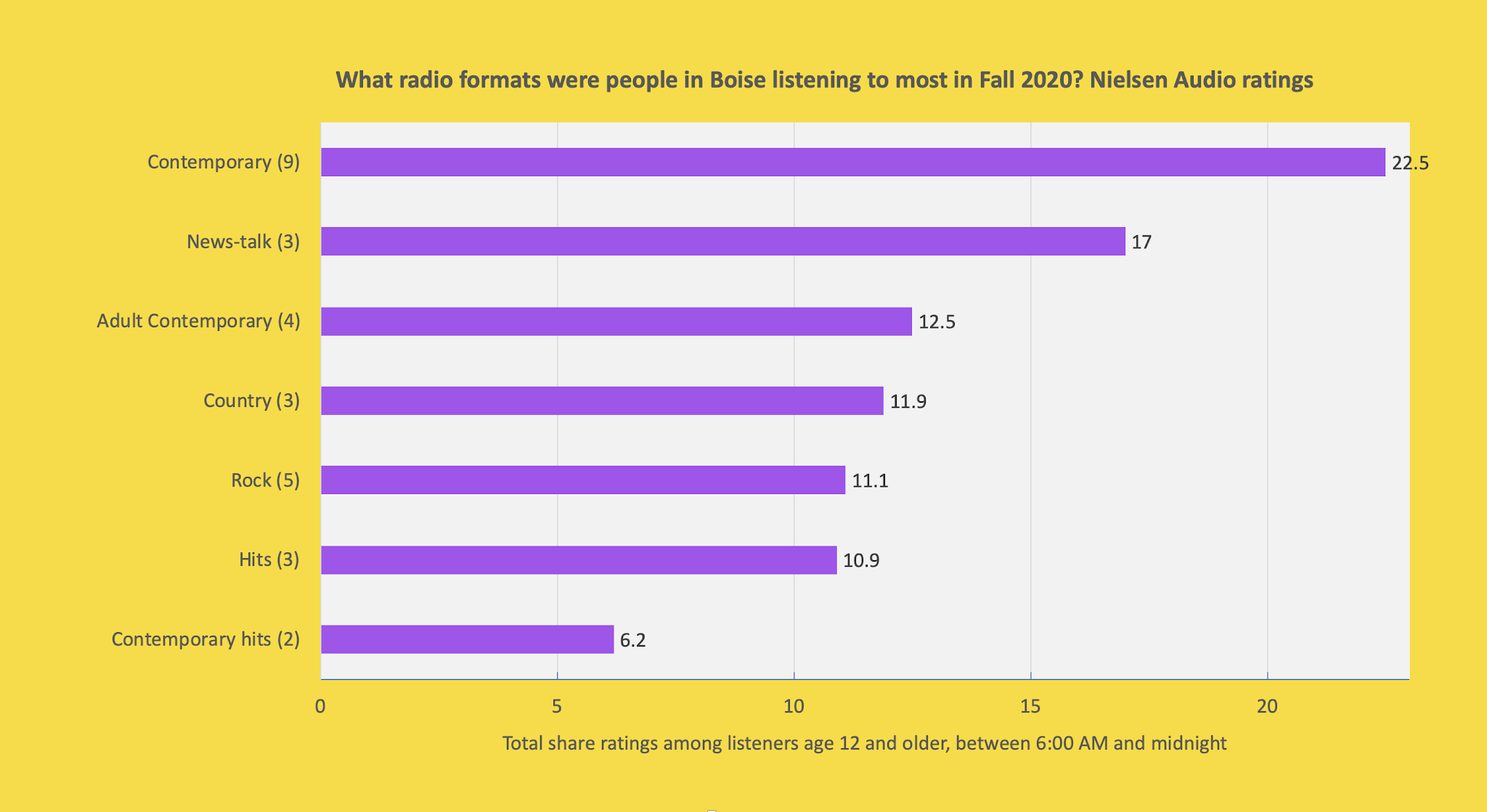
The bar charts identify the format for each of those stations. Adding them up for Fall 2020, as shown above in yet another bar chart,  the most common specific format is news/talk (17.0), followed by adult contemporary (12.5), country (11.9), rock (11.1) hits (10.9), and contemporary hits (6.2). More broadly contemporary (we put the con in temporary) just is an overblown synonym for modern, which can cover a grand total of 22.5.  


Saturday, January 23, 2021

Idaho legislators want to magically declare an end to our pandemic emergency


On November 5, 2020 I blogged about A childish, whining ‘Declaration’ about pandemic restrictions, which sought to end our emergency. Now the legislature is in session and is trying to make it into law, as is discussed in an article by Betsy Russell at the Idaho Press on January 22, 2021 titled Governor: Legislators ‘playing politics’ are endangering state’s efforts to end pandemic.


But as shown above, the case count is still higher than it was at our first peak in the summer of 2020. My guess is that we might need to wait for another six months before ending the emergency.


The magician was adapted from a poster of Thurston at the Library of Congress.


Friday, January 22, 2021

Fluent speech was a struggle for both Amanda Gordon and Brayden Harrington


Watch the YouTube video of poet Amanda Gordon reading ‘The Hill We Climb’ during the inauguration ceremony for President Biden. An article by Allison Slater Tate at Today on January 21, 2021 is titled Here’s what poet Amanda Gorman says about her speech and auditory issues.


On August 24, 2020 I had blogged about A touching two-minute speech at the Democratic National Convention given by Brayden Harrington. He also spoke on inauguration day, as is described in another article by N’dea Yancey-Bragg at USA Today on January 21, 2021 titled Teen who bonded with Biden over stutter delivers powerful rendition of JFK speech in inauguration special.